
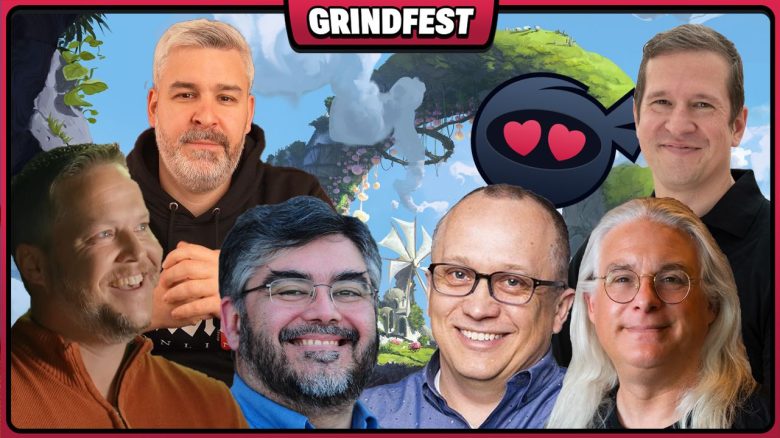
For many years, genre fans have been waiting for an MMORPG to come along that can truly excite. At the Grindfest 2026, we will give a voice to 6 renowned industry veterans who analyze the current challenges of MMO development.
The history of MMORPGs is long and shaped equally by winners and losers. Unfortunately, there have been more disappointments and defeats in the past decade, or to put it differently: MMORPGs with severe false starts, projects halted while still in development, questionable experiments with crypto/NFT models, challenging pay-to-win payment models, or also depressingly unfinished MMO tests.
The few encouraging successes of recent years can be counted on one hand. But why is that? Why is it so difficult for even experienced teams to release an MMORPG that can be both successful and exciting? And how can today’s challenges in MMO development be overcome?
Precisely with these questions, we approached various industry veterans for our Grindfest theme week 2026, who have shaped the genre with their games for decades and wish to continue doing so in the future. And they responded!
Speaking in alphabetical order: Benjamin Zuckerer (CipSoft – Tibia, Persist Online), Greg Street (formerly WoW, LoL MMORPG, and Project Ghost), Jack Emmert (Cryptic – Star Trek Online, Neverwinter, Champions Online), Moritz Bokelmann (Sandbox Interactive – Albion Online), Raph Koster (formerly Ultima Online, Star Wars Galaxies – now: Stars Reach) and Rich Lambert (Studio Game Director at Zenimax Online – Elder Scrolls Online).
In this week, exciting articles about MMORPGs will await you every day. Included: nostalgic retrospectives, thrilling analyses by renowned industry veterans, previews of upcoming online role-playing games, and entertaining streams.
Here’s the program for the big MMORPG theme week 2026 by MeinMMO
MMORPGs must be “unknown monsters”
MeinMMO: “In the past, everything was an adventure; today, it is a second job.” Players’ expectations have changed significantly. While exploring together and community were at the forefront before, today efficiency, min-maxing, and “guides on the first day“ dominate. How much does this changed player behavior limit the classic MMORPG feel, and how do developers respond to it?
Benjamin Zuckerer: I don’t believe that we can turn back time. Information spreads within minutes today. Guides, builds, and optimization strategies have become part of modern gaming culture. The question is: How do we still create adventure?
From my perspective, this cannot be achieved by hiding information but by creating situations that cannot be completely predicted. Therefore, we at Persist Online strongly focus on player interaction. When I enter a dangerous zone, I may know which enemies spawn there. However, I don’t know if I will encounter a hostile guild, if someone wants to steal my loot, or if an alliance forms from a random encounter.
That’s where stories arise. For me, the true allure of MMORPGs was never solely about discovering an unknown monster. It has always been about the unpredictable stories that arise through other players. Tibia has been demonstrating this for decades, and that’s exactly why we pursue a very player-driven approach at Persist Online.

Benjamin Zuckerer has been at CipSoft for almost 20 years and has worked his way up through various positions. Today, Ben shares the management with Stephan Vogler and oversees the development of Persist Online as a product manager.
Under the leadership of Zuckerer and Vogler, CipSoft has recorded the strongest years since its founding in 2001.
With Persist Online, the team is currently working on the first new MMORPG since Tibia, which counts DayZ and Escape from Tarkov among its sources of inspiration.
Greg Street: I agree that this has significantly changed things. It’s rarely fun for a player to experiment or theory craft to discover the best build when those answers are already known and solved.
The best solution is to make the answers highly situational. This build might be the best for Boss 2 but weaker against Boss 3 – and by the way: What if you can’t rely on Boss 3 behaving the same way every time? The more endgame focuses back on static single-target DPS against a “hit point sponge,” the easier it becomes to log these answers and calculate them through modeling.
One should consider an approach like in Diablo: There may be a best item for many situations, but there are so many items that you can’t just plan for when you will get that best-in-slot item. Variance plays a significant role here. I think many players approach loot with the mentality that everything is junk until they get their best-in-slot piece, and they rightfully expect to get it after a few tries.
Greg Street has already introduced his Project Ghost to MMO fans in an early prototype version:
Jack Emmert: I think, as always, it’s crucial to focus on what players want. If players want to min-max – that is, make well-informed decisions about their builds – then I, as a developer, should ensure that they can do that in the game without first having to rely on YouTube, Discord, or other platforms.
I would also add that today’s market gives a game no more than a few hours before a decision is made – if the game isn’t fun within 15 minutes, players will move on to the next game. In early MMOs, the motto was: “The game only starts at the endgame” – sometimes not until after 100 hours! That’s simply not feasible today. Players accepted that back then because it was the only way to play with other people. And today? Virtually every game is a multiplayer game.
Anyone wanting to develop a competitive MMORPG must plan many years of development and expect an AAA budget. This was the case 20 years ago, and it hasn’t changed today.
However, what has generally changed is that the development of large AAA games takes increasingly longer and becomes progressively more expensive. If a Star Wars: The Old Republic costs a staggering 300 million US dollars in the 2010s, a comparably ambitious project would likely cost double today.
Raph Koster: I think we need to take a step back and not simply accept the changes as they appear on the surface. Why is everything dominated by efficiency and min-maxing? The phenomenon of guides and game advisors is not new; it has existed since the MUD days; the development is more about the sheer volume and the easy accessibility.
I believe the answer is FOMO [Note: Fear of Missing Out] – people feel a competitive pressure; they feel like they are “wasting” their playtime if they don’t keep up or deliver at a certain level.
To some extent, this is certainly fueled by other players who instill this in them – probably because finding groups or guilds requires certain armor sets or similar, which then perpetuates a positive feedback loop.
By the way, Raph Koster showed us his new MMO Stars Reach during Grindfest 2026 and answered many of our questions:
And why do groups or guilds demand certain armor sets? Probably because the gameplay in which guilds participate requires it, by allowing guilds to compete with each other in terms of raid efficiency or through similar mechanics.
And we must bear in mind that many people do not want that pressure all the time. Many simply want a cozy retreat with less pressure or a fun gathering in the spirit of a relaxed “Friendslop” session, completely without the focus on min-maxing [Note: “Friendslop” describes a casual, low-pressure, but entertaining gaming session with friends]. An MMO does not have to cater to just one facet – it is an entire world.
What I mean is: Humans are still humans. But incentives greatly shape player behavior in a game or online world.
Our overall approach is to make these play styles purely optional. One should not feel forced to min-max unless one wants to experience the game that way. And we strongly rely on procedural generation and emergence to ensure that guides have less fixed points of reference and the world remains a mystery.

Rich Lambert: I’m not sure I would agree that the mentality of players has changed so much. Players have always been fascinated by min-maxing and optimization. Even in the early days of the genre – for example, in The Realm, Ultima Online, or EverQuest – there were guides for efficiency, the “best” builds, and optimal ways to progress … you just had to know where to find them.
What’s different today is the speed and scope. Through public test phases, previews, early access, and creator culture, much of this information exists before a game or update even comes out. Moreover, for many people, it has become a real profession, leading to these contents spreading faster and being present everywhere.
For designers, the reality is that you can’t hide as much as you could 30 years ago. It’s become much harder to keep secrets or challenge players through their own discoveries – because the moment someone finds something out, it gets posted.
The other reality is that you have to respect players’ time more. It is one of the most precious resources they have. In the age of social media and the huge selection of great games available today, players have countless other options the moment they lose interest. That simply wasn’t the case in the past.
On the next page, we continue with the question of rising development costs, the players’ hunger for ever-new content, and the danger of burnout.

Your opinion is important to us!
Do you like the article? Then let us know!