
Theme Park vs. Sandbox – the solution lies somewhere in between
MeinMMO: Players consume content today faster than developers can ever produce it. At the same time, production costs and graphic standards for AAA titles have exploded. How can the endless hunger of the community for new content be sustainably and healthily financed and satisfied today (without massive developer burnout)?
Benjamin Zuckerer: I believe you inevitably lose this race if you try to deliver new handcrafted content every week. The answer is also not procedurally generated content or “User Generated Content,” as the quality simply varies too much.
Sustainable MMORPGs therefore do not primarily rely on content but on systems. A functioning economy, conflicts between players, territories, social relationships, rivalries, or cooperations can create new experiences over years without developers needing to build every single situation.
A good example is PvP. As a developer, I can design a castle. The actual stories only emerge when players defend or attack it. When they form alliances or commit betrayal.
That’s why we focus on persistent worlds where decisions have consequences. This scales significantly better in the long run than simply producing more and more content. At the same time, it is healthier for developers, as one does not try to satisfy an infinite hunger solely with new assets and quests. However, building a large persistent world is also difficult and challenging, requiring many years of development time.
Persist Online is the new MMORPG from CipSoft that throws you into a zombie apocalypse – here is the trailer:
Greg Street: I don’t think it’s possible to hand craft content faster than players can consume it. I’m honestly not sure if it was ever possible. The better approach is to take a more systemic approach, where the game rules just work to provide content for players without every consideration having to be preordained and designed around by the development team.
Here are just three examples of the kind of thing I mean:
- Physics-based simulations: If your game has rules, like walls can be destroyed, then it typically gives players another tool in their toolbox. If they are trying to break into an enemy base, sure they can try to defeat the guards at the gate, but they can also knock the walls down. In a game like WoW, the only walls that can be destroyed are the ones the developers specifically flag as being destructible. Things like oil being able to apply burning or water being able to put out fire are along the same lines.
- Roguelike variance: Roguelike variance. I think this is a really untapped area. Loot used to be one of the only sources of variance in MMOs (e.g. what is this boss going to drop?) but even that has become more and more deterministic over time. MMOs could do a lot more with say creature affixes, wandering monsters, or even variable world states so that players have to react more to current situations instead of just focussing on execution on say a dungeon or boss fight where everything is always the same.
- Leveraging the unpredictability of other players: Harnessing the unpredictability of other players. PvP is an obvious example here, where human opponents are still (at least for a few more years) far less predictable than NPCs. But I also think developers can overly focus on PvP when we know it doesn’t interest every player. How else can we harness the fact that MMOs are inherently social? Maybe auction houses should be more about player interaction (finding someone with that rare recipe or enchant) rather than just clicking a button on an auction house interface that is more about interacting with the game UI than other players. I am also talking about states like a world boss that needs to be killed before everyone can access a dungeon. You can’t assume the world state ahead of time. You might even have to go kill the boss.

Greg Street has been in the gaming industry since 1998 and lists the IP Age of Empires as his first credit. In 2008, he made the switch to Blizzard and WoW. There, he served as Lead Systems Designer as well as a spokesperson, as he consistently sought direct contact with the community.
Street has remained true to the MMO genre ever since. First as Creative Lead of the team from the LoL MMORPG, then with his own studio Fantastic Pixel Castle, where the MMO project Ghost was supposed to come into being. Unfortunately, last year NetEase cut off funding, which forced the studio to close and the project to be discontinued.
Jack Emmert: I’ll play the same content over and over and over – if the rewards are worth it. In my own MMO, I ran the Neverwinter dungeon well over 100 times in order to get the full set of gear for my Fighter! Of course, the content has to be fun so that a player doesn’t mind running it over and over again. For me, that’s always meant adding elements into the content that create interesting new wrinkles. Small elements of randomization – could be the boss attack cycle – could be the adds – could be environmental elements.
I also favor mechanics that don’t compel players to complete content for hours at a time. Instead, I think limiting content to dailies and weeklies means that players aren’t constantly grinding. That’s a recipe for player burnout.
As for a developer, I think it’s vital to design the game with these concepts in mind. This way the team doesn’t need to produce frantically content at an unsustainable rate.
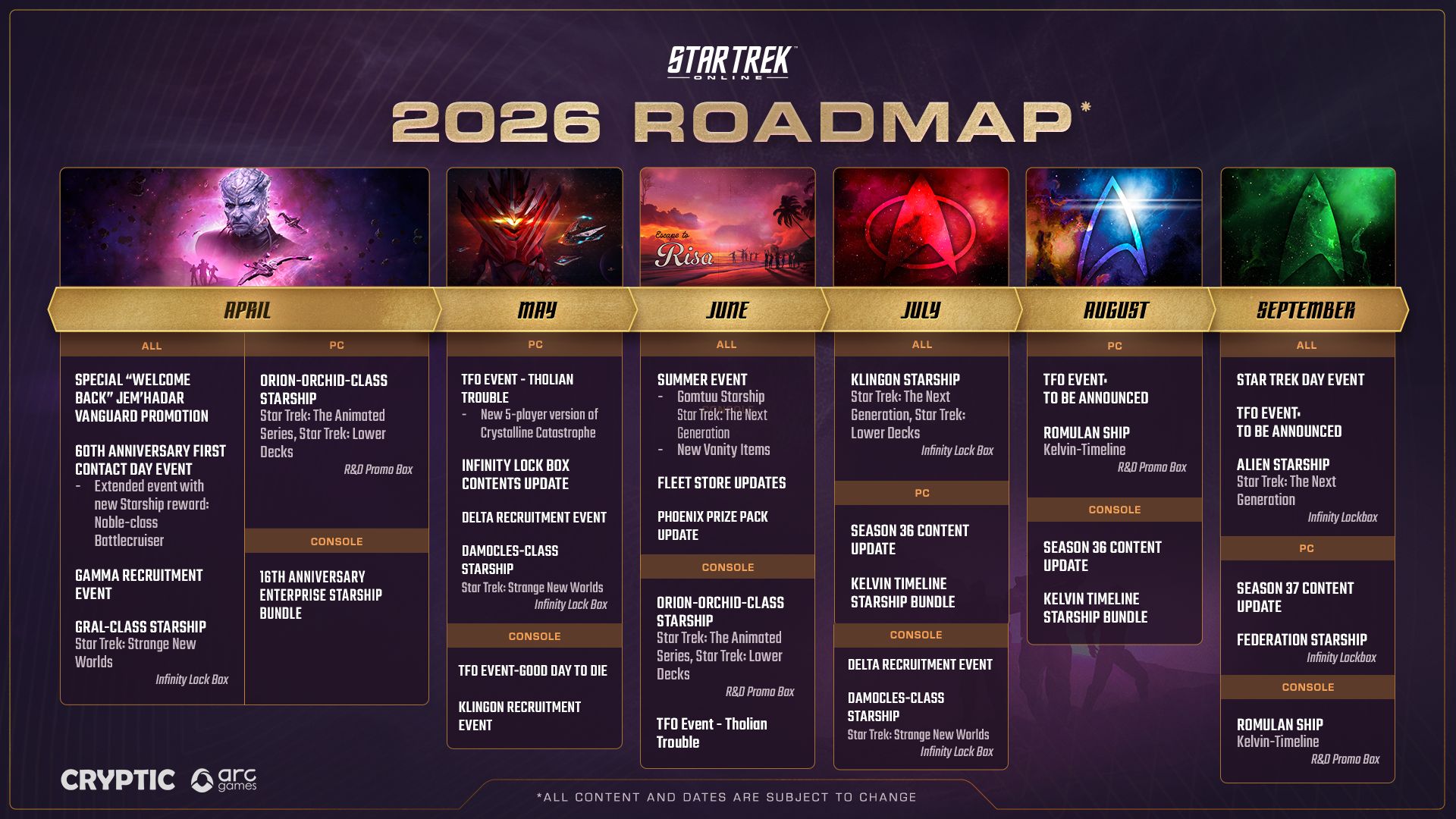
Cryptic has concrete plans for each of its MMOs – here is the current roadmap for Star Trek Online:
Moritz Bokelmann: Honestly, it was also impossible in the past as a developer of a theme park MMO to develop content as quickly as players could “complete” it. How often were new World of Warcraft raids already “solved” on the first day? Sure, those were ultra hard-core groups – but still: day one.
That’s also one of the reasons why we chose a sandbox approach. We were a really, really small team when we started – and by comparison, we are still a small team today. So we always had to act cleverly and develop systems that allow players to find their own content – or to be their own content.
To make it work for theme park MMOs, you as a developer have to cleverly develop replayable content, accept that you can never, ever, ever keep up with the content hunger of players and also accept that during the inevitable slower times, players will also play other games. But if you do your job well, they will come back for the next content drop.
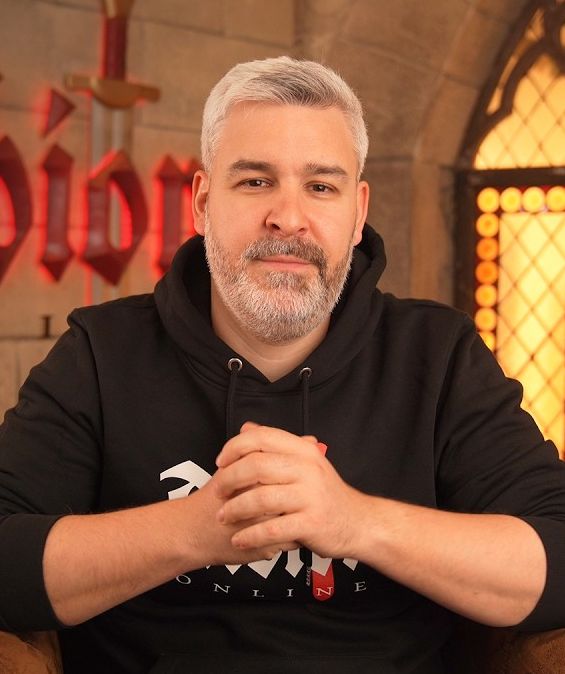
Moritz Bokelmann has been the Game Director of Albion Online since November 2024. Previously, he worked as Head of Production and UI Designer at Sandbox Interactive. He has been part of the Berlin team since 2018. Through his roles, he was able to significantly shape the successful path of Albion Online.
The sandbox MMORPG from Germany was released in July 2017 and has become one of the most successful games from our country – with increasing player numbers, winning the German Computer Game Award in 2022, and reaching new target groups (most recently through the release on Xbox).
Raph Koster: In our case, we look to a few core strategies: emergence, simulation, and enabling player creativity.
The first two really go hand in hand. If you design your game so that it is built out of rules rather than handcrafted content and one-offs, you have a simulationist design that allows for handcrafted stuff to be dropped on top. Rules can interact to create emergent behavior, things that weren’t predicted. This then makes everything in the game deeper and more consistent. The place where we have embraced that the most is of course our world simulation.
Developing AAA games is not only becoming more expensive, it also takes longer and longer. It makes a huge difference whether you work on a game for 2 to 3 or 7 to 8 years. These days, when designing a new MMORPG, you have to expect that by the time it is finally released, there will be new platforms, graphic engines, trends, and competitors on the market.
Making a world out of rules also means that it is far easier for players to affect it. The biggest cities in Stars Reach weren’t built by developers, they were built by players. They evolve and change. That isn’t about “having players do all the work” – we’re still building and handcrafting content ourselves. But it all sits atop the ruleset, and that lets players build, reshape the world, change things. It’s their world, after all. And they have incredible creativity, and bring a lot to the experience.
Elder Scrolls Online is one of the currently best MMORPGs for consoles. Which online role-playing games on PlayStation and Xbox are also worth recommending, this is discussed in this video from MeinMMO’s YouTube channel:
Rich Lambert: If I have learned one thing in the last 30 years of making games, it is that players will always consume content faster than developers can make it. That is why you have seen studios embrace modding more, and why more games are leaning into player-generated or system-driven content. Content that players can repeat, reshape, or get different results from has a much longer tail than something they finish once and move on from.
That is harder to do in MMOs because everything is connected. You have to worry about economy, balance, progression, moderation, and fairness in a shared world. But you are starting to see more systems that provide repeated play value or give players more agency over what they create.
Housing in ESO is a good example of that. Players get a space that is theirs. They can build it the way they want, decorate it the way they want, and share it with other people. It’s one of the stickiest features in the game because of that. The trick is finding the balance between high-quality authored stories and systemic, emergent behavior. You still need great content. You just cannot rely on “one and done” content alone to carry the whole game forever.
On the next page, it’s about the competition with other service games, but also with social media, streaming services, and other offerings that all want a piece of our precious free time.

Your opinion is important to us!
Do you like the article? Then let us know!