

MeinMMO demon Cortyn sees gaming as a hobby that unites all social classes. But that is slowly but surely crumbling.
Gaming is our favorite hobby. If that is not the case for you, I honestly don’t know how you ended up on this article. But hey, I’m still bringing you along.
One of the coolest aspects of gaming is that real life can largely be ignored. When we take on the role of a Night Elf mage in World of Warcraft, step into the shoes of Master Chief in Halo, or become a blocky avatar in Minecraft, it doesn’t matter what else we are doing in real life.
Within the multiplayer game worlds, we are at our core the same. We have the same starting conditions and only what we earn in the game.
At least that was the case in the past.
A currently affordable game with good ratings is Mina the Hollower:
Those who are wealthy in real life are seen in the game
Nowadays, many games have “Pay2Win” mechanics or “Pay2Progress” mechanics that provide advantages. Additionally, there are special game editions that sometimes cost double the price, which in the best case provide cosmetic upgrades and in the worst case grant gameplay advantages.
In other words: The thicker your wallet is in real life, the more it shows in the game.
This is currently still the best case if you can afford gaming at all under these perspectives.
At the moment, another aspect is becoming more significant: the cost of hardware. This applies not only to purchasing a new gaming PC but increasingly also to consoles, where even the prices of the current generation are slowly but surely rising. Where it was once common for the prices of a PlayStation or Nintendo console to decrease over the years, the opposite is now the case:
Those who wait longer are increasingly “the sucker” and pay more later. Just recently, the price of the Steam Deck has exploded.
For gaming PCs, it’s the same problem. Hardware is getting more and more expensive. Certain components, especially RAM and SSDs, are becoming increasingly costly and are hardly affordable for many people with an average income, making upgrades very expensive.

More and more games, less and less in common
Another aspect worsening the situation is the massive selection of games. While it’s certainly great that we are seeing more and more good and fantastic games and more developers can realize their dreams, this also has a negative side effect.
At least in my circle of friends, it has become increasingly common to ask: “Hey, do you want to check out game X or Y together?” Agreeing on a game is just getting more difficult because the selection is so enormous.
In the past, that basically didn’t exist.
Of course, there were already many more games than the handful we played – but there were significantly fewer new releases per month than there are now.
If you don’t believe that, you just have to take a look at Steam and how the releases there have changed (Steamdb.info):
- In 2006, there were 70 new games on Steam.
- In 2016, there were already 4,651 new games.
- By 2025, there will be already 21,464 new games.
That’s simply an increase of over 30,000%.
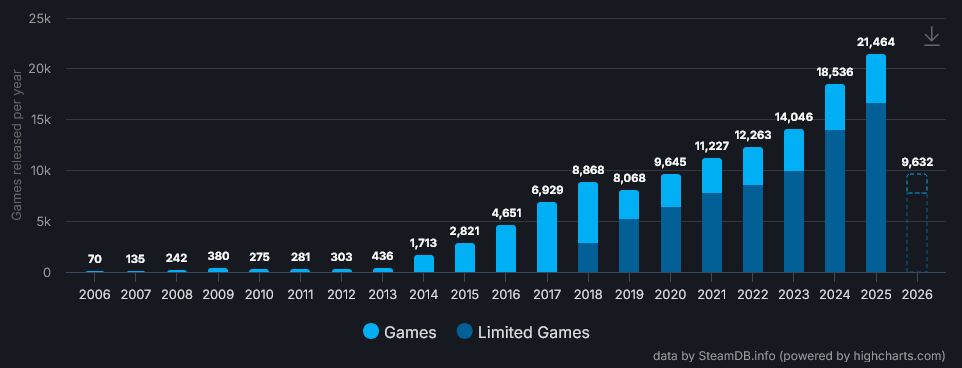
Of course, some of them are “junk games” that can hardly be called finished games. But the quantity of playable titles has also drastically increased.
It was different before. That doesn’t mean it was better, but it was certainly easier to agree on games – simply because the selection was smaller and you were not overwhelmed by an oversupply.
Games themselves are getting more expensive
Additionally, games themselves are becoming more expensive – at least in the last few months. For many years, the price of new games remained quite stable. Back then, you paid 100 to 120 DM for some new games, up until recently the price was around 60 €.
Sure, there were the Super Special Collector’s Editions, but the price remained stable. Strictly speaking, games even fell in price for a long time because their price did not increase with inflation.
Now, it seems that dam has been broken. Games easily cost 70 €, some already 80 €. Any Ultimate Editions also go up to 120 € or more.
The number of games that one can still afford – especially with a good conscience – is rapidly decreasing.
Gaming as a hobby that unites all social classes
When I think back to my school days, we had a pretty mixed class for the standards of that time. There were children from truly all social classes represented. From the rather poor daughter of a migrant family whose parents could hardly speak German to the son of a rich millionaire living in a small villa, everything was truly represented without exception.
Of course, gaming wasn’t free back then and was much harder for some families to manage than others. But this gap has since widened. This is not only due to rising prices for gaming and hardware but also to increased living costs and the ever-widening gap between rich and poor.
But I still remember how gaming brought most of the boys and many of the girls in my class together back then.
If you played Halo together on the Xbox or even at a “System Link” party, it didn’t matter who your parents were and what they earned.

When we competed against each other in tower defense maps in Warcraft III, which could also be played on absolute junk computers, it didn’t matter if you could only play football with a street team on an empty field or if you had riding and piano lessons with private teachers.
Gaming was a hobby that spanned nearly all social classes, creating and solidifying connections and friendships. It was something everyone could participate in to strengthen these social connections.
But it is becoming increasingly difficult with every month and every year. More expensive hardware, more expensive games with more DLCs, subscriptions, hidden or open Pay2Win mechanics, and the sheer flood of games make it increasingly difficult for gaming to unite people.
Yes, you can still find these connecting experiences. But it is getting harder and harder. Cognitively and financially.
That is why I am very glad to have grown up in the time I did with gaming. I probably wouldn’t have many friendships today and would be missing many happy memories if gaming had been as expensive and fragmented back then as it is increasingly becoming today. I really wish that this uniting element of gaming would have remained for a long time. Because it is currently crumbling massively.
But what do you actually think about it? Are you satisfied with the state of gaming and still find exactly the experiences that you enjoy? Are the prices and costs for our shared hobby concerning you and presenting you with problems? Or do you think that it is not that bad at all and that nothing has changed? Let us know in the comments.
We have presented you with really good games at solid prices: the 14 best RPGs on Steam.

Your opinion is important to us!
Do you like the article? Then let us know!