

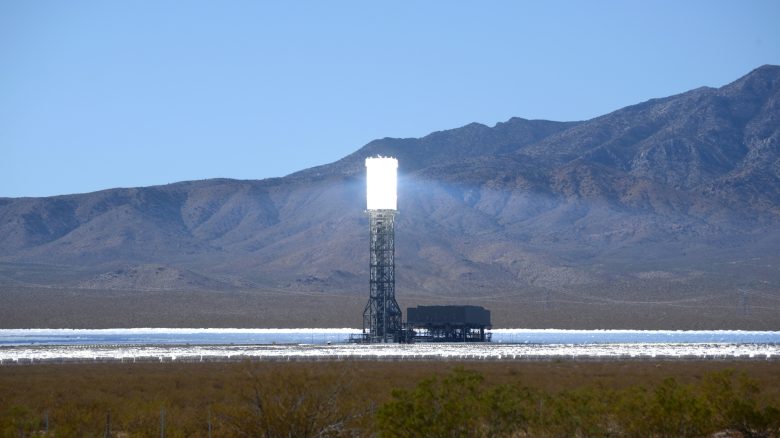
In 2014, politicians and tech giants celebrated the massive solar plant Ivanpah as the future of the energy transition. Just a few years later, part of the billion-dollar project is being shut down – researchers are now providing new approaches to prevent the shutdown.
What solar project is this about? The Ivanpah Solar Electric Generating System in California was long one of the most well-known solar projects in the world. With hundreds of thousands of mirrors in the middle of the Mojave Desert, the facility was supposed to prove that solar energy works on a large scale too. (gry-online)
In the solar thermal power plant, heliostats with two mirrors each concentrate sunlight onto the solar towers. The project was developed by the Israeli solar power specialist BrightSource Energy in collaboration with the American company Bechtel Corporation. (Bechtel)
At the end of 2025, co-owner NRG Energy announced that the facility would likely be gradually shut down in the spring of that year. (Focus)
New research is now re-evaluating the case of Ivanpah: An analysis published in 2026 in the journal npj Thermal Science and Engineering explains that while Ivanpah has missed long-term cost-effectiveness, it has provided important insights for future solar thermal projects.
Out after just 10 years?
Why is Ivanpah facing shutdown at all? Just like NRG Energy, PG&E (the largest utility in the United States) wanted to terminate the contracts for Ivanpah Unit 1 and Unit 3 prematurely because the costs and power yield were not economically viable.
These contracts were originally supposed to run until 2039, and customers would not have received any power from these blocks after 2026. (PG&E) The regional utilities are now only partially sourcing the generated electricity instead of fully as originally planned until 2039. (Focus)
A new approach
The key point: Ivanpah has been overtaken by classic photovoltaics. According to the analysis, the costs for solar power from photovoltaics were still above 30 cents per kilowatt-hour in 2010. Ivanpah’s power purchase agreement was set at nearly 20 cents per kilowatt-hour. However, by 2024, large photovoltaic projects were averaging only about 6 cents per kilowatt-hour. (Nature)
This turned a project that was once a special prestige project into an expensive contract in a rapidly changing market.
However, researchers do not believe that Ivanpah is lost forever. Instead, they propose a technology that could fundamentally change the power plant: gigantic salt storage. Since this technology is already proven, a corresponding expansion of the Ivanpah power plant would not require an unknown system.
Currently, the plant can only produce steam and thus electricity. Furthermore, it is very dependent on weather conditions and times of the day. (Nature)
Such storage systems absorb the heat generated during the day and release it at night to keep the turbines running continuously. According to the researchers’ calculations, this modernization would increase cost-effectiveness by about 30% and theoretically solve the profitability problem. (gry-online & GS Tech)



Whether the feasibility study by the companies will actually be evaluated and implemented remains to be seen. In Germany, new forms and approaches to contemporary energy generation are also being continuously tested. Countless solar panels have recently been placed on lakes in Bavaria: Germany is focusing on a new idea in the energy transition: photovoltaic systems that float on water.

Your opinion is important to us!
Do you like the article? Then let us know!