


In Baldur’s Gate 3 you can rely on multiclassing to get even more out of your characters. MeinMMO author Fabienne Kissel presents a powerful bard build today, with which you can deal a huge amount of damage and defeat many enemies in just one move.
In Baldur’s Gate 3, there is a multiclass build that allows you to defeat even the strongest enemies in one move: the killer bard. This unique build combines the classes bard, fighter, and rogue, providing an effective way to deal massive damage in a short period of time.
What makes it so special? With the killer bard build, you are also well protected with medium armor and can take quite a bit of damage. Thus, you are not just a pure Glass Cannon
. Overall, the killer bard is a lot of fun, as you act not as a supporter but as an almost unstoppable killing machine.
One of its unique features is the exploitation of the power of hand crossbows in Baldur’s Gate 3. Unlike the official rules of Dungeons & Dragons, you can wield crossbows in both hands in Baldur’s Gate 3. In D&D, you need a free hand to reload (which makes more sense), preventing the use of two hand crossbows.
However, in the game, you can use your off-hand (second hand crossbow) to shoot as a bonus action. This allows you to create a bard who deals enormous damage with hand crossbows.
At the same time, your high charisma allows you to take over all interactions and even gain advantages in many conversations.
The build is also known as the ranged bard and became popular through the YouTube channel d4: D&D Deep Dive. We want to present this killer bard build from the YouTuber in more detail here.
Multiclass Killer Bard Build: How to Level Up
Attribute Points Distribution:
- Dexterity: 16
- Charisma: 16
- Constitution: 14
- Intelligence: 10
- Wisdom: 10
- Strength: 8
Killer Bard Build – Items
- Two hand crossbows
- Medium armor
Level 1 – Bard
- Choose class: Bard
- You level in the bard until level 6
- Key class action: Bardic Inspiration
- Spells: Tasha’s Hideous Laughter, Healing Word, Faerie Fire, Bane
- Cantrips: Vicious Mockery, Friends
- Fighting style: Two-weapon fighting
Bardic Inspiration can be given as a bonus action to one of your party members three times per long rest at level 1. The class action ensures that the target receives a bonus on its next attack roll, next ability check or next saving throw (1d6).
Normally, you would use the action supportively for your allies, but with this build, starting from level 3, you need the charges of Bardic Inspiration for yourself to perform your weapon actions. As a killer bard, you do not act as a supporter but as a pure damage machine.
Level 2 – Bard
- Class feature: Jack of All Trades
- Class action: Song of Rest
- Spell: Pick your favorites
Through the Song of Rest, you gain an additional short rest per day, which is especially appreciated by warlocks, monks, and fighters. Druids also regain their charges for transforming.
Level 3 – Bard
- Subclass: College of Swords
- Skills: Pick your favorites
- Armor: Medium armor
- Spell: Hold Person (but pick your favorite, it heavily depends on your team composition which spell you might not have and need)
- Fighting style: Two-weapon fighting
As a subclass of the College of Swords, you gain proficiency in medium armor. In addition, you gain various melee and ranged attacks to deal damage. For all these actions, Bardic Inspiration (1d6) is added, allowing you to deal more damage overall.
Therefore, you need the charges of Bardic Inspiration for yourself to use Swashbuckling Strike
. As a killer bard, you focus on the ranged attacks.
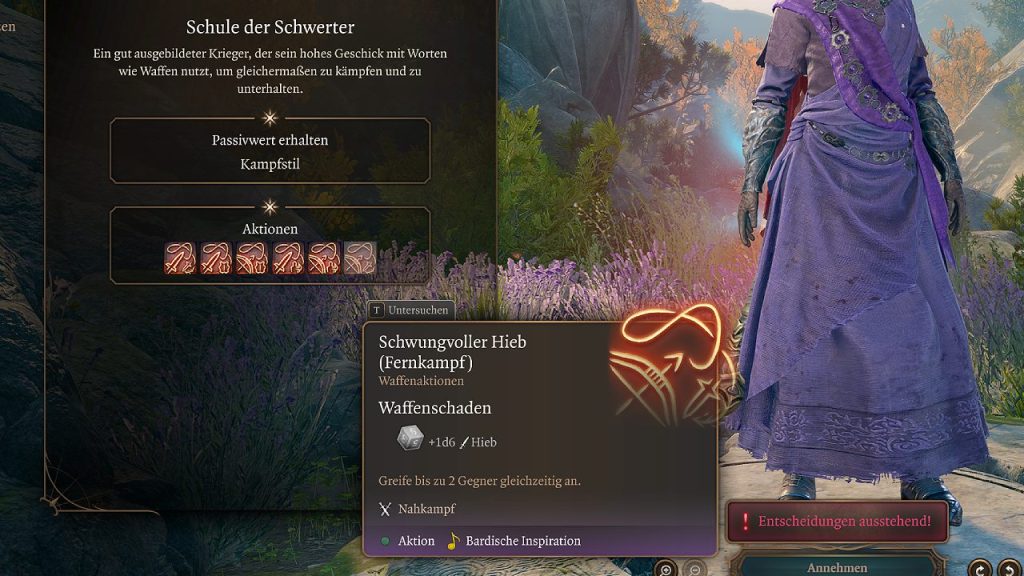
Swashbuckling Strike.
The Most Important Component: Swashbuckling Strike
One of these weapon actions is your most important component as a killer bard: Swashbuckling Strike (Ranged)
. With this weapon action, you can attack up to two enemies simultaneously – similar to the later Eldritch Blast from the warlock, where you can shoot a total of 3 beams, distributed over 1-3 enemies. You can choose to target both attacks at one opponent instead. Both attacks additionally receive 1d6 damage from the bardic inspiration.
With your bonus action, you can then make another attack per turn with your off-hand (hand crossbow) – for a total of 3 attacks at level 3. With the fighting style Two-weapon fighting
, you can increase the damage of your off-hand (hand crossbow) by adding the Dexterity modifier.
Level 4 – Bard
- Feat: Sharpshooter
- Spell: Pick your favorite
- Cantrip: Pick your favorite
With the Sharpshooter feat, you can gain +10 on your ranged weapon attacks, but with a -5 penalty on your attack roll. This is a passive feature that you can turn on and off.
In combination with this feat, it’s worth having a cleric or paladin with you who can cast the spell Bless
on you. Because through Bless, your hit probability increases by gaining a bonus of +1d4 on attack rolls. You also receive the same bonus on your saving throws. The concentration spell Bless can last up to 10 rounds and is considered one of the strongest spells.
Level 5 – Bard
- Important class features: Improved bardic inspiration and source of inspiration
- Spell: Hypnotic Pattern or Fear
Level 5 is among the most important levels. You receive an improvement to your bardic inspiration. Instead of 1d6, it is now 1d8.
Additionally, you now have four charges of bardic inspiration. And through Source of Inspiration
, you regain your charges from both long and short rests.
Level 6 – Bard
- Subclass feature: Extra Attack
- Spell: Pick your favorite
At level 6, you unlock the subclass feature Extra Attack
, which allows you, as the term suggests, to make an additional attack. If you have used an action to make an attack (i.e. Swashbuckling Strike), you can make another attack in the same action. Together with your action Swashbuckling Strike
(hand crossbow) and your bonus action (off-hand hand crossbow), you may possibly unleash 5 attacks in one round.
All together, they can benefit from Sharpshooter, resulting in an additional 10 damage from each attack. Most also gain an extra 1d8 from bardic inspiration.
If you have a wizard or sorcerer with you, or another class that can cast the spell Haste
, you can cast that spell on your killer bard. Through Haste
, the target gets a +2 bonus to armor class, advantage on Dexterity checks, and double movement speed.
But the most important thing is: You gain an additional action per turn. So as a killer bard, you can make up to 7 attacks by attacking again with Swashbuckling Strike
– and this is already at level 6. Haste
can also be obtained through potions. However, with a Haste potion, the effect lasts only 3 rounds, while the spell can last up to 10 rounds.
Level 7 – Fighter
- Fighting style: Archery
- Class action: Action Surge
Level up to level 7 in the class Fighter
. It’s especially worthwhile because you gain the fighting style Archery
. This gives you a +2 bonus on your ranged attacks as a passive feature, increasing your hit chance. You also get the class action Action Surge
, which allows you to heal yourself via a bonus action once per short rest (by 2-11 hit points).
Level 8 – Rogue
- Skills: Pick your favorites
- Weapon action: Sneak Attack
Level up to level 8 in the class Rogue
. Through Sneak Attack
, it’s possible to deal an additional 1d6 damage once per round with a ranged or finesse weapon (in this case: hand crossbow) if you have advantage against the target. Or if an ally is essentially standing next to the opponent (that is, within 1.5m) and you are not at a disadvantage. So if, for example, your paladin or cleric is standing in front of the enemies, you can use Sneak Attack
.
Level 9 – Rogue
- Refined actions (class actions): Dash, Disengage, Hide
All three class actions – Dash, Disengage, and Hide – are practical, and depending on the situation, you can use them sensibly. All three can be used as a bonus action. For example, Dash to double your movement rate in combat (in the current turn).
Level 10 – Rogue
- Subclass: Choose the
Thief
- Subclass features: Fast Hands, Second-Story Work
Fast Hands
gives you an additional bonus action, allowing you to use two bonus actions per turn now.
Your combo will then look something like this: Swashbuckling Strike (action) + Swashbuckling Strike (Extra Attack) + Bonus Action (Off-Hand Hand Crossbow) + Bonus Action (Off-Hand Hand Crossbow)
If you attack with Swashbuckling Strike
, you can already land a total of 4 hits with your hand crossbow on, for example, one target through the Extra Attack. With your two bonus actions, you can land another 2 hits with your off-hand (second hand crossbow) – resulting in a total of 6 hits in one round, without Haste.
Your attacks with Swashbuckling Strike
gain an additional 1d8 from bardic inspiration. And all your ranged attacks can benefit from Sharpshooter, so you deal an additional 10 damage per hit.
Level 11 – Fighter
- Class action: Action Surge
At level 11, you go one more level into the fighter (level 2). By doing this, you unlock the class action Action Surge
. With Action Surge, you gain an immediate additional action in your turn once per short rest. This means that in theory, you can unleash 10 attacks in a single round with the bard – once per short rest.
Again the same game:
- Swashbuckling Strike (action) + Swashbuckling Strike (Extra Attack) + Swashbuckling Strike (by previously activating Action Surge) + Swashbuckling Strike (Extra Attack) + Bonus Action (Off-Hand Hand Crossbow) + Bonus Action (Off-Hand Hand Crossbow) = 10 attacks, since each Swashbuckling Strike can deal 2 hits.
Level 12 – Rogue
- Feat: Ability Score Improvement
At level 12, you go one more level into the rogue (a total of 4). You choose the feat: Ability Score Improvement to raise your Dexterity to 18. Note: There are several ways in the game to increase your Dexterity earlier. So if you reach 20 Dexterity by level 12, it is advisable to alternatively level up another level in bard instead of rogue.
To gain a deeper insight into the The Killer Bard
build from d4: D&D Deep Dive
, you can watch his video on YouTube.


This killer bard build turns you into a real damage machine. With this build, you can effortlessly take down several strong opponents in just one move, especially when you have Action Surge ready – and you can additionally withstand some damage. By combining the classes bard, fighter, and rogue, you achieve a wide range of abilities and maximize your damage almost down to the last detail.
If the killer bard build is not quite to your taste, there are of course many other multiclass builds to discover. MeinMMO editor Sophia Weiß has introduced the best builds: Baldur’s Gate 3: The Best Multiclass Builds and What Makes Them Good

Your opinion is important to us!
Do you like the article? Then let us know!
Comments