

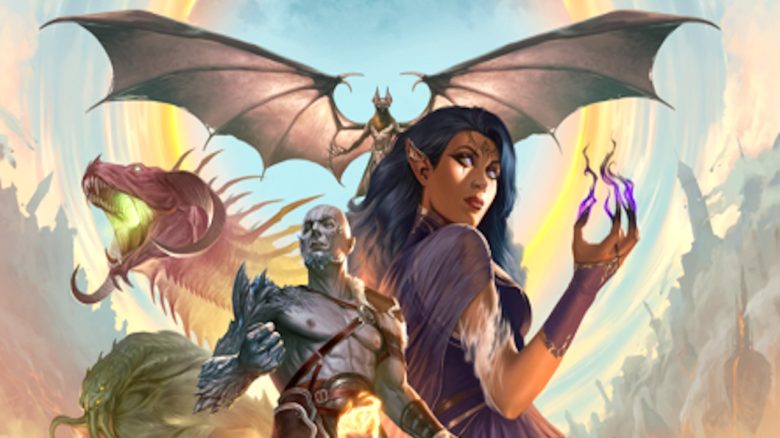
MeinMMO editor Alex had an experience that many tabletop enthusiasts wish for: He was able to convince his friends, who are unfamiliar with role-playing games, to start with the best hobby in the world. And the “culprit” was Daggerheart, the role-playing system from Critical Role.
It was Easter, and we had some friends visiting that we hadn’t seen in a while. As so often, we enthusiastically talked about our recent tabletop sessions and shared our adventures, characters, and epic as well as funny wins and fails.
One friend, who had absolutely no connection to role-playing games or gaming in general, said: “That all sounds really exciting, but I can’t imagine how it works. It sounds incredibly complicated. I would love to try it out myself.” I am also very sure that he said that exact last sentence and no other (Spoiler: He didn’t, but my tabletop heart wanted to hear it so badly).
I thought for a moment, because he wanted it, and I wouldn’t let that opportunity pass. I first thought of my starter box of D&D that was on the shelf, but then another idea came to me. Everyone at the table at least knew the series Vox Machina from Critical Role, even if they had nothing in common with the topic behind it – I had managed to persuade them enough in the past.
So… why not Daggerheart? After all, it’s the in-house system of Critical Role, and that’s practically also Vox Machina, right? So I laid the rulebook and the accompanying cards on the table and asked: “How about we just play a round?” And I was not to be disappointed.
What exactly is Daggerheart?
Daggerheart is a modern, beginner-friendly pen-and-paper role-playing game from Critical Role and its publisher Darrington Press, which was further developed after an open beta in 2024 through community feedback. The system was specifically designed to support a narrative gameplay style with a strong focus on shared stories and emotional character relationships.
In contrast to more rules-driven systems like Dungeons & Dragons, Daggerheart emphasizes fast, cinematic action and easily accessible mechanics. Ultimately, the rulebook serves as a flexible toolbox that gives players a huge sandbox to freely create their own adventures and unforgettable moments.
Here you gain a brief insight into Daggerheart if you are unfamiliar with the system:
A toolbox full of possibilities but manageable
To my surprise, everyone agreed, and I quickly printed out some character sheets that can be easily downloaded via the homepage, including a quickstart guide (For those interested: It is currently only available in English). And then I decided: I would consciously hold back and see what happens. No guidance from me, just experimentation and trial and error with my beloved, but very inexperienced noob friends.
I also decided to only use the quickstart set, as I was relatively certain it would be sufficient. And it was. At least at first, but more on that later. Everyone chose one of the pre-made characters and skimmed through the corresponding materials. Then the discussion began almost spontaneously about how and why the characters would know each other and their relationships.
After a little over half an hour, they felt ready to get started. To not completely overwhelm them, I wanted to take on the role of the game master. However, since the quickstart guide also has a section for DMs, one of the more seasoned gamers in the group volunteered, so I decided to observe and step in if they got stuck. But that would prove completely unnecessary.
Because, since not only the quickstart guide but Daggerheart in general is very clear and operates in comparison to many other systems like Dungeons & Dragons at a significantly lighter level, it only took a short acclimatization period and the group knew where to find their information and quickly internalized what their characters could do without getting lost in too many stats or abilities.

Writing stories together, like a conversation among friends
Because in Daggerheart there are no fixed combat orders or similar things, but everything unfolds in a flow and through collaborative storytelling, a dynamic quickly developed within this group. Since the game master also didn’t know how it works in other role-playing systems, their game did not follow any established patterns. Instead, it emerged from a conversation where the novice game master described some framework conditions along the guide, and the group quickly found their flow on what they wanted to do.
However, conversations between characters within the game were somewhat sidelined, and dialogues with NPCs were sometimes a bit awkward, but they led to funny interactions outside of the game and to creative solutions and actions within. I immediately noticed that, compared to my experienced, regular group, this group communicated significantly more about what they wanted to do or what the others could do, rather than directly taking action and instead interacting more with each other within the game.
But it worked, and it didn’t take long for the group to become bolder, funnier, and more creative. And even if not everyone found complete access to it, they still wanted to play a second round and switch roles. Because they had caught the bug and wanted to try something of their own with their characters and a freer story.
New round, new hobby?
So I handed them the cards for the races, communities, classes, and subclasses and let them just go ahead and create their own characters based on the templates from the quickstart guide. And it worked better than expected. Although they were initially a bit overwhelmed by the many new possibilities, they quickly found their way due to their previous experiences.
After some discussion and lively exchange, they at least created usable characters. For this round, I took on the role of the game master and gave them a rough setting and premise while ensuring not to constrain them. And quickly I noticed further significant progress. They engaged more with NPCs and became involved in the action instead of merely going through points like in a video or board game.
And here the points came together that make Daggerheart so perfect for newcomers and beginners: It provides enough material and rules to create a framework to orient oneself, while allowing enough freedom to shape the game to fit the group. Minimalistic skills and stats enable a quick entry and provide plenty of space for interpretation.
A lack of a fixed order in combat and simple but impressive and useful abilities at a low level encourage creativity and strong teamwork among players and characters. It motivates players to develop a story together without getting lost in too many or deep rules that one must first learn.
This way, Daggerheart allows its players and even inexperienced game masters to dive directly into the game and find their own path, which primarily aims for one goal: To have a good time together and experience exciting stories. This role-playing system embraces chaos where others get bogged down in strategy and planning loops. And that makes it both lovable and beginner-friendly.
This openness and the sometimes simplified rules might seem overwhelming to some who prefer a clear-cut approach. So, if you need clear conditions and as balanced values as possible, you will probably not be happy with Daggerheart.
Although not all of the five said after our two short sessions that they would play it again, they all agreed on one thing: They had an incredible amount of fun and it was a unique way to connect with friends. And that was all I wanted to achieve. My tabletop heart was happy.
And again in this session, a particular strength of Daggerheart emerged that I personally love: It allows significantly more action than many other role-playing systems. This makes it faster, more interactive, and encourages players to play more realistically. And it makes this possible through some clever tricks: The role-playing system from Critical Role is perfect for anyone who finds Dungeons & Dragons too lacking in action

Your opinion is important to us!
Do you like the article? Then let us know!