


If you want to buy a new game on Steam, your eyes will probably first land on the reviews. But do you actually know what they mean?
What feature is this about? Anyone who regularly shops on Steam is likely familiar with them: the reviews. Every Steam user can rate all products in their library with a simple thumbs up or down and write a short text about it.
This system, however, consistently causes problems. For example, when users misuse it to express their displeasure, or when players want to be particularly funny.
A current discussion shows again that many do not really understand the reviews.
No developer is likely to be happy about negative reviews.
Developer complains about a negative review and sparks a discussion
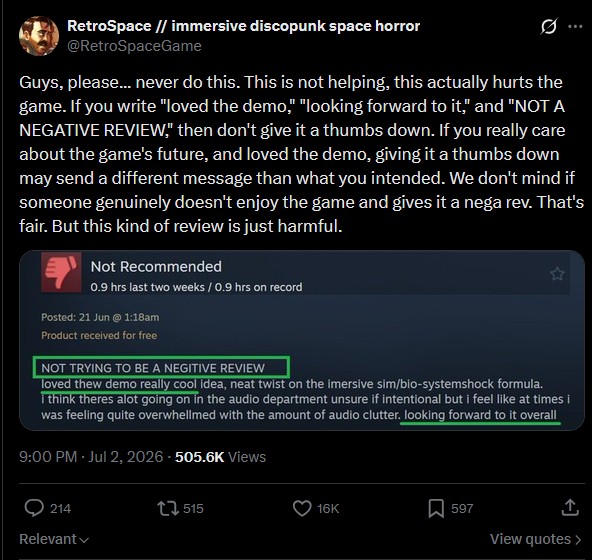
What is the discussion about? A developer shared a negative review of the demo of their upcoming game RetroSpace on Steam on X. The player had given a thumbs down but wrote that this was not meant to be a negative review at all. They loved the demo, thought the idea was cool, and were looking forward to the finished game. The only criticism was for the overwhelming ‘audio chaos.’
The developer states: Writing that one has loved a game and then giving a thumbs down is not helpful. This type of review is even harmful. However, he emphasizes: Negative reviews are absolutely fine if you really didn’t like the game.
A fellow developer adds under the post: “We get a lot of those. ‘I loved everything about this game, it’s my favorite of all time, but unfortunately it’s in early access and not finished, so I give it a thumbs down.'” The developer believes: You could also simply choose not to write anything.
Hand on heart: How do you use the Steam reviews? What role do they play for you when buying new games?



Absolutely undisputed are the reviews when it comes to the following games, as they have reached “God Tier”: This means a status of “very positive” with over 100,000 reviews. Here are 10 games that have reached “God Tier” with their reviews on Steam
The post was seen more than half a million times and received over 16,000 likes – but not everyone agrees with the developer.
Everything quite simple – or not?
Where is the misunderstanding? One would think it would be quite simple: If I liked the game, there’s a thumbs up; if not, a thumbs down. However, that is not strictly speaking what the reviews represent. When Steam asks you to rate a game, it does not ask if you liked the game, but: ‘Would you recommend the game to other players?’
This small but fine difference regularly leads to frustrations. For the developer, the review of his game did not make sense: Someone loved the demo and yet rated it negatively – what’s the deal? However, some users see it differently and explain how they understand the review: Someone likes the game, but in its current state, it just cannot be recommended. However, the game has potential to become good.
This type of review is often found with titles in early access or demos, which are often shown in abundance during the Steam Next Fest.
For this reason, a third, neutral option is also controversial. Many players wish for this, to be able to write a review even if they are not entirely convinced, and yet do not want to give the game a thumbs down. But a recommendation is binary.

Bad reviews hurt especially small games
Why is this even such a problem? This has something to do with how Steam reviews are perceived. Theoretically, there are 9 gradations, from “very positive” to “mixed” to “very negative.” If a game falls below 70% recommendations, it is only “mixed,” and the font color changes. From blue it first turns orange and finally deep red when it really crashes.
A review in the middle range is actually not that bad, but many players directly filter these titles out of their minds. After all, thousands of games are released on Steam every year; why should one even give mediocre representatives a chance?
Such negative reviews can be painful for smaller games, even if they contain well-meaning improvement tips, or are even only meant ironically (“The game is so good that it cost me hundreds of hours, I can’t recommend it to anyone!”).
Other players also refuse to give a positive review to an unfinished game because they see potential in it: After all, new players could be misled, who then expect a polished experience due to positive reviews.
Hand on heart: How do you use the Steam reviews? What role do they play for you when buying new games?
Absolutely undisputed are the reviews when it comes to the following games, as they have reached “God Tier”: This means a status of “very positive” with over 100,000 reviews. Here are 10 games that have reached “God Tier” with their reviews on Steam

Your opinion is important to us!
Do you like the article? Then let us know!