

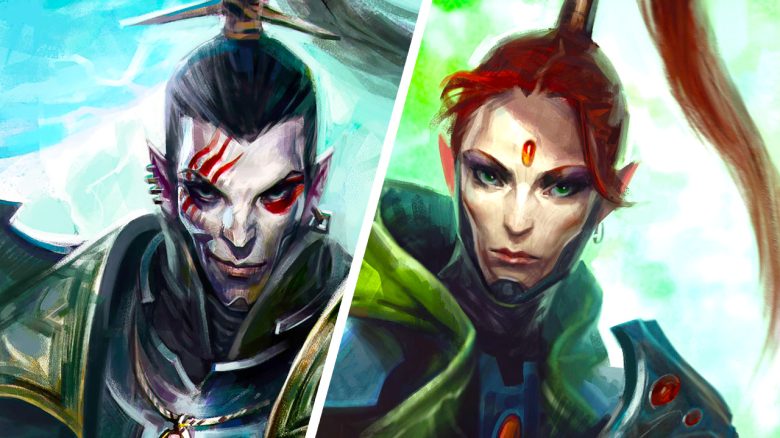
If there is one thing that ranks alongside chaos worship as the highest crime in the Empire, it is allegiance to the enemies of mankind. Nevertheless, the role-playing games allow you to Warhammer 40,000 to do just that. The Inquisitors of MeinMMO spoke with two of the people responsible for this heresy.

In Warhammer 40,000: Rogue Trader, you can form relationships with many of your companions – even with Xenos. Yrliet, the Aeldari, and Marazhai, the Drukhari, are already available options in the base game.
While you play as a rogue trader and thus someone who has more freedom than anyone else in the Empire, even someone like that would not escape the Inquisition’s scrutiny if they consort with the enemies of mankind.
Owlcat, the studio behind Rogue Trader, is currently working on Dark Heresy, the second RPG in the grim dark future of the 41st millennium. Here too, you can form romances, even with members of the Adeptus Mechanicus, if they show interest.
We recently reported why Owlcat is forgoing explicit sex in their RPGs. The two narrative designers Nika Alborti and Arseny “Thai” Kyrmov also answered further questions from MeinMMO – with exciting insights into the topic of love in video games.
Writing games is full of “expected surprises”
A little info beforehand: Owlcat has discussed in a blog post how the studio approaches romances in RPGs and how the personality of the companions plays a role. The studio’s portfolio includes not only the Warhammer games but also the two Pathfinder RPGs Kingmaker and Wrath of the Righteous. Accordingly, the answers here do not (only) refer to the dystopian sci-fi setting.
MeinMMO: You mention that players are often attached to details that differ completely from what you expected. How much does the feedback you receive after release change the way you write future projects? Do you intentionally incorporate “meme-worthy” details?
Nika Alborti: Fan feedback is an important source for learning and improving writing skills. But trying to replicate the “viral” elements of your previous works is, in my opinion, futile. All such scenes, lines, and details are usually “lightning in a bottle” events that cannot be reproduced. There is only one Abelard, and he can only represent the esteemed rogue trader.
Arseny “Thai” Kyrmov: I avoid thinking about the reader when I write, except in the most abstract way: “Here the reader should feel this.” Of course, we look at player feedback during the planning phase, but once the thing gets rolling, it’s just me against the empty page. As for “meme-worthy” things… You cannot control the flow of memes, and any attempt to force something feels pathetic, so no.
MeinMMO: You state that you assign each character a “romance archetype.” Has any character ever surprised you during development and organically developed in a direction you didn’t expect?
Nika Alborti: We usually write romances very late in the development process, at which point surprises are unlikely. However, when we speak about companions and characters in general – there are many such cases where understanding what a person really is only came during development. Sometimes that changes through external sources. For example, a voice actor comes with a unique reading of a character, and we adapt the writing accordingly.
Arseny “Thai” Kyrmov: Not really. Don’t forget that game writing is very different from book writing: it’s an iterative process where each next phase brings something new, sometimes unexpected, but rarely something drastic. There are many little surprises along the way; sometimes you plan something, and then you start writing only to realize that it doesn’t work that way. But those are expected surprises because that’s how it typically goes.
“You have to get everything perfect to earn their love”
MeinMMO: You use the 1+2+1 model: one retreat route, two main dynamics, and the “True Love” when planning romances. Have there been characters or stories where you consciously broke this formula because character development simply didn’t fit into this scheme?
Nika Alborti: Of course. 1+2+1 is a helpful guideline, not a rule. We have different types of characters, even those that are the “all or nothing” type – they have only one romance route, and you have to get everything perfect to earn their love.
Arseny “Thai” Kyrmov: Nika’s 1+2+1 model was a great insight for me, but it’s less about the numbers themselves and more about the idea behind it, especially that first 1. How does a story become a game? First of all, it has to be possible to lose! This is how you implement Sid Meier’s definition of a game as “a series of interesting decisions” in narrative design. The exact formula depends on the type of story you’re telling, but the approach is brilliant.
MeinMMO: For many romances in games, “the journey is the destination.” You write: once you have “conquered” a character, that is tentatively the end. But the real “relationship work” only starts after that moment. You have already written about farewells, jealousy, and small “you are together” moments in the blog post. How deep would you go if there were no technical or time constraints in development? After all, such a relationship could strongly influence the choices of the game and the character in this context for the rest of the game.
Nika Alborti: We would like to go deeper if we have the resources and a suitable game concept. It would be really cool to give our players the feeling of living and going on adventures as a couple with their beloved.
Arseny “Thai” Kyrmov: You ask how far I would go if there were no limits set? Isn’t it obvious? I would go the whole GAAAAAAAAANZEN way, and the game would never finish!
MeinMMO: In the blog post, you mention that a romantic relationship with some characters is simply not possible. You also note that characters without romantic storylines are less developed than those with them. Would you consider integrating your “double layer” into characters without romantic story paths in the future to give them more depth as well?
Nika Alborti: That’s a question where we aren’t even in agreement with ourselves. I, for instance, think that all our characters are fully developed, with and without romance. Their companion quests are what develop them.
Arseny “Thai” Kyrmov: I think the problem can be solved by giving each character two personal quest lines: one “professional,” something you do as a leader for them, and one “personal,” which could be a romance, a rivalry, or a friendship – something that opens the secret part. Of course, that would cost a fortune, but it would eliminate the problem of some characters feeling underdeveloped.
In the end, I can never be sure how much of this is applicable to the real world
MeinMMO: How do you prepare for different romantic scenarios when writing them? In the post, you touch on polyamorous relationships, which are very complex in reality and require a lot of effort from everyone involved to work.
Arseny “Thai” Kyrmov: Just as we prepare for everything: through careful planning, writing design documents, counting all assets we need to create (not just dialogues, but also artworks, animations, level designs, sound, etc.). Polyamorous relationships are just one instance of tricky, costly, but not impossible things that we can achieve.
MeinMMO: Has writing about human emotions, conflicts, and romances in a fantasy world changed your own perspective on the topics of “love” and “relationship” in the real world? Does creating fictional characters teach you something about human nature that you would otherwise overlook in everyday life?
Arseny “Thai” Kyrmov: Perhaps it does. Or it’s exactly the opposite, and we apply the lessons we’ve already learned to what we write. It definitely makes a writer think a lot about the meaning of what they write about, but in the end, I can never be sure how much of this is applicable to the real world.
MeinMMO: According to your analysis, polyamorous relationships are incredibly complex due to the potential number of people involved and the different possible dynamics. Have you ever attempted to write “simple” polyamorous relationships, or do you stick to your “all or nothing” approach?
Arseny “Thai” Kyrmov: Yes, we have done that in Kingmaker. Twice. There are two possible love triangles, but neither of them can be combined with any other character. Perhaps that is the route we should take in the future.
Romances in games are a game in themselves
MeinMMO: You often use the “fade-to-black” technique. Do you think the success of very explicit titles like Baldur’s Gate 3 has changed fan expectations, or do you remain true to your literary, subtle style?
Nika Alborti: There are games that are more focused on explicit scenes, and there are characters who benefit from passionate and physical representation of love. But that does not apply to all games and characters. So we decide based on what we want to achieve.
Arseny “Thai” Kyrmov: It depends on the story you want to tell. Open eroticism in Baldur’s Gate 3 aided its notoriety, but you have to ensure there is no tonal dissonance. I’m sure that would look bad in Wrath of the Righteous. Still, whenever we discuss a new IP that we should work on next, I always vote for Oglaf – that would be fun and challenging to write!
MeinMMO: Wrath of the Righteous and Kingmaker both had a “secret” romance that can only be unlocked late in the game, but must be prepared early (Galfrey and Nyrissa). Not all your games feature such romances. Is this something you would like to do more often?
Nika Alborti: It depends on the story of each game. We gave romances to Galfrey and Nyrissa because we thought that adding them would genuinely enrich the story. However, we won’t create a secret romance just for the sake of having a secret romance.
Arseny “Thai” Kyrmov: We make large games with many, many paths. It doesn’t have to be a single romance, but there will always be something – that’s just how we do things.
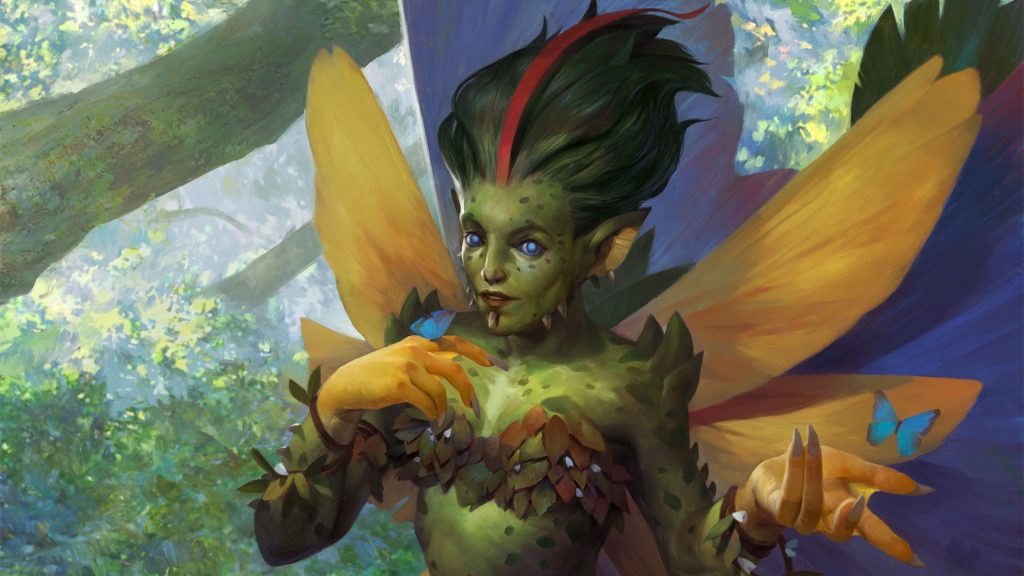
MeinMMO: Coincidentally, some romances like Arueshalae and Octavia feel like hidden quests you have to complete to reach a goal. The obvious answers in dialogues are – unlike with Sosiel, for example – not the correct ones. Do you enjoy when players have to figure out such things with characters they wish to form a relationship with?
Nika Alborti: Interestingly, romances in games are a game in themselves. Understanding your beloved is the key to it, so yes, we expect players to listen closely and guess what their beloved likes or dislikes.
Arseny “Thai” Kyrmov: I’m conflicted. On one hand, I think it’s interesting to have a player understand their companions, figure out what they like and hate, and find the way to their hearts. On the other hand, players don’t like to lose, especially in an 80+ hour game. So I know that if you want to romance Arueshalae, you will most likely do it with a guide. That diminishes the impact, and I’m fully aware that we’re steering players towards that decision – only our most passionate fans would dive into something like this blind, accept the loss, and replay the entire campaign for the right romance ending. Then again, I think the emotional reward would be disproportionately larger, so… cheers to our crazy fans, I guess!
MeinMMO: Thank you for your answers!
The interview for MeinMMO was conducted by Sophia Weiß.



Would you restart an RPG entirely if you didn’t get a desired romance? Or would you rather use a guide? Where is your pain threshold? Feel free to write us a comment!
Romances will also play a role in Owlcat’s upcoming work, Warhammer 40,000: Dark Heresy. In the new RPG, you play as an Inquisitor in a completely new dynamic and with many possibilities. I have already played the first chapters: New RPG of Warhammer 40,000 starts beta on Steam – I played the content, and by the Emperor, it’s a lot

Your opinion is important to us!
Do you like the article? Then let us know!