
The First 3D MMORPGs from 1996
When Meridian 59 was released in 1996, a thrilling phase began for all fans of online adventures in the West. The still-playable classic launched the MMORPG genre into the 3D age, although movable objects were still represented in 2D. A few hundred players could fit into each version of the game world. The developers initially wanted 10 dollars per month.
The gameplay focus at the beginning was primarily on PvP duels. Virtual death was heavily penalized – through the loss of maximum health points and all possessions that could be looted by other players. This potential frustrating experience was also present in various other online RPGs of the 90s and early 2000s, earning the genre a certain hardcore reputation in its early days.
Publisher 3DO referred to the game at the time as an MMPRPG, meaning “Massively Multi-Player Role-Playing Game” – without the “Online”. The term that is now standard, “Massively Multiplayer Online Role-Playing Game” (MMORPG), was coined a year later by Richard Garriott.
Entering an online role-playing game for the first time during this pioneering era must have been an unforgettable experience for every player. After all, one found themselves in often vast, persistent online worlds. Additionally, the understanding of multiplayer gained a new dimension.
Players could meet others everywhere to team up, fight together, or simply chat (MMORPG chats were essentially the precursors to today’s social networks). In what other games of that time was this possible?
The concept of open worlds was also not yet a buzzword that could be applied to almost every genre. Even single-player role-playing games, with 3D engines and large, open worlds, were something special (and often procedurally generated, as in Elder Scrolls II: Daggerfall). You can read more about this here: It’s really sad – those trying an MMORPG for the first time will never feel the fascination of the veterans.
Milestone Ultima Online
The same Garriott, known for his Ultima series as “Lord British,” had his own MMORPG candidate in 1997 with Ultima Online, which could draw on a wealth of lore, races, classes, and more thanks to the Ultima series. Additionally, Britannia featured the first player housing and the first mounts.
But the learning-by-doing principle for character development (for example, those who cast spells often will hit with spells increasingly often) as well as the moral virtues like bravery, self-sacrifice, honesty, or humility also captivated players, as they could significantly impact the gaming experience.
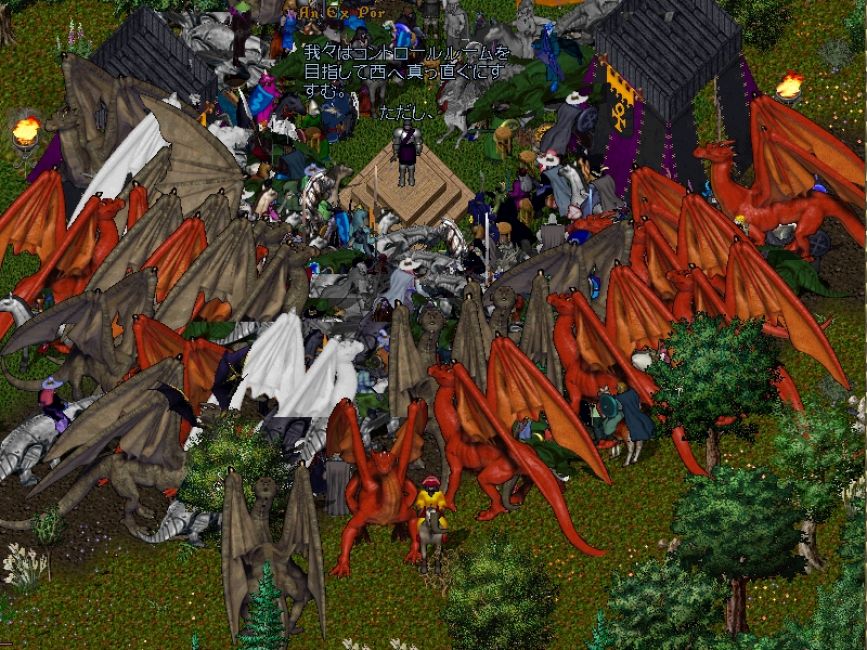
However, the MMORPG could also be quite frustrating when so-called player killers aimed to hunt newbies. At one point, even “Lord British” himself fell victim to an assassination attempt. You can read more about it below:
By the way, for a long time, it looked like Ultima Online would never come to fruition. The team led by Richard Garriott had to pitch their idea of a “multiplayer Ultima” to Electronic Arts three times. The prognosis was always: this will be a total flop.
When they finally received the doubting “go” from the decision-makers, they not only had to start completely without publisher support but also make themselves comfortable in the fifth, still unfinished floor of the building.
Additionally, the term “shards” traces back to Ultima Online. The developers originally wanted to accommodate all players in one version of the game world. However, due to the enormous demand, this was not feasible. The team therefore came up with the story of the game world being split into many shards, which all player characters must piece together through their actions. This way, there was a narrative explanation for the distribution of players across multiple worlds.
This should change only when the beta was imminent. At that time, hardly anyone was able to download such a large game over their slow modems in a timely manner, so the developers had to send the beta version of the MMORPG on CDs.
However, at that time, they were already running out of money (they couldn’t afford the CD shipping), so Garriott and Co. had a bold idea at the time: every player interested in the beta had to pay 5 US dollars – the first “early access” for an unfinished online game was born.
The “new Ultima” generated so much interest that in the first few days, there were 50,000 registrations for the test – EA had only expected 30,000 sold units over the entire lifespan of the game. The publisher took notice and even shelved entire projects to significantly expand the team for Ultima Online in the final stretch.
In 2024, new Legacy servers for Ultima Online were released – here is the trailer:
Dark Age of Camelot and RuneScape
From 1996 onwards, various other online RPGs appeared, in all shapes and colors. While Ultima Online relied on an isometric 3D view and a subscription model, games like Tibia (1997) utilized 2D graphics and a free-to-play access.
In addition to the popular fantasy theme, developers increasingly turned to alternative settings such as science fiction (Terra, 1996) or horror (Dark Eden, 1997). In Furcadia (1996), the longest-running social MMORPG (via guinnessworldrecords.com), players first controlled anthropomorphic avatars.
When Asheron’s Call was released in November 1999, it brought technical innovation to the genre with its boundless, interconnected world. Older MMORPGs divided their game worlds into zones, which were located on different clusters of computers, causing brief delays whenever players switched to a new region.
Gameplay-wise, the fantasy MMORPG offered quite a bit, but the first title from Turbine (who would later create Asheron’s Call 2 (2002), Dungeons & Dragons Online (2006), and The Lord of the Rings Online (2007)) could never emerge from the shadow of Ultima Online and EverQuest. Asheron’s Call and Asheron’s Call 2 nevertheless went offline in 2017.
In the early years, aside from Ultima Online, it was mainly EverQuest (1999), Runescape (2001), and Dark Age of Camelot (2001) that left significant footprints.
DAoC particularly captivated players with its three-front war between the realms of Albion, Hibernia, and Midgard. Veterans still fondly recall nighttime phone trees that successfully repelled enemy faction attacks. One such veteran is our former editor-in-chief Schuhmann, who always cherishes his memories of his time in Dark Age of Camelot:
RuneScape, meanwhile, attracted countless players with its low barriers (browser game plus freemium model) and thus was able to achieve several entries in the Guinness Book of Records – including for the most registered players (over 254 million) in 2017 (via Guinness World Records).
Amazingly, both RuneScape and the classic version Old School RuneScape from 2013 still rank among the most popular MMORPGs on Steam. Through modernizations, mobile ports, and indeed the Steam releases, developers have managed to keep the RuneScape community alive and continue generating high revenues.