


With Marathon, Bungie has stepped into the genre of extraction shooters. How is the latest game from the Destiny studio doing one month after release?

About 1.5 months ago, Bungie released a new game titled Marathon. It is an extraction shooter where you can play classes with different abilities and try to collect loot or complete quests while fighting against other players and NPCs.
Marathon had a rough start, even though the shooter has some gameplay qualities. For MeinMMO editor Dariusz, it is even one of the best shooters we will get in 2026.
While Marathon has a small community that speaks very positively about the game, the large player numbers were missing even at release. For weeks, the Steam charts and development costs have been a hot topic of discussion. Early on, it was said that the game cost over 250 million USD, and it appears that Bungie expert Paul Tassi has learned from internal sources at the developer studio that these figures are allegedly accurate (via Forbes).
A month after release, the question arises: How is Marathon doing and can the game survive?
Bungie surprises with strong post-launch support
Before we look at the raw numbers, let’s take a look at the work done by the developers since the release. Bungie reveals a strength here that many fans long missed in Destiny 2:
Quick and effective response to player feedback.
Bungie shows that they are willing to deliver the best possible game to the Marathon community and address issues or points of criticism. The team around Creative Director Joe Ziegler communicates transparently with the player base and actually makes changes quickly.
- Players want a duo mode → Bungie tests a duo mode → Bungie announces that they will implement a duo mode
- The UI is heavily criticized → Bungie makes improvements, such as in the display of items, and now better indicates whether a weapon mod fits a weapon
- The “Recon” runner shell is too weak → is buffed
- A weapon that the endgame boss drops is too strong → is nerfed
- The battle pass offers too few rewarding contents → Bungie adds more content, including runner skins
The biggest criticism of the game continues to be the difficulty. Marathon is aimed more at hardcore gamers and is not very casual-friendly. This is also shown by the endgame map “Kryo-Archiv” released after launch, which not only demands the best equipment from players but also requires a certain skill in a 3-man team. The problem is clear: There are contents in Marathon that some players will never see.
However, anyone who enjoys the gameplay loop and has no problem with endgame content being truly for players who reach the endgame, and these contents not being completed on the first attempt, can still have fun with the game a month after release. The casual-friendliness of Kryo-Archiv is comparable to the raids in Destiny.
The numbers – full disaster or reason for hope?
A month after release, a picture of Marathon emerges that gives a better impression of whether the extraction shooter is a financial success for Bungie and Sony or not – and recent findings suggest more of a failure.
According to the market research company “Alinea Analytics”, Marathon sold around 1.2 million copies cross-platform in the first two weeks after release, generating a revenue of around 55 million USD. The strongest platform was Steam with 800,000 copies sold (via X). Paul Tassi from Forbes reported, however, that these numbers seem to match according to his sources at Bungie.
Moreover, Marathon offers microtransactions in the form of skins, battle passes, and in-game currencies. However, this requires a loyal player base. On Steam, Marathon’s strongest platform, the downward trend continues:
- In the past week, the 24-hour peak fluctuated between 22,000 and 28,000 concurrent players.
- For comparison: Even years-old games like DayZ, Dead by Daylight, and Warframe have a peak of over 55,000 every day.
- The core community of Marathon is estimated to be primarily in the USA. This is also reflected in the player numbers. When Americans are offline, the numbers drop to as low as 6,000 to 7,000 players.
- Even after content-rich patches or the introduction of Kryo-Archiv, there was no noticeable increase in player numbers, and the downward trend continued shortly afterward.
Even if each of the estimated 1.2 million players had purchased around 35 Euros worth of in-game currency to buy the battle pass and a skin for their favorite class, the total revenue of Marathon would still be below 100 million Euros – however, this calculation is not 100% representative, as we took the European price of in-game currency, which is usually higher than in other regions.
It is clear: Marathon is not a financial disaster like Concord, but is still far from recouping the estimated development costs of over 250 million Euros.

Wrong color palette in the wrong genre
In my last analysis of Marathon, I posited that the biggest problem with Marathon is the current perception of Bungie by players. The developer studio has lost favor with players. Another criticism that contributed to the lack of success of Marathon is the art style.
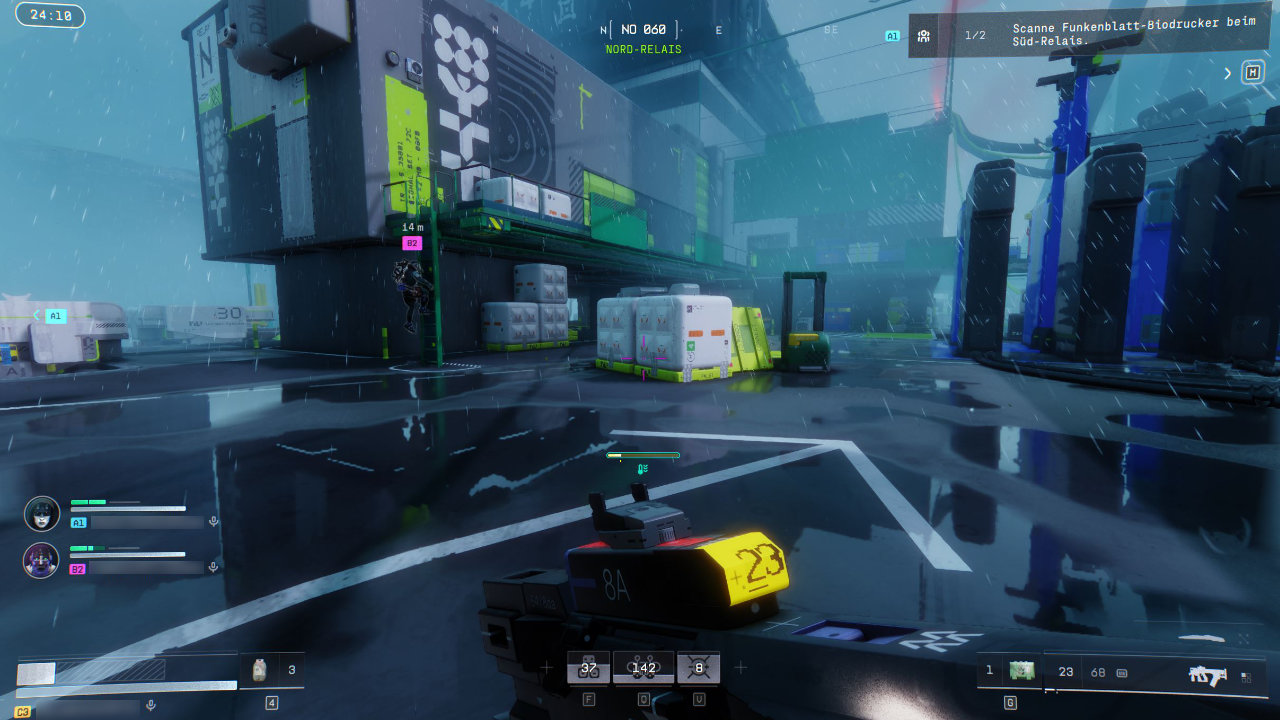
Marathon is futuristic and uses vibrant colors. The story takes place on the alien planet Tau Ceti, and you play as a cybernetic mercenary wandering the planet in 3D-printed runner shells while your consciousness is at a distant, unknown location. Everything on Tau Ceti looks somewhat 3D-printed because a colony was attempted to be established there with simple resources.
The game is not classically colorful and can be quite dark in some places, but many buildings are in bold colors. The color design of the game is likely inspired by real companies or similar entities, where colors are used for department division and orientation.
- The green line leads to the area with the green walls, where the goods are produced.
- The yellow line leads to the yellow walls, where the product is packaged.
In Marathon, on the map “Düstermoor”, there is, for example, the greenhouse that comes from the outside in a striking color combination of blue and neon green, or the bio-research laboratory that is painted in a striking turquoise. Many shooter fans find that too colorful. Especially in the extraction shooter genre, bright colors have so far been a rarity. Even the futuristic, post-apocalyptic ARC Raiders relies on a more subdued color palette, with plenty of gray, brown, and green plants.
No successful extraction shooter is colorfully striking. Escape from Tarkov, Hunt: Showdown, Arena Breakout: Infinite, Gray Zone Warfare… all games that – similar to ARC Raiders – have a comparatively realistic, muddy color scheme. With The Cycle: Frontier, we have also seen a rather colorful extraction shooter die in recent years.
The combination of hardcore gameplay with a PvP focus and the relatively colorful map design likely has a very small target audience and so it is difficult to imagine that Marathon can attract large numbers of new players despite its gameplay quality in the future.


Sony has a choice to make
Marathon is performing mixed. While the core community enjoys the game, continues to have fun, and appreciates the developers’ work since release, the already weak numbers of the shooter are declining. For Sony and Bungie, there are essentially only two options for how to proceed with Marathon:
- Stop development and minimize losses
- Continue to support Marathon, accept ongoing development costs, and try to recoup expenses through new game sales and microtransactions in the long run
Option 2, however, is a balancing act because a balance must be found between costs and revenues. Not too many developers should work on Marathon to keep ongoing costs as low as possible. However, there should not be too few employees, because a lack of content, inadequate response to player feedback, or inconsistent quality in new content could drive paying players away or at least reduce their interest in spending their existing purchasing power.
Sony and Bungie must now essentially dream of a comeback, similar to what No Man’s Sky demonstrates to the entire gaming industry. The survival game received a lot of criticism at launch, but today it is mainly known for exemplary support with strong free content. Just recently, they introduced a kind of Pokémon update: No Man’s Sky brings unexpected “Pokémon-update”, even Palword reacts to it

Your opinion is important to us!
Do you like the article? Then let us know!