

MeinMMO editor and passionate D&D fan Caro sat down with psychotherapist Benjamin Lechner, who uses the tabletop role-playing game for therapeutic purposes. In the interview, he explains how this works, what it can help with, and what this work means to him.
Dungeons & Dragons is a role-playing game where players’ self-created characters not only fight monsters but also level up as fast and as much as possible. It is a shared experience, where you often take on the role of an adventurer together with friends. This adventurer has not only strengths and weaknesses but also an appearance, personality, and other aspects assigned by the player that motivate them throughout the adventure.
Even though it is an imaginary persona, the characters of many players are very close to their mental creators’ hearts. Because whether it is a reflection of oneself or a joke character – this figure will face conflicts during the game, make certain decisions, and evolve.
How personal and informative our actions in Dungeons & Dragons actually are about the things that concern us became clear to me during the conversation with psychotherapist Benjamin Lechner.
We at MeinMMO became aware of the concept of “Psychotherapy & Dragons,” which Lechner applies in his group therapy with teenage clients. Dungeons & Dragons as a psychotherapeutic method – I found this so fascinating that I absolutely had to talk to him.
He enjoyed his legal education a lot; however, he felt restricted in his work helping people this way. In his role as a psychotherapist, he can view the life experiences of people from various perspectives and embark on different developmental paths with them:
“Working with children and adolescents has made my workday much more vibrant and I identify very much with the role of a supporter for young people.”
On his website, you can learn more about the concept of “Psychotherapy & Dragons.”
A concept that is not so foreign to psychotherapy
During the interview with Mr. Lechner, I found out that Dungeons & Dragons does not need to invent the wheel anew in group therapy; it simply turns it differently: with a rule set, playing, and a bit more fantasy.
Caro (MeinMMO): How does therapeutic play differ from classic D&D or a regular D&D session with a group of friends at the table?
B. Lechner: Well, I am a psychodramatist. The school, the psychotherapeutic school I use, is called psychodrama. And in psychodrama, role-playing is a core element, at least in group therapy.
Using role plays in a group setting is very typical and actually the core of the therapy. Only in a classic adult group are these role plays actually staged on a kind of stage. So, a group room is then delineated, a stage is set up, everyone gets a role on this stage, and these roles are played out in a full-bodied manner. And afterwards, there’s a so-called role feedback and the opportunity to discuss what one experienced in this role play.
In this respect, the step to Dungeons & Dragons is actually a small one because the role play is already there. It is just technically staged a bit differently, we would say. The advantage, however, is that especially with teenagers, who are usually not very role-play motivated, it provides a means to excite them about this form of self-reflection.
Okay, and now the difference to classic Dungeons & Dragons… well, how should I put it…
Caro (MeinMMO): Let’s put it this way – in the way you do it: Do you refer to the official rule set or is it rather seen as a basis for something that you have newly created for the therapy?
B. Lechner: No, I play relatively classic Dungeons & Dragons. I also use the rule set in a somewhat simplified form.
There is a set designed for therapeutic use, called “Critical Core.” It comes from the USA and is essentially based on Dungeons & Dragons, and already simplifies certain aspects. The characters are pre-made, the character sheets are simplified, and some rules are simply omitted. And that is at least a good start.
Depending on how experienced my group is, we gradually approach the classic D&D rules. So when one group develops a certain enthusiasm, they engage with it, and by the end, they often know more about it than I do. So I must admit, I’m not a master of the rules …
Caro (MeinMMO): Me neither, but I don’t think anyone is with the hundreds of pages of rules.
B. Lechner: Exactly. I see myself as a master of role play and staging, but the exact rules… My participants often take over that for me. They say, “Benjamin, we need to do this a bit differently,” and I reply, “Okay.”
They then start playing privately, and I am quickly challenged – which is a very good sign! In adolescence, it is about developing autonomy, and actually, it is a very, very good sign when they start to compete with me a bit. Saying: “Actually, I can do this better than you.” That is a very healthy sign; I’m very pleased with that.
The process is more similar to normal D&D than expected – with a relevant difference
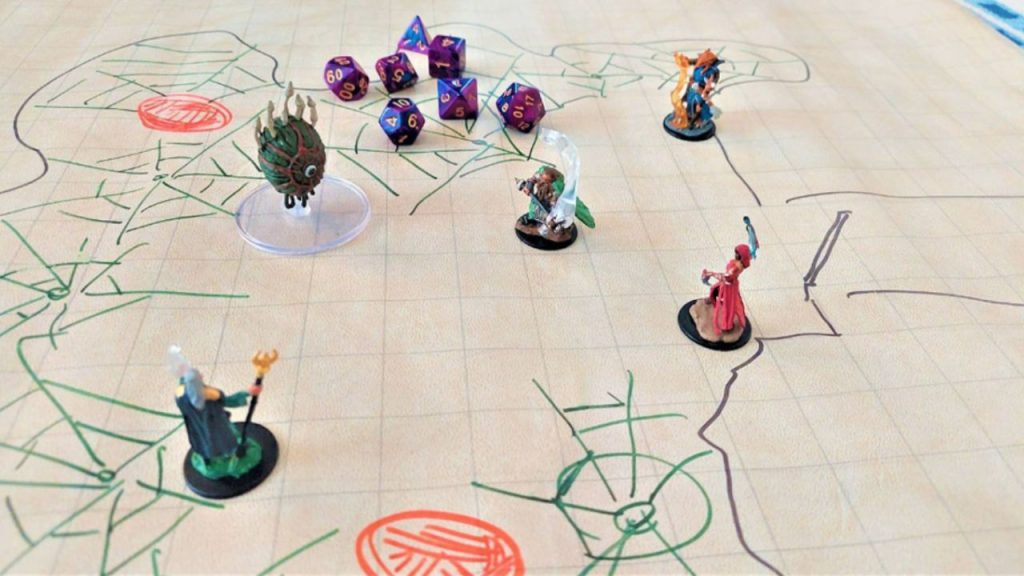
To explain to me how a typical group therapy session with Dungeons & Dragons looks, Mr. Lechner explained how it usually proceeds. While the pure role-playing period is actually completely similar to a normal session, it is mainly the preparation and follow-up that shows that it really is a therapy session.
B. Lechner: Shall we describe the process?
Caro (MeinMMO): Yes, please! That would have been my next question.
B. Lechner: A classic group unit works like this:
The participants come into the group room, and we begin with an opening round. Everyone can tell me how they are feeling today. And already here, topics can develop: What is currently on the group’s minds? What things do we want to address?
And then, when we come to the role play … at the beginning of the group year [usually a group year lasts a school year], the characters are developed.
Then there is the so-called check-in question. We would refer to this psychodramatically as “rolling in.” That means we enter our role. We stand behind our chair and answer a question like, “What is my favorite food?” for ourselves. And then the participants sit in the chair and answer the same question from the perspective of their character. And from then on, I expect them to play their character and no longer themselves.
And then I take on the role of the game master and stage – this is a difference from classic Dungeons & Dragons – one to two encounters, more simply isn’t feasible due to time constraints. After that, it continues classically with the psychodrama therapy:
There is a role feedback. How did it feel for me in my role today, and what can I learn and take away from this about myself?
The difference mainly lies in the timing. I do not have four- or five-hour evenings but the gameplay phase is usually half an hour to three-quarters of an hour.
And of course, there is the focus. Because the focus of the game is already to learn something about oneself and not just to “play.”
Caro (MeinMMO): So it ends with the feedback round, “How did my character feel, how did I feel because of that?” Is that how you can determine whether a session “worked” or if there were any progress?
B. Lechner: Yes, and usually – when I say that the topics come up in the opening round – you see this in the game. For example, if a client comes in with fears, then in the game you will usually see these fears or whatever lies behind them.
If I am very anxious myself and find it difficult to confront challenges, then that might also be noticeable in the character. And it is often easier to talk about the character and help them rather than oneself.
Caro (MeinMMO), who feels very caught out: Ah, so a kind of detachment, so that one does not take everything so directly onto oneself, but can actually derive something for oneself in a metaphorical sense?
B. Lechner: Exactly. Psychodramatically, we would say, “getting some distance from the role” that I am playing here. Because I play the role of the anxious person in both the role play and in real life. And with the distance that is created, it’s easier to talk about it.
Caro (MeinMMO): How would that work – or would it even work – if you did this with adult clients? Or do you feel that adults might somewhat belittle it because of D&D, but that with children, through the rules and through the play, it might be more attractive?
B. Lechner: Actually, I do not use it with children. I know concepts with very simplified rules to use it in child groups, but I do not do that because children already play role plays without problems.
I mainly use it with teenagers, but also with adults. I have conducted workshops with adults where it works just as well. The difference between youth therapy and adult therapy is significant, but in my view, it works with adults just as well as classical psychodrama therapy.
There are also fairytale-oriented concepts in psychodrama therapy, and this works in a very similar manner. Whether I play Snow White or dwarves and elves, there are certain cultural traits involved that almost everyone can relate to.
Caro (MeinMMO): What difficulties and limitations do you experience compared to classic psychodrama?
B. Lechner: The biggest difference to classic psychodrama role play is that the game based on pen and paper often takes place while sitting. This can lead to reduced identification with the role, making it easier to switch between the role and “oneself,” which can weaken the emotional experience in the role.
The pure class choice cannot say as much as the actions and decisions of the players
Now that I understand more about how role-playing in Dungeons & Dragons can be used for therapeutic purposes and what a typical group therapy looks like with this concept, there are further questions where I was curious about the answers.
As I am very engaged with the community regarding Dungeons & Dragons, whether for my work or in my free time, I wanted to ask him about a topic that comes up often on social media:
Caro (MeinMMO): There are so many videos on Instagram and TikTok saying: This class means that, this race says this about you … What do you think about these classifications?
B. Lechner: I would never make a final interpretation of a role of a client in my role as a psychotherapist. It is not about what I, as a therapist, think I see, but about what my clients can learn about themselves from their role-taking actions.
It may happen that I have questions about certain characteristics or behaviors of characters, and there are also situations where I would offer an interpretation or a parallel to the clients’ real lives; ultimately, however, the clients always decide for themselves which aspects of their characters they want to address and what the experience means for them.
When asked if he, as a fan of the role-playing game, has a favorite class or experience, B. Lechner mentions that he regularly plays D&D in his private life as well. Oftentimes, when he is not feeling well, the shared role-playing experience helps him a lot.
Many fans of pen and paper can certainly identify with this statement.
As an example, he mentions one of his favorite classes, which he chooses in moments when he feels he is losing himself in his thoughts: the Barbarian. With a – to put it kindly – “reduced” intelligence as a dump stat, he doesn’t have to think as much in those moments, can just go all out, and contribute his part.
He has many favorite moments from his sessions. Especially the final moments when a campaign draws to a close and the group manages to overcome the BBEG often remain in memory. For this reason, a painted picture from one of his group members is framed on the wall behind him while we talk in the video call: A picture in which the adventuring party emerges victorious after a year of teamwork and character development.



Dungeons & Dragons is much more for many players than just a game. It is more a shared experience that can be more personal than one might initially suspect. Anyone who has been playing for years will likely have formed their own opinion on it.
However, anyone who has not yet had the chance to gain their own experiences with D&D but is still curious and motivated to try it out for themselves should dedicate a few minutes to another article here on MeinMMO. In this article, my colleague, D&D enthusiast and MeinMMO editor Alex tests the starter box “Heroes of the Borderlands”: The new starter box for Dungeons & Dragons in review: “Heroes of the Borderlands” is the best tabletop entry I’ve ever had

Your opinion is important to us!
Do you like the article? Then let us know!