Dungeons & Dragons is now over 50 years old. Back then, in the first edition, the game looked very different – and had completely different rules. Some of them you could hardly imagine today, especially if you wanted to play a female character.
These are the origins of Dungeons & Dragons:
- The role-playing game first appeared in 1974 and was already more of a niche phenomenon with a strong focus on a young, male player base. It aimed to stand out from the then-popular “Wargaming” – like the later popular Warhammer.
- A huge world has emerged from Dungeons & Dragons, from which the card game Magic: The Gathering has also emerged.
- Some campaigns have been running for over 40 years and during this time D&D has changed several times, most recently with the revised version 5e in 2024. Many of the old rules would likely be considered rather questionable today.
What was so different back then? There was a complete set of rules for if you wanted to play a woman in D&D – regardless of your own gender. Women often had completely different names for their classes and different abilities than men.
In the companion magazine “The Dragon”, which published additional rules and errata for D&D, there is an overview of women and magic in Issue 3 (Source: darkshire.net as PDF). Some highlights:
- Women had no charisma, but a “beauty” score that determined the success and effect of certain spells.
- Female thieves – that’s what rogues were called back then – could cast spells with a certain level of intelligence. Male thieves could not.
- The strength score of women was generally lower than that of men. This applied to all available races. As a result, they could not wield certain weapons and armor.
Especially the “beauty” score is interesting here, as witches (i.e., female spellcasters) with a low beauty score could directly kill male beings they wanted to enchant through “seduction”. No joke.
Furthermore, characters had to roll for a saving throw to resist seduction. If a cleric failed, they could lose their celibacy, which – depending on the rules used – resulted in a loss of divine power, similar to oathbreaker paladins.
“That wasn’t meant to be sexist”
The American author Tim Kask, who was among the original playtesters of D&D and later the first permanent staff member for the “Dragon”, talks in his video on YouTube about exactly this section in his magazine.
Kask explains: the rules at the time were not meant to put women down. On the contrary, it was meant to entice women into the hobby. The interest simply wasn’t there at the time:
It’s not that we didn’t try to talk to the girls. They came by and looked at the pretty [toy] soldiers. And unfortunately, that was it. This article, Women in Gaming, was an honest attempt to make D&D more attractive for women.
Women should feel more belonging to the “nerdy type”. However, all of this must be viewed in the context of the year 1976 with its very different society.

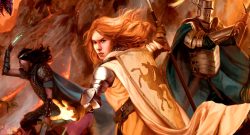
The YouTube channel DnD Shorts, whose operators publish additional materials for D&D, has also taken up this topic (on YouTube). There, he talks to YouTuber and tabletop expert Ginny Di about the old rules.
The two conclude: From today’s perspective, these rules do actually have a sexist undertone, but in a certain way, they also attributed considerable power to women. After all, they could kill with their (lack of) beauty or have clerics betray their god.
Since the first release of D&D, a lot has changed and especially the new rules from 2024 have caused some confused faces among fans. However, other controversies are also making the rounds, especially at the parent company Hasbro. Our experts have discussed this: At the company behind Dungeons & Dragons, a lot has changed – How it might continue is discussed by our experts