

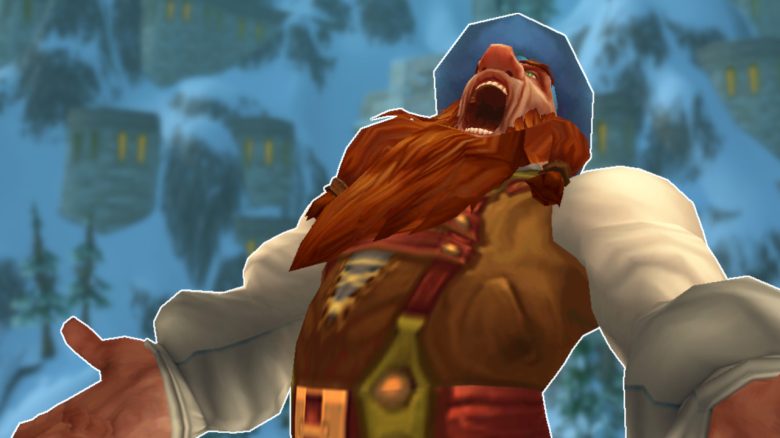
Whether in Tolkien, World of Warcraft, or other role-playing games, dwarves are often portrayed as a short-statured people. Clearly, because: dwarves are small. But that’s actually not true – at least the original legends don’t support that.
Some of you may know, that dwarves actually come from Norse mythology. However, most people are likely only aware of four things about dwarves:
- Dwarves live underground, in mountains and caves – less often as “wild dwarves” outside.
- They can forge excellently and are outstanding stone cutters.
- What is made by dwarves is durable and lasts through all time.
- Dwarves are stubborn, but deeply loyal, grumpy, have beards, and are… small.
While much of this can clearly be traced back to the sagas, legends, and songs of the Vikings, such as from the Edda, their defining characteristic as a short-statured people is never mentioned there.
Is it all just Christian propaganda?
Like many beings from modern fantasy, dwarves originate from Norse mythology – just like trolls, giants, or elves, the latter of which were heavily mixed with the Celtic Sidhe. One of the reasons for this, by the way, is Tolkien, who is considered an icon of the genre and borrowed a lot from these mythologies.
So why are dwarves considered small? It’s not necessarily Tolkien’s “fault,” but rather a result of lack of tradition and deliberate change. Many writings that deal with the sagas of the Vikings were created long after their time, when Scandinavia had already been largely Christianized.
One of the most important sources is the Edda by Snorri Sturluson. Rudolf Simek writes in his Lexicon of Germanic Mythology, which is considered one of the most important works on the subject: “Furthermore, Snorri was a Christian, and his Christian upbringing has influenced his portrayal. Nevertheless, his works are one of our main sources for Germanic mythology.”
Why precisely dwarves are attributed with a small stature is difficult to establish clearly. It is possible that Christianity wanted to depict the old Norse religion as literally “smaller.” However, it could also simply be a faulty and ambiguous translation.
The Norse “dwarves” were brilliant blacksmiths, but not necessarily small
In the Viking sagas, dwarves are called “dvergar” (similar to the dwarven name used in Warhammer) and, while described as “different,” are never explicitly referred to as small.
The German medieval archaeologist Matthais S. Toplak extensively studies Norse history and sagas. In his contribution “or brimi bloðgo” – Physicality and Exclusion in the collected essays Res, Artes et Religio, the researcher writes:
The central parameter in the external appearance of the dvergar would therefore not be their small body size, but their monstrosity, which makes them appear as a distorted image of humanity.
M. S. Toplak in “or brimi bloðgo” – Physicality and Exclusion, free to read via academia.edu
Even if it may indeed be possible that dwarves were small, that is not one of their fundamental traits. Moreover, there are speculations that the dvergar and the svartálfar, or “dark elves,” might have been the same people.
What is true and where Toplak also agrees is that dwarven craftsmanship is considered masterly. They forged various magical artifacts, such as:
- Freya’s necklace Brísingamen
- Gleipnir, the chain that bound the wolf Fenrir – with ingredients such as the beard of a woman, the saliva of birds, and the breath of a cat
- Odin’s powerful weapon Gungnir, a masterful spear
- and of course Thor’s famous hammer Mjölnir

Giants aren’t actually that “giant” either
While we are at it, let’s destroy your notions: dwarves are not only not small, giants are also not that giant – at least not when you look at their models. They also originate from Germanic mythology.
In that mythology, giants, or Jötnar, are the quasi-opponents of the Aesir or Asen and the Vanir, the deities we know. There are often wars between the gods and the giants, but also peace and even marriages, such as between Njörd and Skadi.
Jötnar are commonly described as being equal in size to the Aesir, or at least not explicitly larger, and the Aesir themselves are also not described as larger than humans. The only exception is the primordial giant Ymir, from whose body the first gods (Odin, Vili, and Vé) created the world.


Another assumption, although significantly less common, is that dwarves cannot cast spells – among other things, because they supposedly consist of stone. That is also not accurate, as in the Edda they are certainly capable of sorcery, such as shape-shifting (which makes their trope as a “small” people fundamentally flawed). Looking at modern dwarves, they pay a high price for sorcery: In Warhammer, there are 3 types of dwarves and two of them engage in forbidden activities

Your opinion is important to us!
Do you like the article? Then let us know!