
If you have ever wondered whether your dice in Dungeons & Dragons have a mind of their own and could either side with you or turn against you: MeinMMO editor Caro will prove to you that some dice are truly just paid actors.
There are situations in role-playing moments as well as in Dungeons & Dragons where you ask yourself: How the hell did that happen? Which dice gods or demons had their fingers in the pie?
I personally don’t believe in otherworldly dice entities; it’s actually much simpler: Some dice are simply paid actors who decide on the outcome they feel like, despite any calculations of probability.
To prove this to you, I want to tell you about a moment from our D&D campaign. In this situation, the dice’s decision resulted in an incredibly unlikely but perfectly staged moment, despite a probability of only 0.01% – that is, 1 in 10,000 times. And this still remains one of the most memorable moments of our adventurers’ journey to me, even after a year.
However, I want to give you this warning in advance: Don’t let your bards be as reckless as my friend’s bard, despite the following events.
Curiosity outweighs caution – at least for reckless idiots like us
To set the scene: We are together during a long rest. The group has stumbled upon sparkling fairy dust during a visit to the Feywild, which our bard, the character of my friend, is eyeing the most.
Her bard is strongly based on a well-known rock singer of the 70s/80s – for good reason, she bears the name “Nikkie Steves” – and thus has a little “experience” with the substance that we have collected as a group. What we understand by fairy dust probably doesn’t need further explanation.
Back to the scene: Nikkie is completely thrilled to finally see this stuff again and decides to “consume” a bit of fairy dust after the long drought. And this is despite the concern of some of her companions, who can’t help but be curious about what happens next.
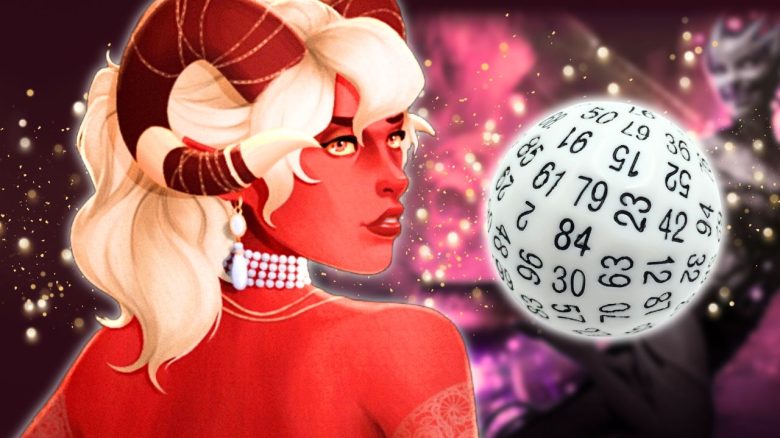
Our DM wants my friend to roll a W100, similar to an activated use of Wild Magic. This means that the effect is randomly drawn from a table, depending on what number is rolled.
Nikkie rolls; she rolls… she shrinks. A head’s length, nothing wild. Considering all the wildly named effects of Wild Magic, it’s quite a mild effect. Good, it went well. But Nikkie is not ready to stop there.
“I know the stuff already, don’t worry too much.”
Caught by the thrill of danger or simply by reckless curiosity, my friend wants her bard to take fairy dust again. Now I am getting nervous too, because you shouldn’t challenge luck again, especially when Wild Magic is involved!
My warlock asks her if that’s really such a good idea; after all, it could be dangerous, but Nikkie insists. She has been familiar with the stuff for years, and nothing bad has ever happened. There is nothing to worry about.
To defend her point, she reaches for the fairy dust again and has to roll again. The group stares intently at the bard; everyone at the table is staring at our DM and Nikkie…
… and simply grows back to her normal size.
She rolled exactly the number on the table that causes her to grow a head, thus reversing the previous effect. Twice in a row, she rolled a W100 exactly the numbers to make her dangerous fairy dust consumption appear far less harmful than it could have been. A “hundredth-of-a-hundredth” chance. So 1 in 10,000 or 0.01%,
I didn’t know whether I should be glad or just feel mocked when I was cheekily grinned at with the words “See, it’s not so bad.”
And the moral of the story? The consequences of reckless consumption: nothing. Our bard learned absolutely nothing and actually had a point. Thanks, dice.
Have you experienced such absurd moments through absolutely unlikely rolls? Do your dice live too? Feel free to let us know in the comments! Don’t be influenced by Nikkie’s luck and don’t fall prey to her recklessness. Dungeons & Dragons can quickly backfire, depending on your DM’s grace, if you make reckless decisions.
Even though the situation was not a strong lesson, it provided a very memorable moment that regularly makes me shake my head when my warlock faces her thirtieth Nat 1 of the session. By the way, she also cannot absolve herself of all mishaps, but despite the cliché-laden Edgelord factor, I try not to spoil anyone’s fun at the table: I am the dark cliché warlock in our D&D group, but I still manage not to annoy everyone.

Your opinion is important to us!
Do you like the article? Then let us know!