

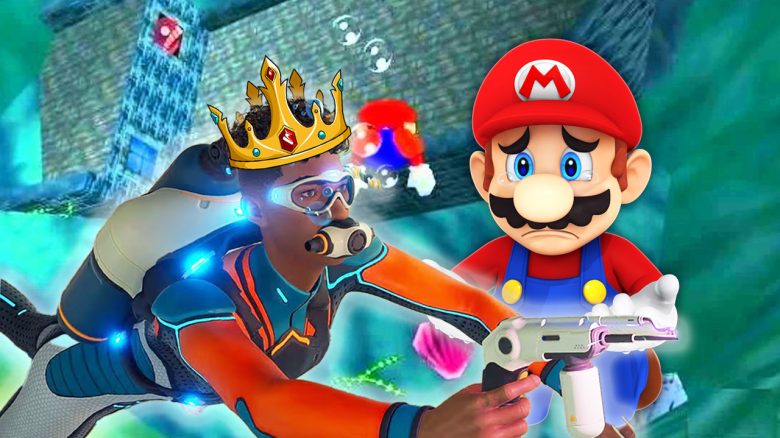
Water levels in video games are often hell. Why does Subnautica 2 achieve the impossible and build an entire, brilliant game on it? We asked the developers – and six designers responded.
We all have our own stories about an underwater level that drove us to despair. We think of the water temple from Ocarina of Time or Super Mario 64. Ouch.
Typically, water levels are slow, confusing, and incredibly clunky in terms of controls and navigation. Then came Subnautica and proved that an entire survival game underwater not only works but is truly fun. With the new Subnautica 2, the studio aims to replicate this feat – and during the early access playtest, the world immediately captivates me.
I observe small, orange Periscopic Clown Crabs darting around in a colorful sea of corals, staring at me suspiciously with their long stalk eyes when I get too close. At the same time, the threat of the ocean lurks around every corner. Dark caves do not reveal how deep their corridors go as I swim in, and whether I can find my way out quickly when air runs low.
I find: This works fantastically. But… why actually?
Why does it feel so good here, while we despair at almost every other underwater level in gaming history?
We promptly reached out to Unknown Worlds Entertainment – the studio behind the survival series – to ask them just that. The surprise was great: six developers responded. From the level designer to the environment artist, each brings their personal perspective on why underwater design is damn tricky – and how they master it nonetheless.
The Freedom of Flying (The Problem with the 3rd Dimension)
Those who stay on the ground are easier to steer. But underwater, vertical freedom breaks all classic gaming rules, as Artyom O’Rielly and James Van Horn explain:
Navigation and Subtle Guidance
“In traditional games where players are generally bound to the ground for movement, we can much more accurately place landmarks and plan the paths that the player is supposed to follow.
In Subnautica, we give the player a third movement axis, which means they can approach any object at any angle at any time. This challenge forces us to ensure that areas are suitable from every direction a player might come from. I think exploration feels more engaging because we have put a lot of work into subtle hints in the environment. For example, we use targeted lighting placement, empty spaces as visual breathing room, as well as guides or movements that attract the eye. This encourages players to move where we want them to, and awakens the curiosity that is inherent in us humans.”
– Artyom O’Rielly, Level Designer
The Balance Between Nature and Gameplay
“Player movements are much harder to predict when designing underwater spaces, which is why you have to consider every angle of approach. Combined with the limited visibility that deep water brings, this leads to situations where we as level designers have to be very careful: We have to balance how subtly we guide players through the world. As humans, we have certain expectations of spaces based on our experiences in the real world – and those cannot be directly transferred underwater.
Creating an immersive underwater environment means maintaining that unique, fascinating feeling of exploring areas that feel completely alien to us, while also keeping the gameplay in mind. The balance between nature and gameplay is key. Creating spaces in the world where players can experience the overwhelming depth of the space without overdoing it with typical ‘video game-like’ elements – that’s a fine line, but it is incredibly important.”
– James Van Horn, Level Designer
Fear, Darkness, and the Psychology of the Ocean
The psychology of the environment plays an important role in Subnautica. Daedra talks about how the ocean itself becomes the enemy and what isolation does to us. Jeremy Blake thinks a lot about how to evoke a sense of awe in the player about the environment:
The Environment as an Opponent
“The level design in Subnautica fundamentally differs from other games because the environment itself is always part of the gameplay. Movement, visibility, navigation, and even the player’s emotions are shaped by it. Players are not just exploring a room – they are confronted with isolation, uncertainty, and the fear of what might be lurking behind the light.
The environment becomes a living pressure system. Darkness, depth, and isolation make navigation itself part of the gameplay.
The level design in Subnautica changes the rules of spatial design. Verticality replaces flat movement, visibility becomes a mechanic, and tension arises as much from what players cannot see as from what they can see.”
– Daedra, Senior Level Designer
The Feeling of Awe
“What I’m really thinking about with Subnautica 2 is conveying that sense of ‘awe’ to the players. Some of my absolute favorite games give me that feeling when experiencing these handcrafted worlds – not just the first time, but every time thereafter. Subnautica as a whole is full of areas that almost force the player to stop and look around.
A big challenge in designing for such a unique gameplay style is developing a new way of thinking about how to design a space while still following certain fundamental design rules. I believe the result of this process is areas that are not only visually stunning, but that can also be fascinating to explore and into which one can wonderfully immerse oneself. That is what I’m aiming for and what I want to achieve.”
– Jeremy Blake, Level Designer
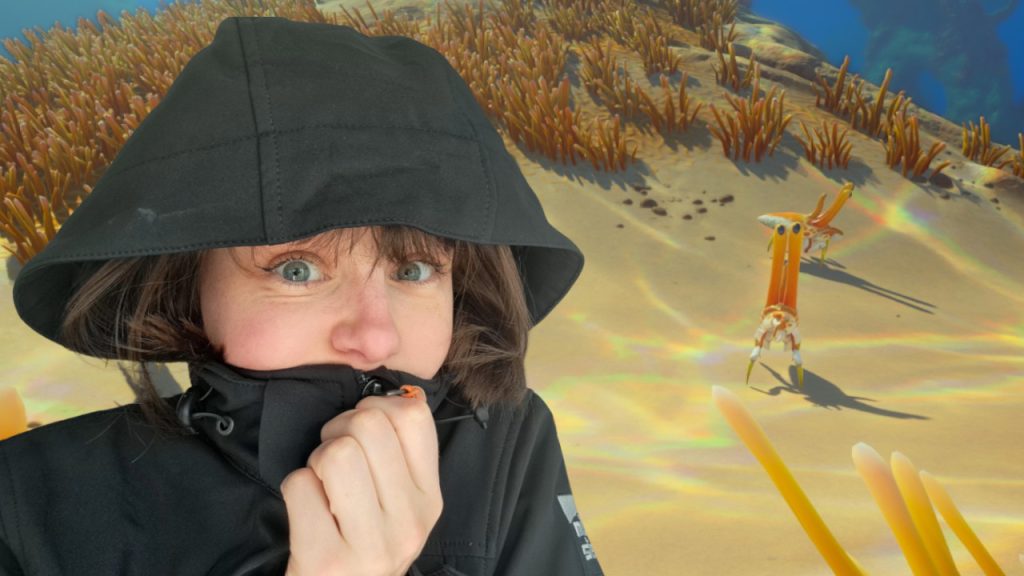
Reading Recommendation: Our author Johanna feels this psychology of awe quite strongly – Subnautica 2 is so much fun for me because I am afraid
The Crux with the Graphics and the Sequel
Developing a sequel brings its own hurdles – both for the feeling of players and for the graphics card. Seb Spatzek thinks about the right balance, while Ben Hale is especially grateful for the misty water:
The Familiar and the New
“One of the most interesting challenges with Subnautica 2 is balancing the familiar and the new. We ask ourselves almost daily how we can maintain the sense of fascination and vulnerability for which the Subnautica series is known, while also ensuring that the world feels fresh and new.”
– Seb Spatzek, Lead World Designer
The Technical Trick with the Fog
“From a graphics development perspective, here’s the thing: Since traditional games severely restrict where the player can go, the detail level of objects is usually scaled back based on how close the player can get to them. The further something is away, the less detail it needs, and eventually collision checking can be omitted. It is completely normal for distant terrain to consist only of a simple 3D model with a relatively low-resolution texture and no collision. But when the player can fly almost anywhere, you have to detail everything pretty uniformly – in geometry, texture, and collision. It’s fortunate that the water is so misty, otherwise it would probably be impossible to optimize this game.”
– Ben Hale, Senior Environment Artist
Conclusion: A Nightmare that Becomes an Art Form
The developers’ responses show: Subnautica 2 works not despite but because of the challenges of water. While other games try to bluntly transfer the soil physics to the water – which often ends in frustrating clunky controls – Unknown Worlds deliberately uses weightlessness and limited visibility as gameplay mechanics. The fog not only hides technical limitations, it feeds our primal fears of the unknown.
In the end, it is precisely this meticulousness in design that makes the difference between an annoying underwater level and an atmospheric masterpiece.
Now it’s your turn: Which underwater level in your gaming career has cost you the most nerves?

Your opinion is important to us!
Do you like the article? Then let us know!