In a new video, Marco Risch from Nerdkultur talks about the upcoming blockbuster Dune 3, which, although from the same director, seems to look completely different from the two predecessors.
Who is Marco Risch? Since 2015, Marco Risch has been dealing with news, analyses, reviews, and interviews about current movies and series on his YouTube channel Nerdkultur .
In addition to that, he meets weekly with his colleague Yves Arievich and chats in the Podcast Nerd & Kultur about pop culture film topics like Star Wars, Marvel, and DC.
Both the YouTube channel and the podcast are part of the Webedia network, which also includes MeinMMO.
In a new video on YouTube, Marco talks about the upcoming blockbuster Dune: Part Three and why it looks different from its predecessors.
17 Years Later
What is the video about? Coinciding with Avengers: Doomsday, Dune: Part Three is set to hit theaters in Germany on December 16, 2026, continuing the story of Paul and the desert planet – over 2 years after the release of the second part. Marco explains that director Denis Villeneuve actually wanted to shoot much later, with a waiting time of 10 years.
But Dune haunted him like a nightmare, which is why he preferred to do it earlier. The problem is that the cinematographer of the two predecessors, Greig Fraser, is busy with the Beatles biopic, which means another cinematographer is needed, but that shouldn’t harm the film.
While Greig Fraser mainly shot the second part from Paul’s perspective, that will likely change in Part 3. The chosen hero
becomes a dubious leader,
and that seems to be represented by the camera as well. Now we see Paul from the perspective of others. Paul has changed, and that fits with the source material.
As Marco points out, Dune: Part Three is based on the second book by Frank Herbert, Dune Messiah. The story begins 12 years after the first book, and in the film, even 17 years after the second film. The new film will not show how Paul fought for his power but rather how the war changed him.
Marco compares him to Marlon Brando in Apocalypse Now. The war and the suffering have changed him (also visually), they show the consequences of too much power.
Paul’s comrades also struggle with this.

Paul’s Allies
The camera, according to Marco, not only shows Paul’s transformation but also the various relationships of the other people in Paul’s life. His sister Alia, played by Anya Taylor-Joy, is shown in close-ups, unlike Paul, who now seems to be portrayed more distantly. For Marco, she represents, with her blue eyes, the path Paul could have taken with the Bene Gesserit.
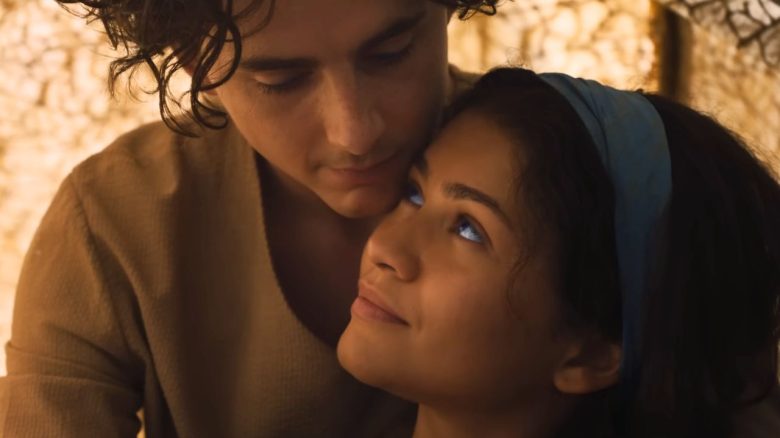
On the other hand, there is Chani, played by Zendaya. Her close-ups, reminiscent of Dune 2, show that she is slowly turning away from Paul: Chani’s gaze as a quote – and as a confrontation!
. A major surprise for viewers unfamiliar with the book is the return of Jason Momoa as Duncan Idaho.
Duncan is important for Paul’s identity crisis. He confronts him with his past. To match the portrayal in the book, Momoa wore bright contact lenses during filming, with a special surface that, along with an LED ring on the camera lens, creates a special effect seen in the first teaser for the film.
This is thanks to Linus Sandgren, the new cinematographer for Dune: Part Three. For the latest installment, he opted for analog film, unlike the predecessors, which were shot on an ARRI Alexa, a digital camera. However, Greig Fraser tricked: [He] exposes analog film material with the shots – and then digitizes it again for post-production.
This created a look that didn’t appear digitally clean
, but instead produced the film grain effect. Sandgren has a different approach.

Different Camera, Different Look
How does Sandgren shoot Dune 3? Sandgren uses an analog camera. According to Marco, for the film First Men
, he used 35mm on Earth but 70mm IMAX film on the Moon to create a different look.
In Dune: Part Three, the cinematographer, who was also responsible for the James Bond film No Time To Die, will partially use analog IMAX. This way, according to Marco, the images become even larger, more impressive, and tangible, which wouldn’t be quite possible with a digital camera.
To connect with Parts 1 and 2, Arrakis is still to use the digital camera. But Marco shows that Sandgren’s images are much richer in color. This makes it look dreamier than Fraser’s work.
For this effect, he even coated his camera lenses, which now shine golden. Marco describes it like [a] fever dream of Paul.
In the end, Marco summarizes: Linus Sandgren justifies his switch to analog film with Villeneuve’s vision: Digital is perfect for capturing reality. But film is perfect for capturing a dream. Or in this case, the dream of Paul Atreides. A nightmare.
More from Nerdkultur can be found here: Movie expert reveals which 10 movies you should watch in 2026