

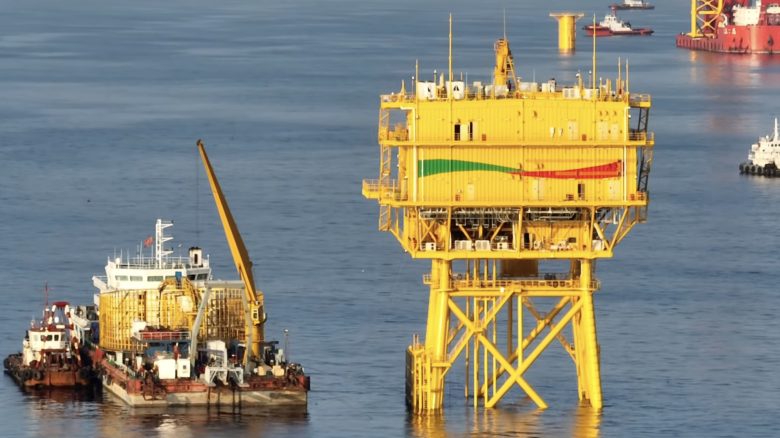
An underwater data center with thousands of servers is now officially in operation. China relies on wind power and seawater and may have solved one of the biggest problems of modern AI: cooling.
What innovative project is this? China has implemented a project that at first glance resembles Bioshock and the fictional underwater city of Rapture more than reality: a fully operational data center on the ocean floor. As reported by Tom’s Hardware and the Chinese medium CGTN, the facility has now entered regular operation.
The project, which officially started in June 2025 and is expected to be completed by October 2025, reached full commercial operation last week after successful initial test runs in February. (Tom’s Hardware) So it took a little longer in the end.
The system is located off the coast of the Lingang Free Trade Zone near Shanghai and houses around 2,000 servers that collectively achieve about 24 megawatts of power. Noteworthy is less the size but the construction: the entire infrastructure is sealed and designed to operate underwater without direct human access for long periods.
The commissioning has been officially confirmed by the Chinese Ministry of Transport, which sees it as an important step for digital infrastructure and the future of energy-efficient AI technologies.
Sustainable underwater?
How sustainable is this really? The project combines several approaches to reduce the increasing energy demand of modern data centers. According to CGTN, the use of seawater can significantly increase efficiency as less energy is needed for cooling.
The Chinese Ministry of Transport emphasizes that such facilities could help optimize resource consumption and reduce environmental impact. (Ministry of Transport of the People’s Republic of China)
Modern AI data centers increasingly face a serious thermal issue: packed GPU racks consume several hundred kilowatts and practically waste all the power they draw. Underwater constructions utilize the surrounding seawater as a natural, passive heat sink – reducing the need for active cooling. (Tom’s Hardware)
However, it remains unclear how maintenance and potential impacts on the marine environment will evolve in the long term.
While underwater data centers offer interesting advantages, they also raise ecological questions. Microsoft’s similar project “Natick” showed about ten years ago that the deployed capsule influenced seawater temperature – although according to researchers, only minimally: just a few meters downstream, the water would warm up by at most “a few thousandths of a degree”.
The situation becomes more problematic given the climate crisis: more frequent ocean heatwaves could mean that even small additional heat inputs become a problem for marine life – warm water contains less oxygen, threatening biodiversity. (Futurezone)



As the demand for computing power from AI continues to explode, companies and states worldwide are searching for solutions to manage energy consumption and cooling. A new data center is set to consume double the energy of an entire US state, and of course, AI is behind it

Your opinion is important to us!
Do you like the article? Then let us know!