Some situations in Dungeons & Dragons result in advantages or disadvantages for players according to the rules. An expert on bows has taken a closer look at one rule and explains why it has a significant logical gap.
Which rule is being discussed? Content creator and archery expert Blumineck takes a closer look at the rules for ranged attacks in the condition “Prone” in his video on Instagram. In his opinion, there is a logical gap in these rules.
Some attacks and actions cause characters and opponents to fall to the ground and remain there until their turn, thereby suffering from the “Prone” condition. When a character is prone, the following rules apply according to the basic rulebook:
- Limited Movement
- You can only move by crawling or spend a movement distance equal to half your speed (rounded down) to stand up and end the condition. If your speed is 0, you cannot stand up.
- Impaired Attacks
- You have disadvantage on attack rolls. An attack roll against you has advantage if the attacker is within 5 feet of you. Otherwise, this attack roll has disadvantage.
According to Blumineck, the part regarding advantages and disadvantages in attacks has a significant weakness, which leads to this rule being inherently illogical and misapplied when considering realistic advantages and disadvantages.
Disadvantage for ranged attackers against grounded targets, yes – but not always
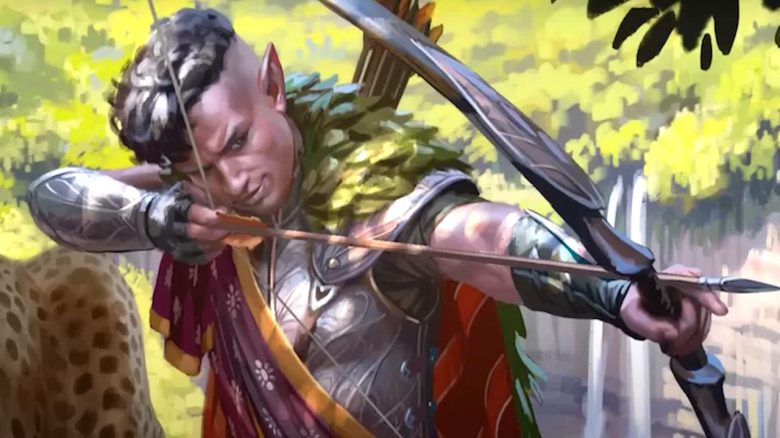
What weakness does the rule have? As Blumineck explains in his video, it is generally true that a prone position significantly complicates attacks with a bow from various distances, but not always.
Historically, shots at high angles, as often seen in movies, have been somewhat rare, and most attacks with a bow and arrow were made either flat or at slight angles. Therefore, it is generally possible to hit targets lying on the ground, especially if the attacker kneels as flat as possible.
Nevertheless, aiming is so complicated that a disadvantage for ranged attackers is justified. The logical gap mainly lies in attacks from elevated positions.
Why should ranged attacks from height against prone targets have an advantage? Blumineck argues that attacks made from above against lying targets should actually have an advantage. According to the basic rules, ranged attacks from height also regularly have an advantage on their attack rolls, as long as the target is standing.
However, following the rules for the “Prone” condition, the advantage provided by the resulting disadvantage would actually negate itself, and ranged attackers would thus have to make a normal attack roll. From his perspective, this is where the logical error lies.
For targets that have fallen to the ground, the rules and logic state that they are restricted in movement and cannot easily react to incoming attacks, which is why melee attacks have an advantage against these targets. However, it should also be easy for archers from an elevated position to aim at such opponents, so they should also have an advantage if one plays under realistic conditions.



From Blumineck’s point of view, the “Prone” condition almost provides a sort of protection for those on the ground, which could even prove advantageous against groups containing multiple ranged attackers. Meanwhile, an expert on longswords has taken a closer look at rules that turn fighters into true attack machines: Longsword expert explains whether 8 attacks in 6 seconds in Dungeons & Dragons are realistic