Rebecca Ford (32) has gone from intern to head of Warframe. In 2022, she became the Creative Director of the MMO shooter. MeinMMO editor-in-chief Leya Jankowski took this opportunity to talk with the developer about her remarkable career. The interview is available as a video (in English) and as a transcript (in German).
Rebecca Ford started as an intern at Digital Extremes studio in 2011. It all began with her primarily handling social media and helping wherever needed.
Already in the next year, she was hired as a Community Manager and took on an increasingly important and visible role in the studio. She voices the important character Lotus in Warframe and earned the nickname “Space-Mama” from the community.
Warframe might not have survived if Digital Extremes had not worked closely with the community to turn things around. She also played a key role here.
Now, 11 years later, Rebecca Ford is the head and has succeeded former Creative Director Steve Sinclair.
“I believe my nerves are still settling down”
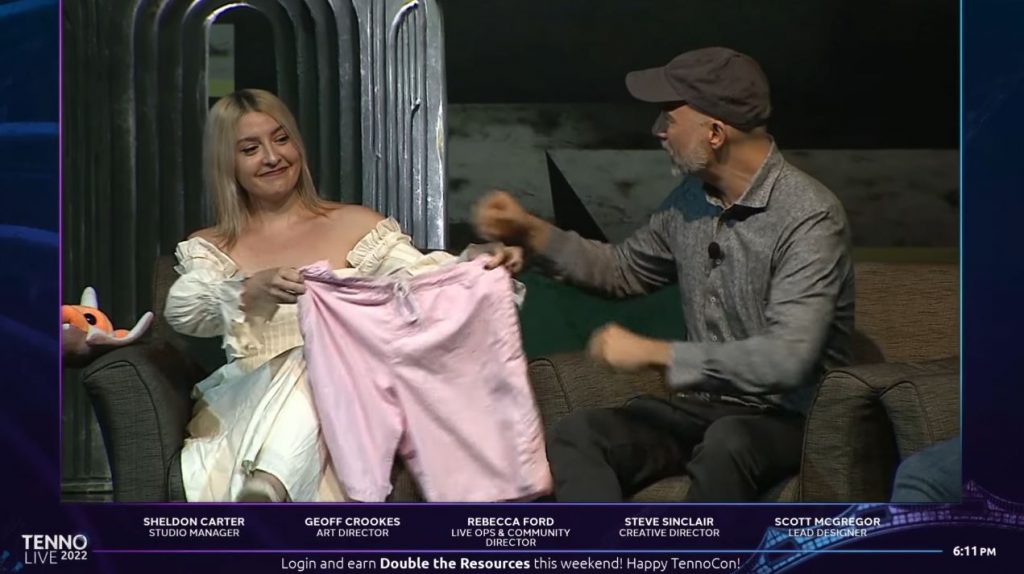
MeinMMO: Thank you, Rebecca, for taking the time for this interview. I was really looking forward to it. Earlier, I rewatched the stream where Steve officially made you the head of Warframe and gave you his pink “leadership shorts,” which are now a meme in your community. What was going through your mind at that moment?
Rebecca Ford: “This moment was one that we orchestrated lightly a day before, wondering how we could do it in a way that felt authentic to us. The pink shorts came into play the day before. We felt the only way to do it right had to be one that felt right for the community. For them, the decision is most important.
The industry is quite complex, and I was afraid that the news would reach people who don’t understand what we’ve been doing with Warframe all this time. I worried about how people would react. Could I withstand doubts and all the things that inevitably come with a leadership change?
Then people embraced it because… I think people who watch TennoCon really know how we’ve operated all these years. My head was spinning, nerves, doubts: Should we take this more seriously? Then it happened, and the outcome only magnified everything I had hoped for. That our community would see the good in the situation and the concerns. We were all on the same wavelength.
I believe my nerves are still settling down. But I’m very excited about what’s coming next.”
The first gaming studio with a product manager from the community sector
MeinMMO: How have the reactions turned out?
Rebecca Ford: Everything I hoped they would be and more. I didn’t expect blind optimism. I didn’t expect an apocalyptic mood. You can’t prevent more controversial opinions, so there’s no reason not to do it.
But all in all, it was a modern decision with the modern game development cycle that we have. Community plays a really important role in live service games, and we are one of the first teams to take someone from the community sector and embed them into the product vision.
The only reason this works for me is that Digital Extremes has believed in the community strongly from the very beginning. It was never a question of how much community involvement there would be. We heavily trust the community team, and [my promotion] is the ultimate proof of that.
Gaming is no longer a purely male hobby
MeinMMO: I was happy when I saw the news, and by the way, I found it funny with the pink shorts. I have been doing this job for six years and have conducted many interviews. And you are the first woman in a leading position for a production of Warframe’s size that I am interviewing today. Generally, there have been very few women I have interviewed in game design, and I usually talk to people in senior positions.
How do you feel when you hear that?
Rebecca Ford: “Not surprised. Under pressure. But also motivated to show that more and more women should take on this kind of responsibility. I can’t say why there are so few women. I can only speculate based on the experiences I’ve read. Some are my own. When I started 10 years ago […], there were so few women, which is still a trend today.
But I believe that the demographics of who plays games are changing. Gaming is no longer a purely male hobby. When I started to build our Twitch presence 10 years ago, we looked into different things. Such as what it means to be a developer studio in live streaming.
Back then, there were no female channels to look to as references. Now it feels like it’s almost equal. That’s obviously just a small metric in a very specific viewer segment in live streaming.
However, I now have more choices on Twitch than just one particular type of gamer. It’s much more diverse now, which is progress in streaming. In development, I hope to see more and more people who I didn’t see 10 years ago.”
Being a nerd girl should be supported
MeinMMO: I know exactly what you mean. I think we are about the same age. I’m 32. When I was in school, I was so lucky to have a girl who also had a passion for nerdy things like games, and we were always the outsiders. Especially as girls who had that hobby. What was that experience like for you?
Rebecca Ford: I had the exact same experience as you. We used to walk to my house during lunch to play Halo. With my first pay, I bought an Xbox 360. I have an older brother who I don’t want to give too much credit to, but a little bit.
I believe that games are the best form of art that can be created as a team. There are many people who can do it alone. Stardew Valley is a good example. So many people should have a chance to create a game like Warframe and know that they can do it.
Things like being a nerdy girl should be supported. It’s so important that all different types of people who come into contact with video games have a chance to be involved in creating a game.
Most of my happiest memories in life come from video games. Be it the N64 with my brother or my first difficult raid in an MMO that I recently did.
All of these things are so formative for the modern tech era. That we can get entertainment from them and not just have an apocalypse around us is such a beautiful bonus.
I’m going in deep right now. You asked me if I was a nerd in high school, and the answer is: Yes, I was.
The answer I’m trying to give is that the video game medium should be enjoyed by all who have access to it.
The more people enjoy it, the more people we get making games, so we can enjoy this hobby for as long as we can. If we limit the medium to just one specific group of people, we will lose something.”
Sexism in the gaming industry: It’s complicated
MeinMMO: The “going deep” part is no problem. I enjoy deep conversations and now I even have a slightly deeper question for you. In recent years, we’ve had an uproar of women in gaming. Many female streamers and developers have shared stories that they don’t feel safe in their work environment.
Why do you think this is still such a problem in the gaming industry?
Rebecca Ford: On one hand, the ratio. It’s a male-dominated industry. It’s complicated. Clearly, no one should go to work and at the end of the day deal with their workload along with the emotional burden of the day. No one should be distracted by romantic this and that. That’s simply unprofessional.
I’m sure there has been trauma in the gaming industry. I believe that the proportions overall relate to the culture and norms that go with it. And how people usually behave in a professional environment has simply not happened.
Because of the culture around it and the marketing in the 80s. This: “Games are for boys, blah blah.” All these factors play into what happens when you walk into the office. That’s a reflection of how one imagines a game studio. People haven’t talked about it because they didn’t feel comfortable, and now people are talking about it, and hopefully, it will improve.
You can believe the studios with their statements that their culture is improving or not. My experience shows a change in this difficult area. I still remember when I had my first experience of feeling like an object. That was at PAX at a consumer event, so a professional event.
That was a very formative event for me, as I was only 20 years old, and that is now a key memory. I want to focus on the feelings that it triggered in me, and… oh, it’s complicated.”
More on the topic of sexism in the gaming industry:
- Sexism in the gaming industry: “I thought it was part of it”
- Former LoL host calls out sexism in gaming live on air
- “What color is your thong?” – Twitch streamer responds perfectly
“I said it could be a problem that I am a woman”
MeinMMO: It’s a super complicated topic, and if we had the perfect answer to this, we wouldn’t have the problem. But as I said earlier, I was very happy that you got the job as Creative Director because for me, it’s a really good sign. It’s a good sign that something is changing. It’s good that more women are getting more visibility.
I believe we are on a path where many good things are happening. What do you think?
Rebecca Ford: I hope it’s a good sign. It’s a sign of skills, vision, and competence when it comes to creating video games. What it takes to lead this process or be directly involved in it. I’m very thankful that Digital Extremes has given me that opportunity.
But in the discussions about it, I’ve also said that it could be a problem that I’m a woman. Do we need a PR preparation [just] because the announcement is happening? Those were all thoughts that went through my mind.
In the end, all of that wasn’t really important. At the end of the day, I know what Warframe is, and I know what the community expects from it. I know why I love the game, and I know what game I want to play. I know the team we have.
And I don’t know if that’s the truth or if I’m undervaluing myself. I probably wouldn’t apply for a Creative Director job elsewhere. […]. Experience is everything, and at Warframe, I have that and am now in this position.
It’s such a unique experience, and I don’t know if I could apply what I’ve learned elsewhere. I hope I’ve built enough knowledge, understanding, and skills in game design that it would be possible. The studio I have now has allowed me to go this path because of the game that means so much to me.
I don’t know what I would do as a Game Director elsewhere. It could be fun, but I don’t even want to imagine it. I want Warframe to be something I can continue to make great with my leadership.”
“Not excluding the community is the reason we exist 10 years later and I am in the position I am in.”
MeinMMO: I understand what you mean. I can assure you that if people haven’t followed Warframe, Digital Extremes, and your career, and you publish such news: Rebecca Ford is now Creative Director, you will have at least one person in the comments saying: There’s the poster woman. You know that, you know the internet.
But you have been with Digital Extremes for 11 years. I looked at your Linked-In before the interview, and you started as an intern. You were there at the launch of Warframe.
What were the key moments in your career that brought you to where you are now?
Rebecca Ford: “I believe it’s the desperation of self-publishing that we went through. Everyone had to figure out together how to make Warframe with the same understanding of live service games.
Earlier, I spoke about modernizing games and community. We had a lot of experience in the team in making games. 11 years ago, we already had people on the team who had been around for 15 years and knew how to make games. They had experienced console life cycles and knew everything about the technology.
All of that was then thrown into an environment where nobody wanted to pay for games. That’s a generalization, of course, I gladly pay for games. But free-to-play is happening, service games are happening, and none of us had experience with that. Because of the lack of experience, I was able to have a common ground with everyone because we all had to figure everything out ourselves.
It’s one thing to have a program that runs and gives you a video game. That’s the art, and all the effort goes into it. The game has to be good. But there are people who need to play it and understand that there is a journey with this product that needs support from the community. Nobody [from us] knew how that worked when you’re racing against time and trying to avoid layoffs because we had no revenue.
We had to figure that out together, and all we had was our mutual assessments of what the game is as a minimal product and what it could be when it works.
When we gave the space to talk about what the game could become, the community was involved from the very beginning. Not excluding the community during these early meetings is the reason we exist 10 years later and I am in the position I am in.
It was a respected part of the development within the team. I’m not quick to be picky. But one thing that has always bothered me in the gaming industry is when it’s said that you shouldn’t treat the community like development teams. They may not write code or scripts.
But we’ve done a lot behind the scenes that we don’t talk about. There’s no reason to defend your legitimacy as a department. Results are what matter to me.”

It’s unrealistic and toxic to expect players to always play Warframe
MeinMMO: Warframe has always been known as a positive example of how community work should function. In your previous role as Community Manager and later Director, you had a significant share in that.
How will this influence your future work as Creative Director?
Rebecca Ford: “I’m still figuring that out. Fortunately, the team is great, and I can focus on the future while others focus on the live challenges.
A game like Warframe has updates in the future, and there’s a live build. I always felt that the community does best when the live build is prioritized based on how to improve the current game and how we let players know where we are headed next.
The live build requires constant attention. Whether it’s crash fixes or quality of life features. But everyone needs to know why what they’re doing matters. That’s why we do dev streams that show where we are headed next and how quickly we’re getting there.
From that has developed TennoCon [fan event], which became the really loud signal of where we are headed next. We have been doing dev streams for 10 years now, which is a long time to show where the path is going.
It works in such a way that people can decide whether they want to go along with the path or choose to step away and be done with Warframe.
The community team will ensure that this cycle continues so that players never have to be in the dark about which direction we’re heading next. […]
Because it’s unrealistic and toxic for one’s soul to expect people to always play Warframe.
We need to create a balance of how the game has a healthy relationship with our updates and not toxic feelings. That’s the hardest part. I could talk forever.”
The longer a game is around, the harder it is
The big challenge of an MMO: Endgame vs. new players
MeinMMO: I think that’s a very MMO-specific point. MMOs are a very special game genre. So I would like to know: What are the biggest challenges of being responsible for an MMO that has been around for so long, and how are you dealing with it in the future of Warframe?
Rebecca Ford: “A pragmatic challenge is creating endgame content while improving the experience for new players. I won’t lie. I enjoy thinking more about what comes after “A New War” and where we are headed. But as a company and a team, we are also responsible for figuring out how to get people to the point of “A New War” and have a good experience along the way.
If someone comes to the game, 8 years of content is their first impression. We might not have enough people who are interested in what happens after “The New War” if they are unimpressed by this appetizer.
For me, the most difficult part is figuring out how to reconcile the reality of working on a game that is a long-standing live service game. We are also looking at how others do it, why they do what they do. I can only speculate. But I can also derive with a certain amount of confidence that, the longer a game is around, the harder it gets to bring players to the endgame.
For me, it’s important that we pay attention to not ignore 8 years of development. But it’s equally important that the team can work on something they enjoy and want to play. And if everyone only worked on the experience for new players, there would be nothing for the people who want what’s next.
That means prioritizing, managing, researching, trends, excitement – all mixed into a cocktail that is burning something down the road, but hopefully will be worth drinking.”
Warframe is afraid that the community might break under growth
The younger Rebecca Ford would cry if she could see herself now
MeinMMO: I could talk to you about this for hours because I find it totally fascinating. But I see that we are almost at the end [of the interview]. I have one question left for you, and I think it’s a nice question. Imagine you could talk to a much younger version of yourself.
Let’s go back to teenage Rebecca. We’ve talked a bit about her today and how she was a nerdy girl and maybe a little lonely in being a nerdy girl. What do you think her reaction would be if she could see you now and hear what your older self has achieved today?
Rebecca Ford: (With tears in her eyes) She would cry because I never thought I would ever do what I’m doing today. I’m just so happy that I never put down the controller. I’m so glad that I… that I never listened to others. You only get one playthrough on this planet, and I’m in the middle of mine. If I ever make a decision that serves another’s happiness, then I’ve made a mistake.
I’m so happy, and I hope this little space we created with Warframe is nice enough that all the shit that happens … that we can prove it doesn’t have to be that way. It works with trust and a long-term mutual belief that happiness can be found in video games. And if we’ve done that, others can too.
Don’t stop. Never put the controller down and maybe take the keyboard and mouse because PC gaming is fun too.
MeinMMO: Thank you for a beautiful answer. Now I almost started to cry myself.