
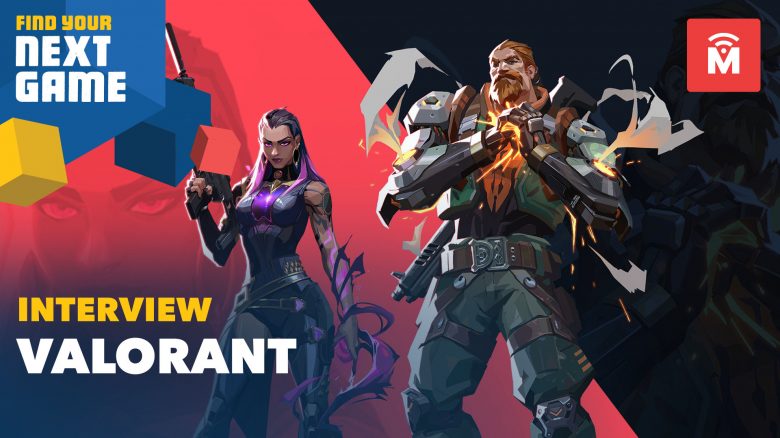
Valorant celebrates its release today, June 2nd. MeinMMO editor Leya Jankowski conducted an interview with Game Director Joe Ziegler for this occasion. Find out here what the developers learned during the beta and what the future holds for Valorant.
Valorant is officially released today. The release was at 7:00 AM. When Riot offered us at MeinMMO an interview for the release, I did not hesitate. The shooter turned the ecosystem of the streaming platform Twitch completely upside down. Something happened that could be groundbreaking for the future of streaming and gaming.
As we learned from the official press release about the launch, Valorant broke viewer records on the very first day. Over 1.7 million concurrent viewers watched streams for a total of 34 million hours, only surpassed by the League of Legends World Championship finals in 2019. A world record.
Riot originally just wanted to showcase Valorant but accidentally broke records
When I started the video call with Joe, a lively man greeted me on the screen with a broad smile. Was the adrenaline noticeable in the Game Director due to the upcoming release of the team shooter?
Riot’s strategy to exclusively distribute beta keys for the game on Twitch was a brilliant marketing move. Therefore, my first questions revolved around how Riot experienced this beta phase on Twitch.
MeinMMO: Valorant had almost a million viewers on Twitch right on the first day of the beta. Did you expect these numbers or was it a surprise for you?
Joe Ziegler: “We definitely did not expect these numbers. To be honest, we surpassed our own predictions of how many people would actually show up. Our goal was really just to let people see our game before the release. That was actually our only goal. We knew we had a competitive FPS game, but we did not know how many people would really want to play it. It was important to us that people saw Valorant first before diving in. It’s a hard game to grasp. Our goal was that people would watch it long enough before making the decision whether to play it or not – before they had access to it and downloaded the game. But we did not expect such a large audience to show up in the end. Both from the viewers and those who engaged in the game. That was definitely a surprise for us.”
MeinMMO: I actually expected it to be very successful and set record numbers. But I did not expect the million viewers. Now the numbers on Twitch are going back, which is normal and to be expected after the initial hype. How many players from the “first wave” do you think are still around?
Joe Ziegler: “I won’t disclose numbers about our retention matrix [the number of players who come back at a later time]. But we have very strong retention, exceeding our expectations. We had just under 3 million daily active users, even in the beta, where access was limited. That was far more than we initially thought. We had to scale up to accommodate everyone. Unfortunately, we couldn’t do that in some areas. It was really a surprise.”
MeinMMO: With streamers like Summit1g [Anomaly and Myth], you have a total of 3 of the top streamers on Twitch showcasing Valorant. Can you give us some insight into how you select streamers?
Joe Ziegler: “First, we looked at which streamers already played similar games to Valorant, who were engaged with us and could explain it well to their followers. We reviewed a large number of streamers active in team shooter games. Then we sought out. And the more people who came on board, the more other streamers approached us asking if they could join as well. Hence, we ended up with a larger group than we initially planned.”
This is how Riot experienced the “Twitch Drop Drama”
Although the server structures suffered under the influx of beta players, overall, it was a good thing for Riot. However, skepticism spread among players about distributing beta keys exclusively on Twitch. Riot was accused of paying streamers to gain a significant advantage here. This was not the case during the beta. Individual streamers also benefited significantly from the demand for beta keys.
MeinMMO: Due to your strategy of linking the distribution of beta keys exclusively to Twitch Drops, some players stayed 24/7 on Twitch and streamed pre-recorded content instead of being live. Valorant has been criticized for not attracting this level of attention without the Twitch Drops. What are your thoughts on this? Are you aware that you effectively destroyed Twitch with your game?
With a hearty laugh, Joe replied: “I don’t think it was our intention to destroy Twitch. As I mentioned before, one of our main goals was to let people see our game and perhaps later want to play it. Once you see it, you know what to expect. The problem was really the scale at which we set up the closed beta. It did not support the massive influx we had. We completely underestimated the interest when we started the game. We didn’t necessarily expect interest from LoL players. We thought we would primarily attract shooter fans and retain some of their interest.
In the end, however, a lot of players who wanted to see the game then wanted to play it themselves came. This created a large number of viewers who also wanted to get into the game. It was not our intention to enable such massive numbers in this way [the Twitch Drops]. We really just wanted players to see the game before they played it. Twitch was a great partner that made this possible for us. We would have liked to do it on YouTube as well, but they didn’t have a good system we could link into to distribute keys. That was quite complicated. In Korea, we even had two streaming platforms because the other one worked similarly. We really wanted to engage multiple platforms, but Twitch ended up being the one that just worked.”
MeinMMO: Twitch reacted to the “Twitch Drop Drama.” They changed the guidelines to prevent pre-recorded streaming. Did you communicate with Twitch on this, or did they decide that on their own?
Joe Ziegler: “We were made aware of the problem through feedback from the streamer community. Many streamers were frustrated by 24-hour Valorant Drops. That was actually unfair. Because we were about exchange, getting people to talk about the game and engage with it. The [24-hour streamers] weren’t providing that. We talked to Twitch, who agreed with us. They said they would change the guidelines to make it fairer so that people could achieve success through engagement rather than passivity.”
Twitch integration is becoming increasingly important for social games to build a community
In my conversations with developers, I notice that streaming is playing an increasingly important role in development. Streamers are being consulted more frequently in the early phases of development. The streamers are expected to make predictions about whether the games might succeed on Twitch and what Twitch integrations the game needs. Amazon’s upcoming open-world MMO New World, for instance, aims to come with Twitch features at launch.
MeinMMO: This is a very interesting development overall. You could become trendsetters for other developers. I know that others are also considering Twitch integration. Do you think developers will need to think about streaming early in the development stages in the future?
Joe Ziegler: “I think the more important question is that one understands how communities receive new content. That’s the key when making a game that requires social interaction. If you are making a single-player game, it’s not as important to think about Twitch. But if you are making a game that relies on a community, like a multiplayer game, an MMO, or something requiring social interaction, you need to think about how people interact and how they are currently receiving content. Twitch is currently prominent in this. Developers are definitely considering how to interact with Twitch. That’s where the communities are, that’s where the community leaders are. They talk to each other, it goes back and forth. They have common interests.
If you have a specific favorite person, you might also like the games that person likes. There’s a high chance that you’ll also enjoy games that are similar. But you have to approach streamers with sensitivity. If you try to recruit all streamers for your game, but it’s not a game that they would enjoy, you won’t get much community interaction and engagement. You really need to study how communities handle their interests and align your strategy accordingly. We can’t say which social platforms will be relevant for building such communities in the future, but the challenge will be to build communities where they feel at home, without tearing them apart or pulling them out of their comfort zone. It’s important to talk to them in a language they understand.”
When I look at how often and how quickly we communicate with our players, this can also have different effects. An example: I was surprised by how little shooter developers communicate with their players while developing Valorant. I come from LoL; I am used to talking to players frequently. I was genuinely surprised that this doesn’t happen much in shooters. That’s something we can improve to break player expectations positively.”
MeinMMO: Where do you think that comes from?
Joe Ziegler: “I’m not exactly sure. I think it’s due to the fear we have about such scenarios. If you are always afraid of how your players will react and don’t want to have that kind of conversation, you’re probably just going to avoid saying anything and hope it all passes eventually. But by doing this, you won’t get any feedback and you don’t understand what players have to say about your game. As developers, you need to be close to your community and respond to them. The competition among the different games boils down to how badly you want your game to be played, but also how you develop yourself and the game. Because players are constantly changing – their needs change. As developers, it’s our greatest responsibility to respond quickly to those needs, to be ahead of the curve in development, and to push the game in the right direction continuously.”
In the beta, Riot learned the most about rankings and how complicated they are
MeinMMO: We just talked about surprises. Was there a feature in the beta where the players’ reaction surprised you?
Joe Ziegler: “Let me think for a second; that’s a really good question. I’ll tell you something that did not go down well. Or better said, it did not go as we planned. That was with the agent Raze, who came in at the start of the beta. What’s funny is: Raze is one of the characters that we’ve had in the game the longest internally. We were probably all blind to her abilities and how to play against her. That’s when we realized how disruptive the introduction of a new character can be and what we can expect in the future with such actions. How we can tune the character so the learning process is smooth and does not disturb the game excessively. And if necessary further tone it down when it gets too crazy.
But the most we learned was from ranked play. Rankings are just a very complicated subject. Different companies and games have very different philosophies on how to do rankings. For us, ranked play is supposed to be a system that is fair for small groups and individual players but does not penalize larger groups. Usually, that’s when one of the two groups is unintentionally punished. In League of Legends, for example, there are solo and flex queues. But larger groups find it difficult to come together there. That’s due to the way those queues work. You feel penalized because the system clearly favors smaller groups. We will keep an eye on the ecosystem in ranked play and make adjustments. However, we do not want to get into a deadlock by clearly stating that we are a team shooter and therefore prefer groups.”

In 5 years, Valorant should establish itself globally as a highly competitive sports shooter
MeinMMO: Finally, I’ll ask you a question that I personally actually hate: “Where do you see yourself in 5 years?” But I’ll ask this in relation to Valorant. What is your vision for Valorant in 5 years? What is your dream?
Joe Ziegler: “This dream has multiple parts. One is that Valorant becomes a kind of global sports presence. Not necessarily esports, but simply as a global competitive shooter with a strong community that springs from it. Where players from Korea, Germany, and the USA meet and exchange ideas together. Where they compete with each other and learn from one another. That sounds like a wonderful future to me. We really want to be uncompromisingly global with the game. We want everyone to bring their unique presence to the table and create a global community within this game. That’s my dream, but we’re not there yet; there are still regions we haven’t reached and some places that are still developing. But we want to get there. We genuinely want this global experience.
The second part [of the dream] is how we expand the core of competitive play and establish a platform of experiences that we continuously augment with new experiences. That sounds vague now, but we want to build an ecosystem of experiences that support each other or attract new audiences. That’s a long-term goal, and we’re not exactly sure how to implement it. But it feels like something that would be simply wonderful.”
MeinMMO: Okay, then maybe one last question: How do you plan to work towards this dream?
Joe Ziegler: “A great question. I think it boils down to banging your head against the wall until it works. It is really hard work and persistence. We usually envision a rough shape and work our way towards it. Over time, it takes more concrete forms. However, we do not want to be rigid in long-term planning. We also have to keep observing the player base, what opportunities arise. That all comes from the players. Their feedback and listening to them and seeing how they interact with our games and those of the competition.
It’s important to understand the players and to consider our experiences as players. Because even though I have an incredibly stressful full-time job, I spend almost all my free time with games. [Laughs] I think all of these things combined will help us realize our ideas in the future. It’s also great that we work at Riot, as Riot is really good at building on such long-term experiences and expanding our game so that we can achieve our goals. And oh yes, also the partnerships with many different groups have certainly played a part in the success. All of these things together are a big machine that really has a focus.”
MeinMMO: Thank you for the conversation and good luck with the launch of the game.
Hit Potential: Promising
In my conversation, I experienced Game Director Joe Ziegler as a reflective and analytical developer. Riot gives the impression that they have developed a roadmap that, while targeting a fixed goal, still leaves room for spontaneous detours.
Valorant has already made significant waves during the beta, also thanks to an intelligent integration of Twitch and its communities. During the pandemic, there is hardly anything fresh on the market. Valorant is now available, free, and has low demands on PC hardware – the barriers to testing it are low. Riot has proven through League of Legends that they know how to show long-term endurance and let a game grow organically. Valorant was largely well-received in the beta. Whether long-term motivation can be maintained remains to be seen.
Leya Jankowski
Brand Manager | Part of the Editorial Team

Your opinion is important to us!
Do you like the article? Then let us know!