

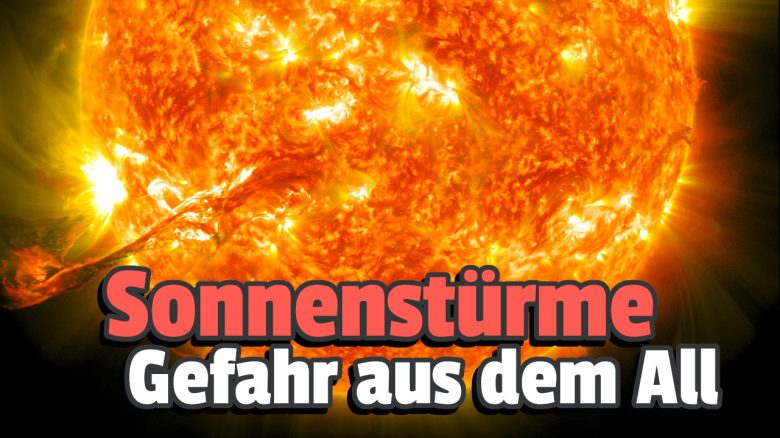
The sun is far more than just a provider of light. It can also pose immense danger to our society. What is space weather and how does it affect our planet and everyday technology? We explain it to you.
What are solar storms? They are energetic events of immense power that plunge into Earth’s orbit. In 2024, we were hit by a solar storm that was expelled into space from a connected network of sunspots (AR 3664). But in 1859, it was much worse:
Back then, during the so-called Carrington event (named after the astronomer who described it), telegraph lines worldwide caught fire, northern lights (also called auroras) were visible far into lower latitudes, and technicians suffered burns.
In 2024, the damages were less severe, but the range of possible consequences includes GPS disruptions or even complete outages of navigation services, damage to power grids, and even a collapse of the internet.
One thing is clear: space weather is a danger. Let’s delve deeper into plasma and radiation storms: What exactly are they and what chaos can they cause?
Meanwhile, the sun, in its various forms, also plays a prominent role in Star Citizen. Here is the continually impressive trailer for the story campaign Squadron 42 for you. Anyone who likes science fiction should at least take a look at the combined MMO single-player experience.
Once again, we got away with it lightly, didn’t we?
What happened in 2024? From the sunspot group named AR 3664 (via Austria Presse Agentur), large amounts of material and radiation escaped. A similar event occurred in 1859.
However, the damages were limited; there were widespread disruptions to satellites and other radio-dependent systems. The GPS was disrupted for a while or at least far less accurate than usual, which hindered commercial uses, including agriculture.
Furthermore, satellites were thrown off course due to changes in atmospheric drag (warming and expansion of the atmosphere), which is now being corrected.
Is that all? It’s harmless, right? The reason why we came through relatively unscathed this time, despite a multitude of electrically powered technology in orbit, atmosphere, and on the ground, is still being investigated by science. But in general, our standards for protecting networks today are much higher than in the days of telegraph lines. This also helps against specific events like solar storms.
Solar storms can cause chaos
Goodbye Internet? It could have theoretically turned out badly. Permanent damage to satellites or electrical systems can have serious everyday consequences (via Astronomy.com). Aside from widespread power outages for hours or even days due to burnt-out transformers, communication could collapse.
Because not only radio or GPS signals can be interrupted. Even undersea cables are susceptible to induced currents, which would disrupt connections between servers.
The consequences of historical solar storms are listed in this slide from the German Aerospace Center (DLR) for Solar-Terrestrial Physics.

What can we do for protection? Varies depending on the area. For example, NASA secured the instruments of the “Chandra” X-ray observatory of the U.S. space agency in recent days to literally take them out of the firing line.
But in general, solar storms and their effects remain a research field of great importance. In any case, continuous observation is essential, as this is the only way to warn services dependent on satellite technology in time.
What is space weather?
Space weather is simply everything that happens with the atmosphere and the magnetic field of the Earth when the sun or other cosmic sources interact with it. The main field of this interaction is the ionosphere. Since 1994, solar-terrestrial processes have been referred to as space weather.
Sunspots: Every eleven years, our sun goes through a cycle at the end of which its magnetic field flips. At the end of 2024, solar maximum is again expected, during which sunspots are most numerous. They represent cooler regions from which the sun expels more material and emits radiation.
Auroras: A significant consequence of solar storms can be auroras, also known as northern lights. They occur when solar material interacts with the upper atmosphere of the Earth. They predominantly occur in higher latitudes but can also appear significantly farther south, for example, over Germany during more intense events.
You can get a deeper overview of everything discussed here in this presentation by a scientist from the DLR for Solar-Terrestrial Physics:
What weather situations are there?
- Radiation and solar wind: Both are always present. The sun constantly distributes enormous amounts of radiation (including visible light) and charged particles, the solar wind. Our magnetic field protects us reliably from this.
- Radiation takes about eight minutes for the journey.
- The charged particles (plasma clouds) take about three days during quiet space weather.
- Solar flares: Strong increase in short-wavelength, high-energy radiation. It is simply higher-energy light than usual.
- Solar storm, also called coronal mass ejection: Dramatically intensified and also faster solar wind, which is why there is often only about one day of forecast time. These plasma clouds can be devastating. The Carrington event described at the beginning and what AR 3664 produced were solar storms.


By the way, the next cosmic victim could be Mars. As the sun has turned further, the sunspot group AR 3664 is now aimed at our red brother planet. Anyone interested in an interesting building game on Mars should take a look at Terraformers.
Currently, the title is even on sale for around ten euros on Steam. There you will take turns to build a colony to ensure the long-term survival and eventual prosperity of the new community on the mostly dead planet. Skilled resource management is essential for this.

Your opinion is important to us!
Do you like the article? Then let us know!