

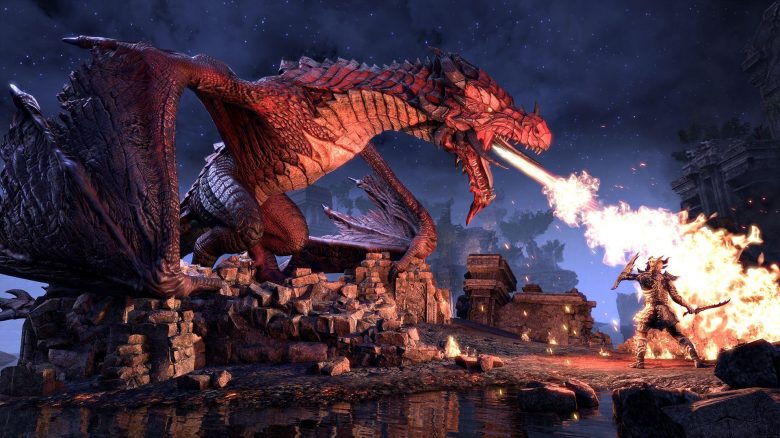
The MMORPG Elder Scrolls: Online is the first game to implement Nvidia’s new technology “Deep Learning Anti-Aliasing.” But what exactly is DLAA? MeinMMO explains Nvidia’s new technique.
The MMORPG is not only getting new content with the upcoming Update 32, but also technical improvements.
The technical improvements include DLSS and DLAA. Both are technologies from Nvidia that you can use with RTX graphics cards. Owners of AMD graphics cards are excluded from this.
The lead Graphics Engineer of Zenimax Online explained on Twitter that ESO will be enhanced with two new techniques from Nvidia:
Furthermore, the new features were presented in more detail during a livestream on Twitch (via twitch.tv). But what is DLAA anyway, and what does it bring to users who will play ESO on PC in the future? MeinMMO introduces you to the technology and its benefits.
DLAA makes graphics nicer with artificial intelligence
What is DLAA? Deep Learning Anti-Aliasing or DLAA is based on artificial intelligence, just like Nvidia’s DLSS.
DLSS scales low resolutions up to high resolutions like 4K, thus saving performance. This allows you to play at higher resolutions while maintaining a stable frame rate. However, the image quality may suffer somewhat depending on the DLSS level.
In contrast to DLSS, DLAA does not deal with scaling resolutions, but rather focuses on anti-aliasing. The anti-aliasing is handled by the AI, and performance improves.
Who benefits from this? Both DLAA and DLSS aim to improve performance (higher FPS) without needing better hardware. This should especially please users with an Nvidia graphics card who do not want to spend thousands of euros for a graphics card on eBay.
However, owners of an AMD graphics card won’t benefit from this since Nvidia’s technology only works with RTX graphics cards. This is because they rely on so-called Tensor cores that are responsible for the calculations. AMD has at least introduced AMD’S FidelityFX Super Resolution as a DLSS alternative by now.
Anti-aliasing requires a lot of performance, DLAA is supposed to need less
What does anti-aliasing actually bring? Simply put, anti-aliasing smoothes the transitions between objects in the game. This makes the game appear more realistic and less blocky.
The downside is that anti-aliasing requires a lot of performance. The higher you set the level, the more powerful the anti-aliasing is, and the more your hardware is taxed.
With DLAA, Nvidia now attempts to improve image quality and soften the jagged edges in the game with the help of AI without requiring much additional performance.
Especially in combination with DLSS, this could get really exciting, since image quality often suffers with DLSS activated. With DLAA, the quality can now improve again.
Can you already try this out? Yes, you can already try both DLSS and DLAA on the official test server of Elder Scrolls Online.
How good is the DLAA technology? In a YouTube video, you can see the difference between “true” anti-aliasing and AI-driven anti-aliasing – if you notice a difference at all. The frame rate is significantly better with DLAA, and the shadows look a bit better with DLAA.
However, the image with DLAA appears a bit blurrier. The frame rate with DLAA is slightly to significantly better (10-15 FPS). The user conducts the test with a GeForce RTX 3080.
Alongside new graphics technology, Update 32 brings many other improvements
In addition to graphical improvements, there will also be new content for ESO. The developers have now introduced the new area Deadlands.
Additionally, a sought-after feature with Update 32 is coming, which many players have been waiting for. This feature is called “Armory Assistants”: Here you can save character builds and change them at any time with the press of a button. This is especially interesting for users who want or need to switch their set quickly in boss fights.
Are you looking forward to the upcoming Update 32 and all the new content? Tell us in the comments and discuss with other users!

Your opinion is important to us!
Do you like the article? Then let us know!