Frostpunk is one of the best games on Steam overall and an absolute hit in the building survival genre. The developers have now released the second part, and MeinMMO editor Benedict Grothaus was allowed to play it in advance. After a series of tough decisions, he has reached the end of the campaign and is reevaluating his moral beliefs.
I am totally into dark games. Games with a grim setting. Dystopias where everything is really broken. The end of the world, the struggle for survival, and the stubbornness not to give up – I particularly like that in games.
Frostpunk 2 falls precisely into my category. Here, the entire world has frozen in the 19th century to industrialization, and the few remaining people are fighting against the ice for their survival. Even the trailer is stressful and just to my taste.
Even Frostpunk is among the best survival games out there and impresses with hard decisions. But with the sequel, I was truly shocked by the extent of my actions.
In survival games, survival is always my top priority, and I am willing to take harsh measures for that. But how these develop in Frostpunk 2 and eventually completely escalate, I did not expect.
Frostpunk 2 will be released on September 20 for PC, Xbox, and PS5 and already in early access from September 17:
Frostpunk 2 is the next level in the building sector
Frostpunk 2 asks the question: What do we actually do after the apocalypse, after we have survived? This thought is further developed here. It’s no longer just about mere survival, but about rebuilding a society.
At its core, Frostpunk 2 is a building survival game. The genre has been thriving for years, with now well-known titles like Banished – or Frostpunk – and hidden gems like Against the Storm established.
But instead of fighting with individual buildings over production and survival, you build entire districts and have the lives of thousands of people in your hands. And to secure the future, sometimes harsh decisions must be made:
- Should children go to school or must they work?
- Should we try to keep food as healthy as possible, or do we add chemicals to supply more people, risking that they will get sick?
- Should we care for the old, unproductive people – or grant them their wish to go to the eternal ice and no longer burden society?
- And in general, what about the dead? Should families bury them, or do we need the bodies to make fertilizer out of them?
Many of these decisions have repercussions hours later. If the old are gone, the young lack stories and entirely new ideals emerge. And this is where Frostpunk 2 becomes really exciting: How do people behave and develop?
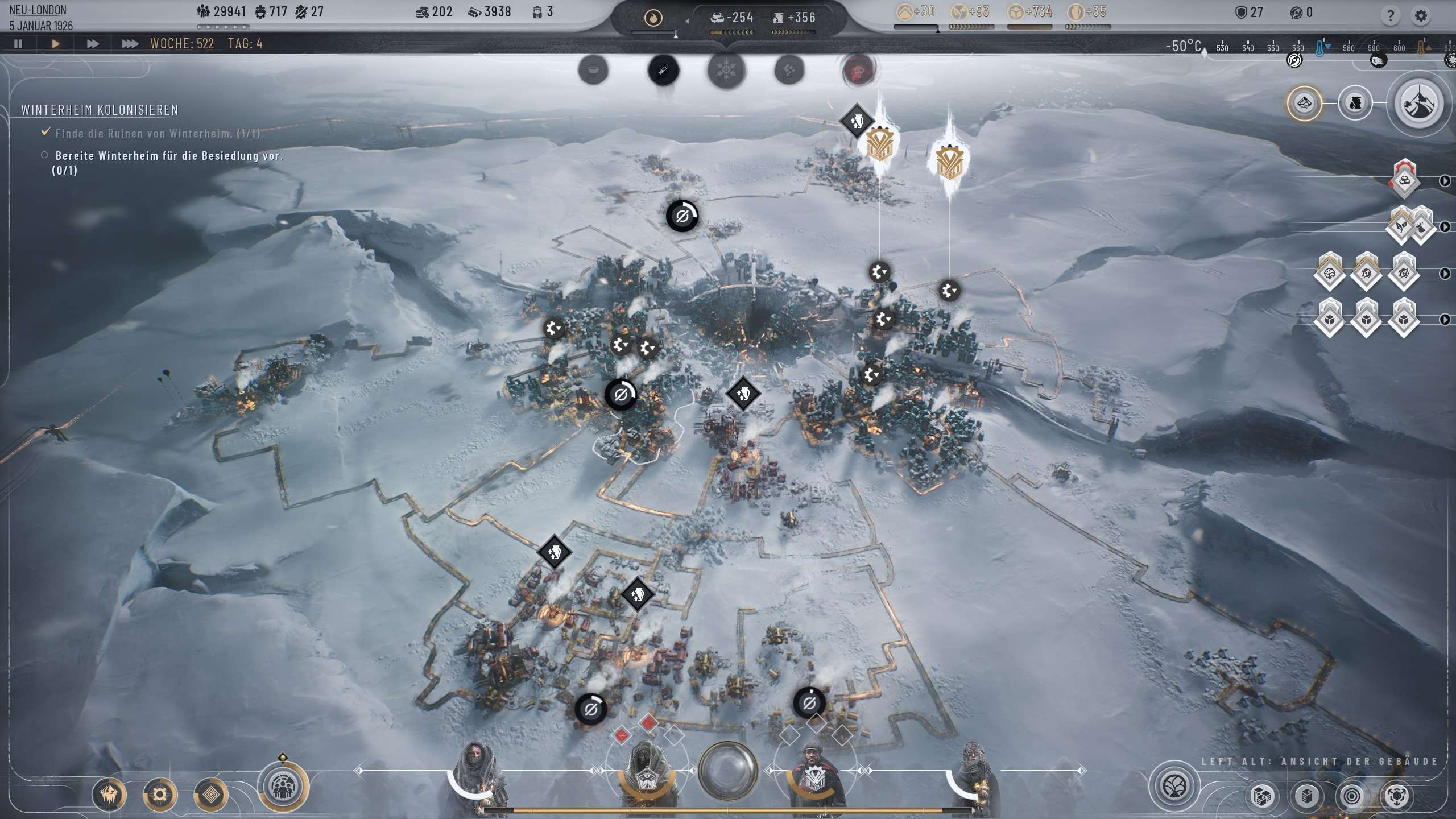
What does a society look like after the end of the world?
Your people in Frostpunk 2 are not simply a uniform mass, but groups that have specific ideas of a perfect society. There are various social ideals, such as:
- Progress or adaptation, how do we deal with the environment?
- Equality or merit, what is the status of the individual?
- Reason or tradition, what values does society represent?
Communities and factions then appear in the city, which have a strong opinion on one or more of these ideals. Lords, for example, follow tradition, while the pioneers emerging from them are interested in progress, merit, and reason.
In my game, enforcers who stand for old values confront pilgrims who believe: Those who want to survive in the ice must adapt to the ice. Most decisions, research, and laws please one faction and displease the other.
My idea was to fulfill the dream of the pilgrims. People should be equal, find their way in the ice, and be able to live anywhere without fear of the cold. So I supported them while trying not to throw too many obstacles in the way of the enforcers. That really backfired…



From tough survival professionals to fanatical drug junkies
The further I progressed in the game, the greater the divide between the factions grew. At some point, there were assaults and even murder of a council member of the pilgrims – the ones who had been advising me well until then and from whom I owe many advantages for the city.
When I was then faced with the decision to establish a new city, I decided to send the enforcers there entirely. Until then, there had been a good balance in the city – from there, everything went wrong:
The city turns out to be a valley full of poison gas, where people die slowly and painfully – which the pilgrims surely knew when they suggested sending the guardians there.
At the same time, the pilgrims in the capital started burning heating oil with herbs in gas masks and getting high with it to convert people with “visions”.
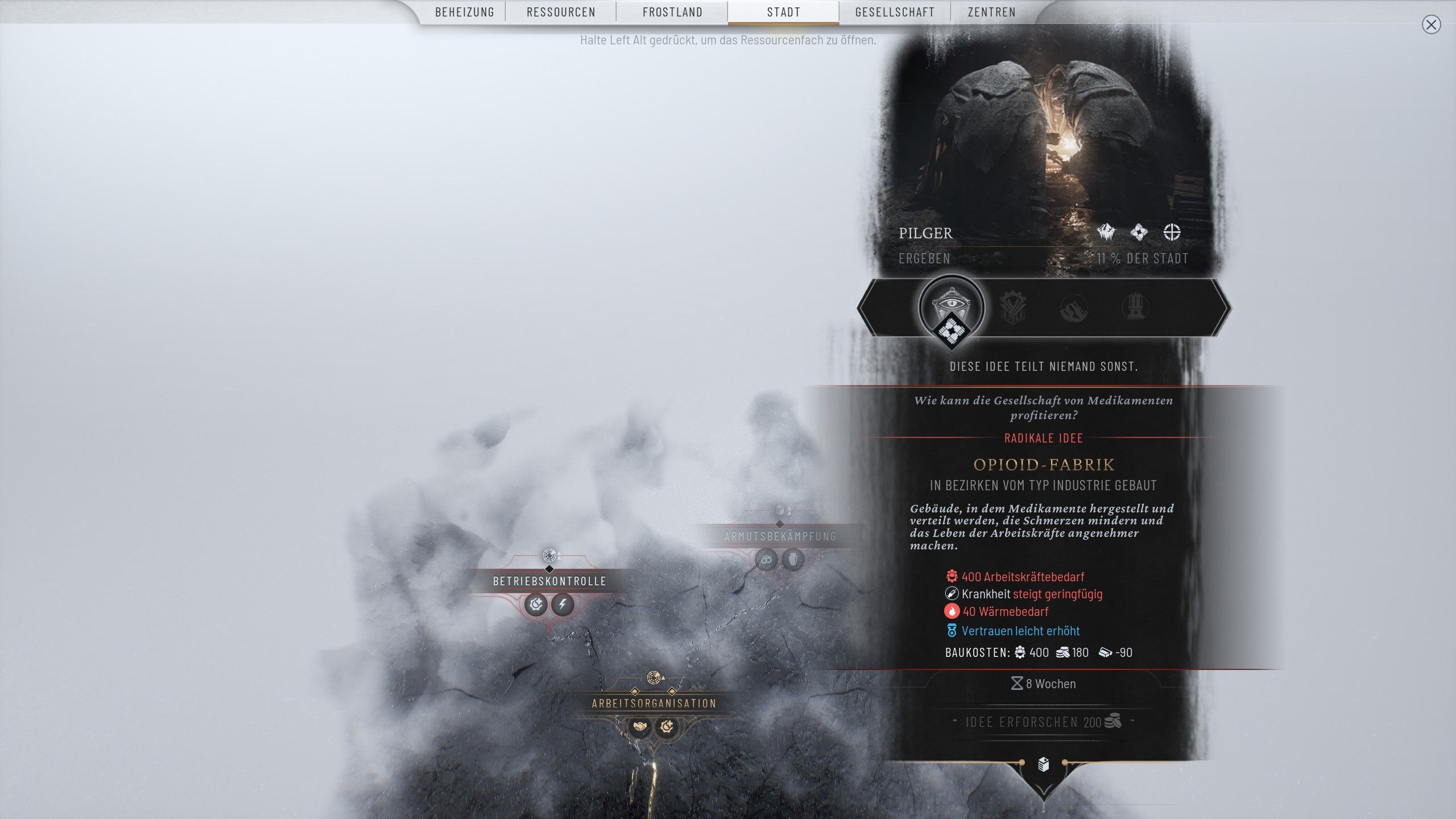
At that point, I could only mitigate the damage. I saved the guardians from death, triggering a civil war. I increasingly realized that I had become a victim of a plot by the pilgrims – by damned NPCs!
After a hard-won ceasefire, I was then able to choose one of three options for how to proceed:
- I could send the enforcers into the ice and thus execute them very directly – as “punishment” for instigating the civil war.
- Alternatively, I could try to achieve an agreement between the two factions. The game is already warning me: This will be difficult.
- Or … I can declare myself captain, that is, the sole ruler. Here too, the game says it will be hard. Nevertheless, I choose that.
After the pilgrims betrayed me and the enforcers showed such stubbornness, I wanted to leave neither faction with any power anymore. Thus, my utopia, in which everyone is equal, became a dictatorship in which I alone decide what people like and what they do not.
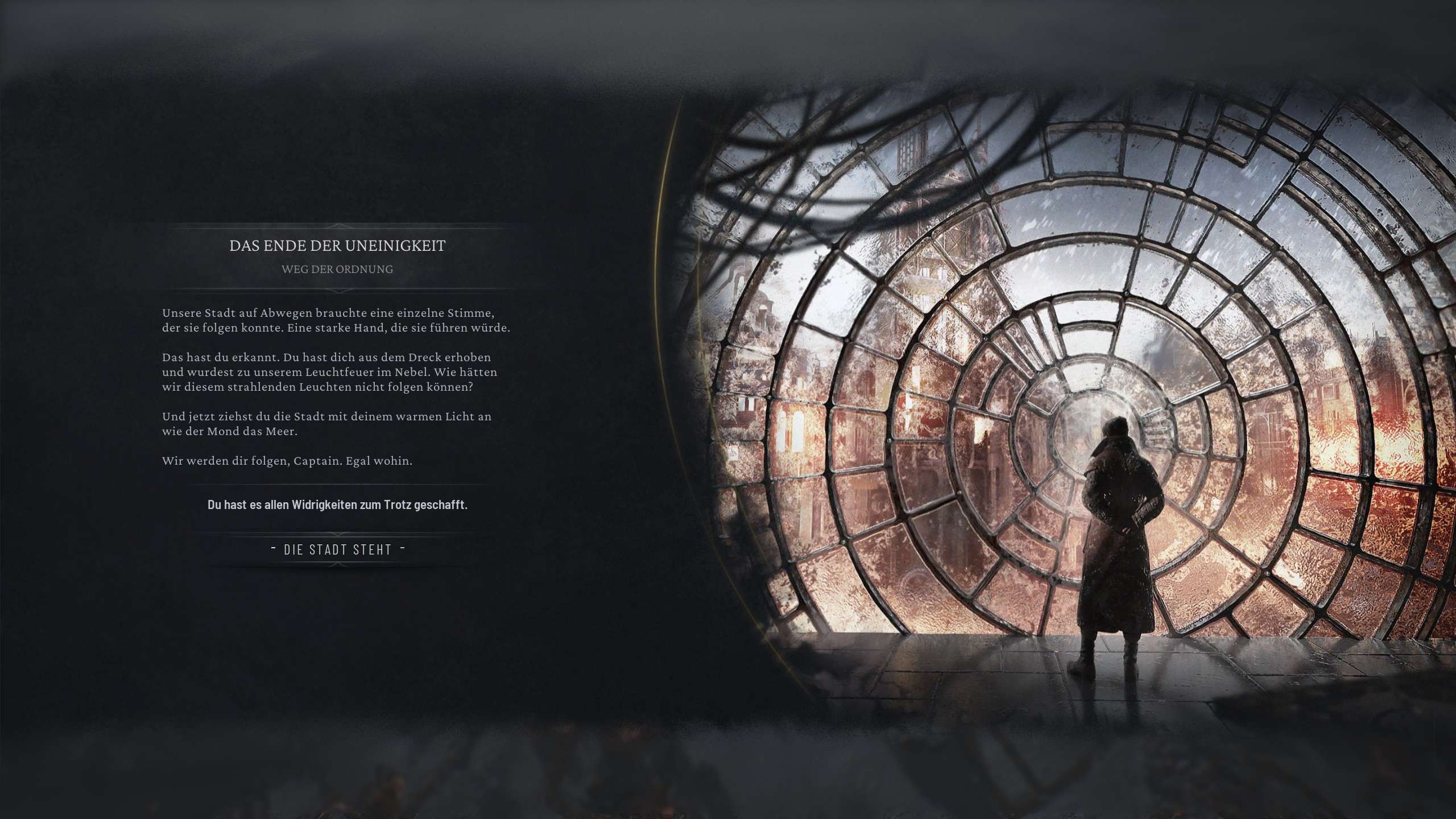
A harsh ending – And I want more
All of this sounds more like a role-playing game than a building game, and indeed, Frostpunk 2 has a few parallels. And because there are even more factions and communities, the game has a great replayability.
In the “Utopia” mode, there are fewer goals and, upon request, random factions, providing new possibilities and experiences. At the moment, I’m in my second (and much harder) run there.
What is really fascinating about Frostpunk 2 is the connection of building, survival, and tough decisions. The Polish developers, 11 bit studios, are real experts in depressing scenarios. They are behind titles like This War of Mine.
For me, Frostpunk 2 is the next step for the genre. No longer just surviving, but shaping the future with tough decisions. Definitely an excellent game for experts – for beginners, I am not so sure: I played Frostpunk 2 as a strategy amateur, failed, and got tips from the lead developer