
On Thursday evening, MeinMMO strategy expert Schuhmann discovered the new game Ara: History Untold on Steam. He spent 3 days with the overly complex mix of city-building simulation and 4X game and says: “I am obsessed with the game, but I can’t recommend it to anyone.”
This is what people thought about Ara: History Untold:
The marketing for the game sounds like “Civilization, but with better graphics.”
Ara: History Untold has been described as a “Civ killer.” It was rumored that Microsoft invested a lot of money in a team of developers who worked on Civilization 5 to challenge the industry leader Firaxis with their Civilization 7, which is set to release in February 2025.
The high production quality of the game has been praised repeatedly, how great Ara: History Untold looks at the highest zoom level, and how vibrant the world is.
Ara: History Untold went live on September 24 for a shocking 60 to 80 € on Steam. Most people will probably play it through the Xbox Game Pass.
City Building with Absurdly Complex Crafting System
What is Ara: History Untold really? The game has great graphics, but that doesn’t really matter to me. Who scrolls deep into such a game to lose track of the map and not even see that the damn French are planning a major attack? Only strategy noobs do that, I say!
Ara: History Untold is a city-building simulation with a pronounced, absurdly complex crafting system, featuring dozens of nested and parallel production chains, paired with a rudimentary combat system.
Especially silly: Units can never be upgraded in Ara: History Untold. So if a troop survives, you will eventually have to disband them yourself, because spearmen just don’t hit hard against tanks. In any case, the combat system is a weak point of the game; you simply build “doomstacks,” meaning as many strong units as possible into a heap and roll over everything.
The strengths of the game, but also its pitfall, clearly lie in city building and the crafting system. In Ara: History Untold, you start with one city, quickly expand to 3, and then work your way up to a maximum of 10 cities in the midgame.
The Most Important Factor for a City: Location, Location, Location
Each individual city needs a lot of space, as it continuously expands. Essentially, you only have to wage war against other nations to make room for your cities by tearing down competing cities that are too close or by assimilating a particularly attractive city of the opponent.
Because cities need space. But each city also requires a lot of attention and love from the player.
To illustrate how absurdly complex all this is – a workshop in Ara: History Untold:
- Has 3 upgrade levels
- Has 4 slots where you can add different items to optimize the workshop
- Starts with 3 items it can produce (plow, tool, rope), but this expands to more than 20 producible items by the end of the game. Because in the factory, the third upgrade level, PCs will be produced as well.
- Every product you can manufacture has multiple slots where you can add different resources to boost production: The resources are either concrete trade goods, like tallow to produce a candle, or you can place abstract things like “material, wood, or gold” in the slot.
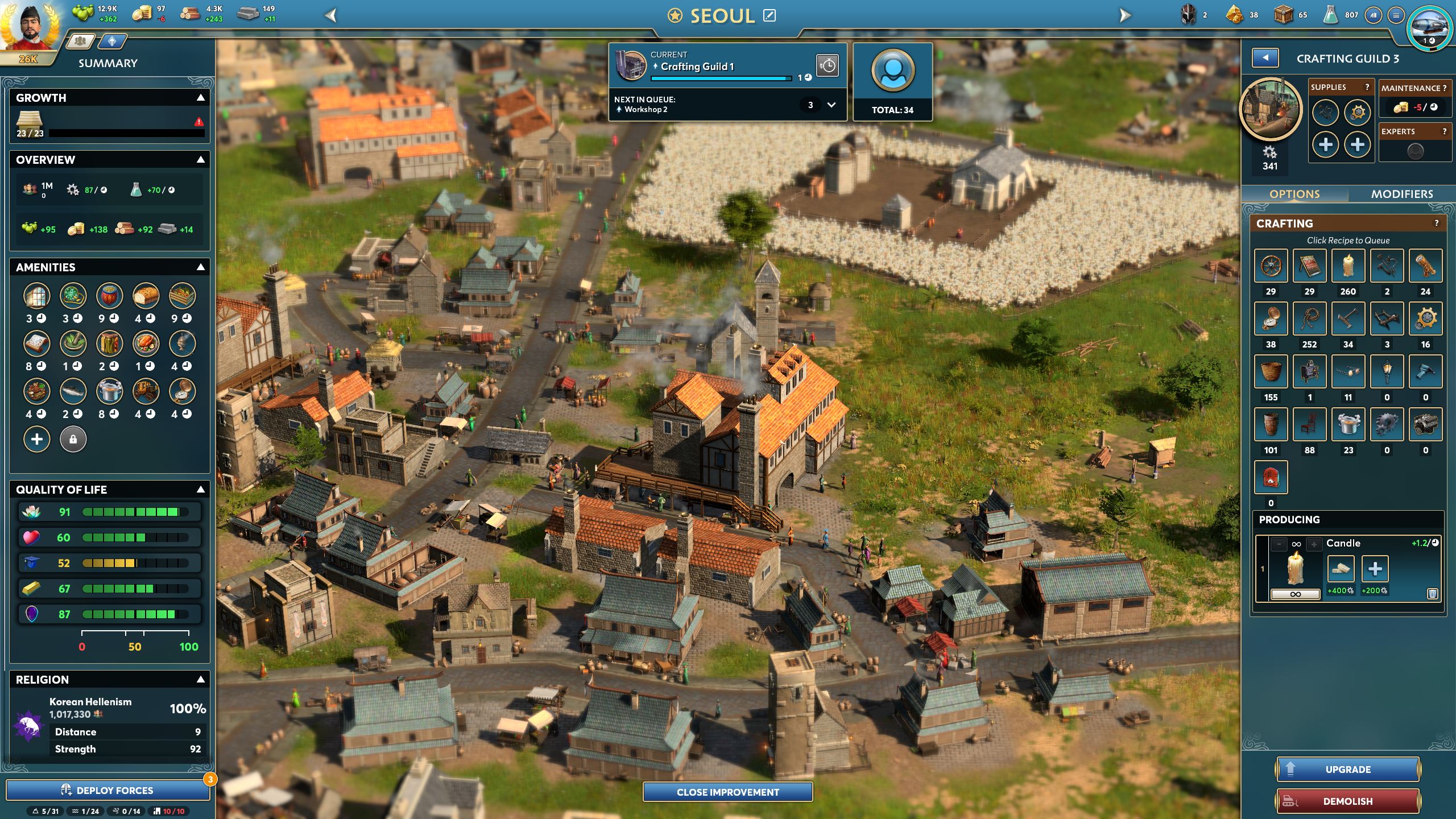
And there are dozens of interwoven production chains. We are talking about around 40 resources, about 70 end products, and still dozens of different supplies to supply your cities.
What’s good about it? The game is incredibly complex, and it is – at least for me – incredibly fun to optimize the economic cycles and cities and figure out exactly how the systems work. Because Ara: History Untold explains itself quite poorly:
- What resources do I need for a city to grow optimally?
- Should I turn the fish I catch into food, or should I use the resource “fish,” or do I currently need salt? How can I use them?
- Is it worth converting a quarter of my city into a chemistry factory so I can finally produce fertilizer?
- Where do I get flowers to build the wonder “The Hanging Gardens”?
Ara: History Untold offers a lot in this micromanagement and attracts with a satisfying learning curve when you find out, for example, that you need to “specialize” the regions or that it is advantageous to build houses or the palace in a specific quarter, in the city center. You get better at the game with each hour, understanding more.
The GameStar tested the game:
Ara: History Untold is a challenge with comfort features
This is the problem: The game is really outrageous in what it expects from the player and what it demands from them.
Because Ara: History Untold expects you to constantly monitor everything: Are the new tools optimally distributed, am I running out of a basic resource somewhere and blocking my entire economy? If a supply runs low, there’s no more bread, and therefore no gourmet meals, and as a result, my cities stop growing.
The really simple messages are withheld by the game. It demands that you check everywhere to see if everything is proceeding smoothly.
Ara: History Untold teaches its players paranoia
The simplest thing would be to show players in the city menu: These buildings can currently be upgraded. Or to issue a warning: “There is currently a problem here, focus your attention on the weave, which cannot operate because you are running out of wool.”
Even when you have spent all your gold, you notice that you can’t build anything anymore. The game expects you to keep track of multiple bits of information in your head.
It is also partly incomprehensible why you cannot demolish certain buildings. They simply save the tooltip and skimp on the information.
It is not even clear from the construction menu which buildings you can build only once per city or only once per nation – all of that is something the player is expected to know.
Ara: History Untold trains you to a real paranoia, as if you must constantly check if you left the stove on or if the door is properly locked. Because otherwise, the slot remains empty, this resource unused, again losing 0.3% of effectiveness somewhere.
I’m sure that in a year, many comfort functions will be added. Because other complexity monsters like Europa Universalis IV have managed over the years to automate many things, and even the most complex systems are presented clearly in a pop-up menu.
At the moment, Ara: History Untold is an incredibly exciting game with a strong focus on economy and great graphics, but it drives me insane.



Lots of Potential, but Currently Not Recommended
This is my conclusion: The game strongly reminds me of Millenia, which fascinated me in March. It is more of a city-building simulation than a Civilization clone. Ara: History Untold has great concepts, but also some glaring teething problems that hopefully will be resolved in the coming months.
After years of monotony and hegemony from Civilization, there is movement in the 4X genre, but I currently cannot recommend Ara: History Untold to anyone. If you want to benefit from my suffering, then take the best leader: This is the best leader in Ara: History Untold, the new game on Steam and the Xbox Game Pass