
In FIFA 23, the Ultimate Team mode will receive an overhaul of the chemistry system. We will show you what this looks like.
This is chemistry: The “chemistry” is the fundamental system in Ultimate Team that dictates how you should build your teams. Previously, players standing next to each other built “links” among themselves, which became stronger the more of these three factors they shared:
- Nationality
- League
- Club
A chemistry link could range from 0 to 10. The stronger the link, the bigger the boost players received on their stats. Conversely, if there was no link at all, penalties would apply, and your stats would worsen.
What changes in FIFA 23: It was already known, that the chemistry will be fundamentally changed in FIFA 23. Among other things, the “penalties” will be completely removed. Your players can no longer receive negative effects from weak chemistry, but can only be improved by good chemistry.
The biggest point, however, is that the direct links among players will be removed. Instead, players can now build chemistry across the entire pitch, rather than just among adjacent players. A left-back can thus influence the chemistry of a forward – something that was not possible before.
Furthermore, the scale from 0 to 10 has been removed. Instead, there are now up to 3 points per player that anyone can achieve.
This creates new possibilities in team-building. In a new blog post (via EA), the developers have now addressed how exactly this will work – and point out that further adjustments have been made, which will take effect at the release of FIFA 23.
This is how chemistry works in FIFA 23
The main changes from FIFA 22: In addition to the changes mentioned above, there are a few more points.
- Players now have a primary and secondary position. These can be swapped among each other. What is no longer possible is to move the player around the pitch using position modifiers.
- There is no more loyalty system. Previously, players from packs or objectives received an extra chemistry point compared to players who were bought on the transfer market. They had to play 10 matches first to receive the loyalty bonus.
- There is no overall chemistry for the team anymore.
How do players get chemistry points? To earn chemistry points, you still need to field some players with similar conditions.
The table shows how many players you need to get 1, 2, or 3 points:
| 1 Chemistry Point | 2 Points | 3 Points | |
| Club | 2 Players | 4 Players | 7 Players |
| Nationality | 2 Players | 5 Players | 8 Players |
| League | 3 Players | 5 Players | 8 Players |
Here EA adjusted the numbers again – initially, the first chemistry point was to be achieved only by three players. Now it will be slightly easier to earn chemistry points.
However, you still need at least two players for one point. Helpful are players who share multiple factors.
This example from EA illustrates this:
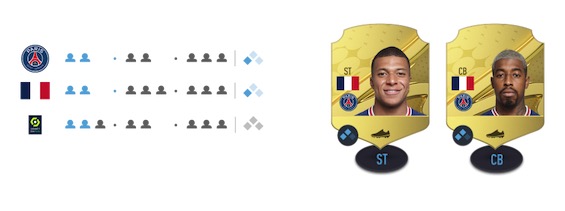
Forward Mbappé and Kimpembe as players of the same club and nationality influence each other – even though they are completely apart as a forward and center-back.
Overall, it will likely take some adjustment to build teams according to this principle. At the same time, there is also a certain freedom, as you are no longer restricted to contiguous positions.
This means that hybrid teams from different leagues are likely to be somewhat easier to assemble than before.
What else does chemistry bring? A few final points:
- There are again Chemistry Styles. These give your players boosts to certain stats – depending on how strong their chemistry is.
- After the start of a match, you can rearrange your teams however you like without losing chemistry. That was the case before and remains so.
With good chemistry, you can continue to improve your players’ stats – only the construction itself works a little differently. Speaking of stats: Due to a leak, some first ratings for FIFA 23 are now known.