


Elden Ring advances the popular ‘Dark Souls’ gameplay, especially thanks to open world. MeinMMO author Marko Jevtic has been a Souls fan since the very first hour and is having a lot of fun with Elden Ring again. However, after the first 15 hours of gameplay, there is one thing that worries and frustrates him.

Elden Ring has been out since February 25, and finally I get to play it too. Unlike my colleagues Tarek Zehrer and Irina Moritz, who were allowed to play in advance, I had to wait patiently.
The waiting was particularly difficult for me, because I have been a Souls fan since the very first hour. I imported Demon’s Souls from Japan back then because the game appealed to me so much before its release in the West. For a long time, it was only playable internationally like this. That was in 2009.
Since then, FromSoftware games have become much more widely spread worldwide, both in stores and in the minds of players. And I have been there for every new release. Every Dark Souls, Bloodborne, Sekiro, even the best imitators like Nioh or Salt & Sanctuary – I have played and celebrated them all.
Because I love the typical Soulslike gameplay:
- They mechanically challenge me over and over again, without being unfair.
- The way they tell their stories only implicitly fascinates me every time.
- Nothing can surpass the feeling of mastering these games and sliding past previously tough bosses like a hot knife through a block of butter.
Of course, I was looking forward to Elden Ring so much. But after about 15 hours of gameplay, I increasingly notice that something is missing. Because although Elden Ring – despite annoying technical problems – is undoubtedly an excellent game, I keep hearing a thought that grows louder in my head with each hour of play:
“I know pretty well what comes next.”
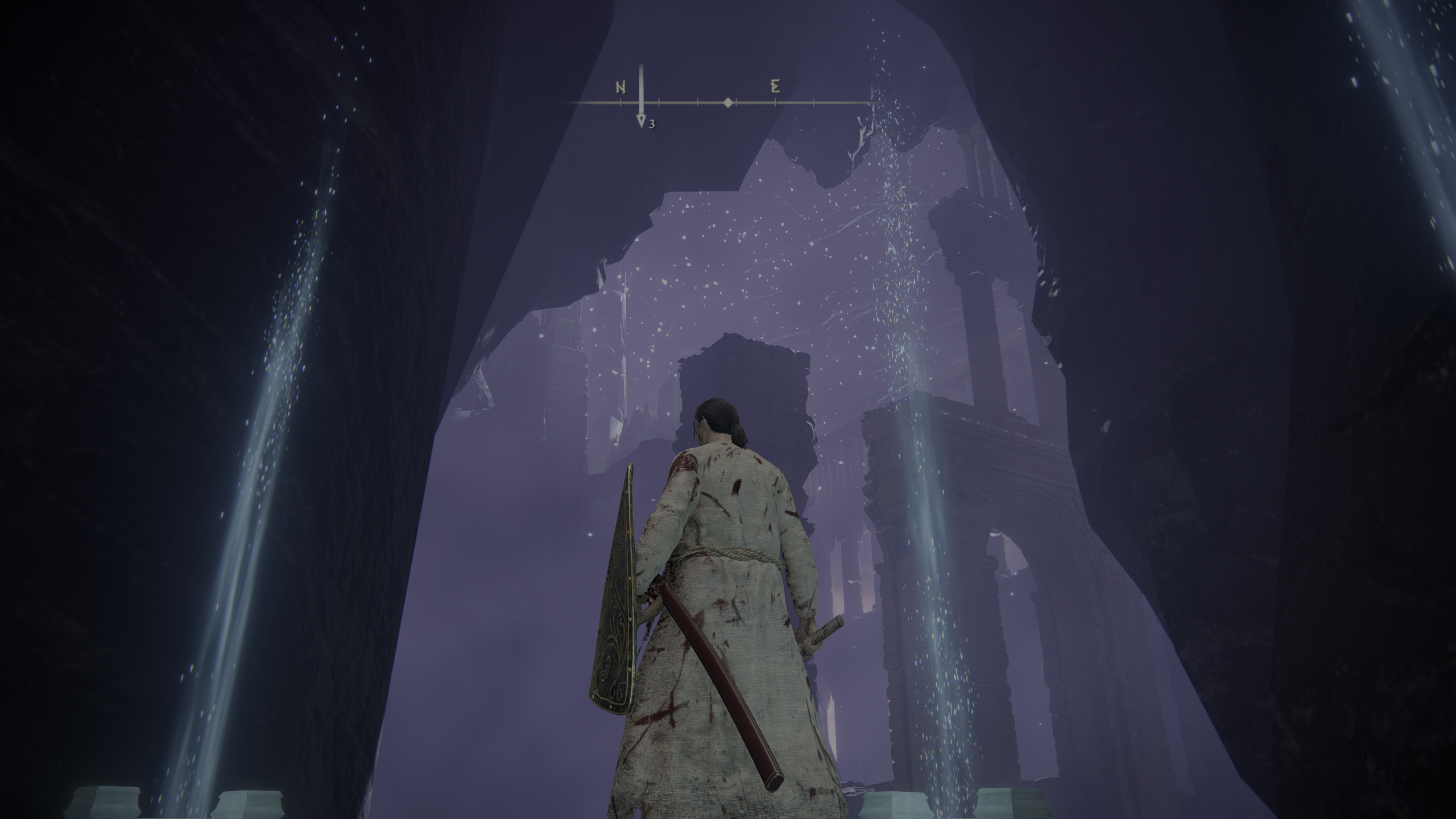
Elden Ring invites me to a dance that I already know too well
The genre that FromSoftware founded with Demon’s Souls, and especially Dark Souls, is often referred to as “Soulslike” in the community.
But more than any game with the word “Souls” in the title, I was particularly fascinated by 2 other titles from the developer: Bloodborne and Sekiro. These spin-offs took the core gameplay and changed it in such an interesting way that I could hardly believe my eyes.
Bloodborne was an irresistible symphony of blood, sweat and adrenaline, thanks to its claustrophobic atmosphere and an incredibly fast and aggressive combat system. Sekiro is like a rhythm game with swords, where the clashing blades produce an electrifying beat that sends me into an ecstatic trance.
But if the battles in Dark Souls are a dance, then I notice while playing Elden Ring that the choreography is already very familiar to me.
Elden Ring refines the combat system of Dark Souls in important aspects, also thanks to new facets like the stance. But it is still clearly recognizable as the combat system of Dark Souls – and anyone who has already mastered that can largely rely on the same, well-known tricks.
The best example for me are the backstabs. They work in Elden Ring in 2022 just as they did in Demon’s Souls in 2009, and are just as effective. The sequence of steps for this dance should be well known to every Souls fan:
- You make eye contact with your dance partner, and you both walk slowly toward each other.
- You both raise your shields in the air, and you circle your dance partner until you are standing behind them.
- You stab your dance partner sneakily and brutally in the back, kick them to the ground and keep hitting them until they stand up again.
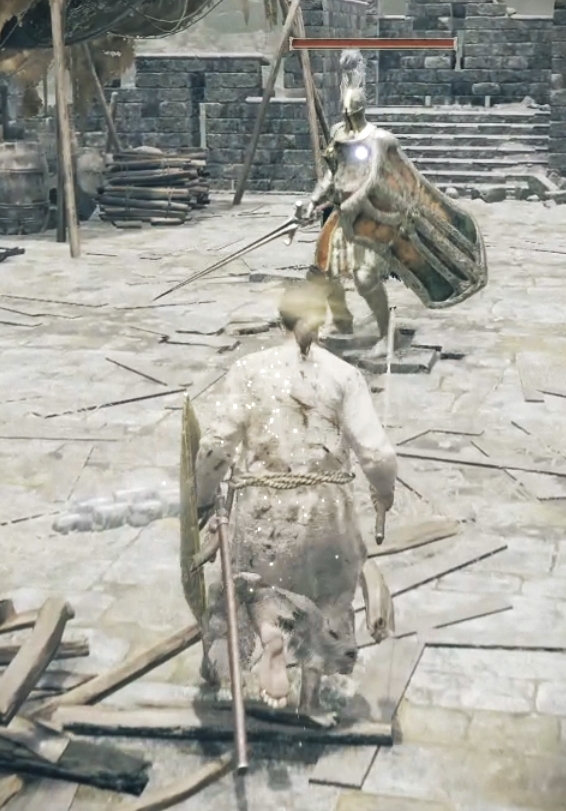


This choreography – and every other in this game – is undoubtedly still fun. But no FromSoftware game has been able to surprise me mechanically as rarely as Elden Ring. However, FromSoftware has shown with Sekiro and Bloodborne that they can reinvent known mechanics in such a way that they fit the unique and special identity of each game:
In Bloodborne, the offensive power was emphasized much more than in other Soulslikes. For example, there was only one shield, which was intentionally completely useless. Additionally, you could heal again if you attacked the enemy immediately and aggressively after taking damage. If you play cautiously here, you lose.
In Sekiro, good timing was absolutely crucial. Every boss had several phases with its own flow and tempo. Each duel was an exciting back-and-forth, dozens of attacks had to be parried in succession, and all defensive actions were also effectively an attack thanks to a refined stance mechanic. No other action game offers this type or quality.
This own and special identity is what I have been missing in Elden Ring so far. Instead, it mainly plays like a Dark Souls 4 under another name – defensive, waiting, well-known.

Elden Ring is a logical evolution of proven gameplay – Unfortunately
This feeling that the latest FromSoftware game refines rather than reinvents the wheel is something I had before: when I played Dark Souls at release.
The FromSoftware games really exploded only with Dark Souls. For most players, the title was the first time they could experience this captivating gameplay. And although I joined that hype back then – by the release of Dark Souls in 2011, I had already played Demon’s Souls for 2 years.
Dark Souls was the logical evolution of Demon’s Souls and a clear improvement in almost all respects. The semi-open world was justifiably praised to the skies, the new healing system was both mechanically more interesting and less frustrating, and the bosses and dungeons were almost all better.
But Dark Souls was not a revolution of Demon’s Souls; it was a understandable and comprehensible next step in important new directions. For without this step, Soulslikes would not be what they are today.

I have the same general feeling about Elden Ring so far. However, Elden Ring is not the 2nd attempt in a completely new genre like Dark Souls was back then but the already 7th Soulslike from the original developer itself. There, the line between perfection and perceived stagnation is clearly thinner.
Unfortunately, I cannot assess whether I would have this disappointing thought if the game was not called Elden Ring but Elden Souls. And it’s not that I’m not having fun – quite the opposite. The typical Dark Souls gameplay is better than ever, and the open world is overflowing with excellent bosses and exciting dungeons.
The formula itself is still brilliant in 2022. But FromSoftware has done too little with Elden Ring to fundamentally change this well-established formula beyond the open world. That they can do this impressively, they have proven multiple times.
I am still early in the game and know that I will likely play Elden Ring for weeks before I have seen everything. FromSoftware can still surprise me.
I genuinely hope that this happens. Because nothing would please me more than to say in a few months: God, how wrong I was with this article.

Your opinion is important to us!
Do you like the article? Then let us know!