

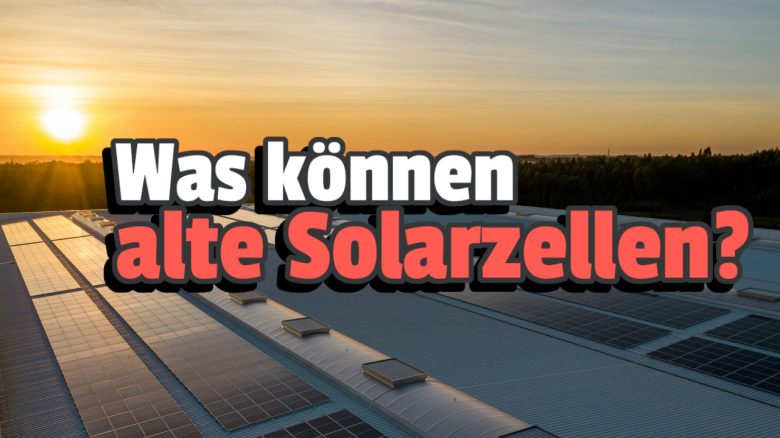
Tests reveal important insights for the energy transition. Not all solar panels are equally robust, but a trend is recognizable.
What kind of modules are we talking about? As our colleagues from Xataka report, the charity Hespul installed a series of small 1kW modules in Lyon in 1992 and connected them to the grid – a premiere. They were the first solar modules in France. Their name: Phébus 1. In 2023, the solar panels were dismantled and brought to the lab. After 31 years of operation in wind and weather, are they still usable?
Less relevant for the future, but definitely an exciting art project:
Beyond the Guarantee
What were the results of the tests? On average, the mini power plant achieved an efficiency of 80 percent. Some degraded by about 34 percent, while others lost only 13 percent of their output. The manufacturers guaranteed significantly less: they promised only 80 percent efficiency across all modules after 25 years. The modules from Phébus 1 would still be usable today without any issues.

Where does the difference between the panels come from? The variance can be explained by the smallest differences in materials and manufacturing – especially considering the age of the products themselves. Back then, the solar industry was still in its infancy, nowadays lesser differences and likely also a higher performance retention can be expected. You can read more about this, for example at Gruenes Haus with references to the Fraunhofer Institute.
How is a solar panel tested? In a completely darkened room, the solar panel is exposed to a bright, standardized flash of light. Subsequently, it is measured how much electrical energy the panel gains from it. If this is done at different points in time – for example, with a 31-year gap – it can be traced how the performance of the panel has decreased.
So roughly 80 percent of the incoming sunlight is converted into electricity? No, the laboratory’s statements do not indicate the efficiency. It quantifies the energy converted into usable electricity. And this value is likely to be poor for these old solar cells from France compared to today, probably under 20 percent.
As a newsletter from the Federal Ministry of Economics and Climate Protection states, this is now over 25 percent for top models.


High-tech and clever ideas are also the focus of another article with us. However, the plan of this applicant turned out to be far less sustainable than solar cells: Because what a candidate for a university career tried during a state examination in Turkey is likely to accompany him for the rest of his life: His cheating attempt with a camera, phone, and AI failed, but the police are quite impressed.

Your opinion is important to us!
Do you like the article? Then let us know!