


The Starship from SpaceX is on everyone’s lips, but do you know one of Germany’s flagship space projects? We introduce you to a company and its rocket that are preparing to respond to Elon Musk from Europe with high-tech.
What kind of German rocket is this? The Rocket Factory Augsburg (RFA) has developed an orbital rocket that is now ready for its maiden flight from Unst. This summer, there is a lot of activity at SaxaVord Spaceport amidst idyllic yet rugged scenery.
While the waves crash at the foot of the steep coast, tests are being conducted above for the fiery ride to orbit. State-of-the-art engines will be responsible for the spectacle, matching those from the USA in (almost) every aspect.
Once it takes off for the first time, the rocket named RFA One will inaugurate the first spaceport in the United Kingdom.

Across the Atlantic in Texas, an unprecedented private industry has been operating at full throttle for years: Elon Musk is building the Starship, the largest rocket of all time, with SpaceX. This will open up the Moon and eventually Mars for humanity. After three test flights, the goal is increasingly within reach.
In Germany, a company is pursuing more modest goals. We explain everything important about the RFA One and why it carries the hopes of a young industry that has lain practically dormant in Germany for decades. Germany wants to have a stake in one of the future economic sectors: commercial space travel.
What is the RFA One?
The RFA One is a 30-meter high and two-meter diameter orbital rocket. It can carry around 1.3 tons into low Earth orbit (LEO). Here we find a variety of conceivable uses for satellites, such as Earth and weather observation.
Should SpaceX be afraid? Elon Musk aims to bring more than 100 tons into similar orbits with his SpaceX-built Starship and Super Heavy booster (over 120 meters tall and nine meters in diameter).



Nevertheless, the design of the RFA One is noteworthy as it is the most powerful rocket from Germany and relies on a high-tech engine (Helix) of its own development, as well as expertise from the luxury automotive industry.
Intended Series Production
Steel and parts from luxury cars are being used for the orbital rocket: In production, RFA, similar to SpaceX, does not rely on composite materials, but instead on steel. This is more cost-effective. Additionally, modified parts from suppliers of German luxury limousines are being used to reduce costs for the engines. The main advantage: proven mass production also lowers costs here.
Special components primarily developed, built, and delivered in small quantities for space travel are exorbitantly expensive.
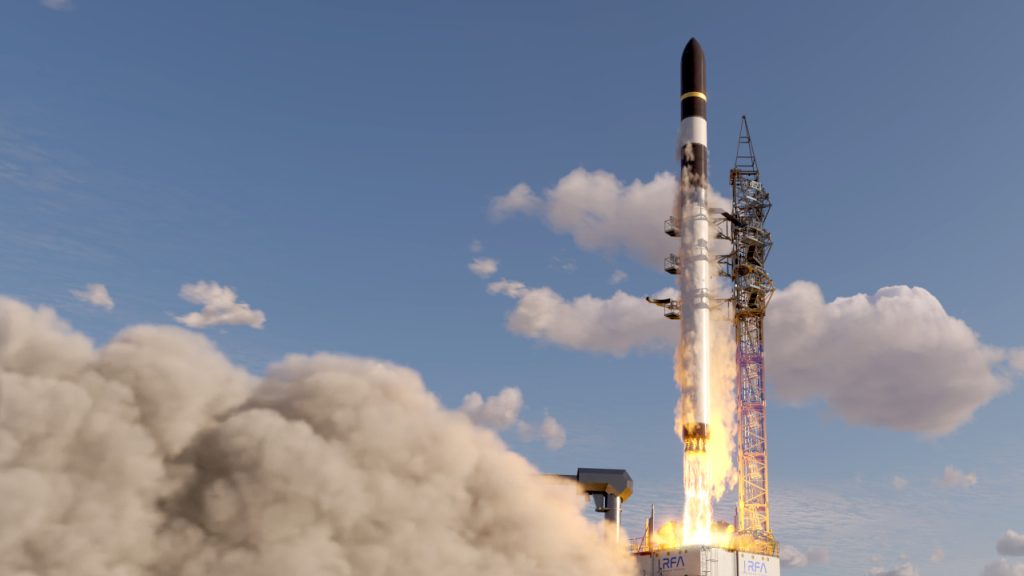
This makes the RFA One a product of the New Space industry that could economically threaten Musk’s company for lighter loads from European customers. The German rocket promises to transport smaller satellites (weighing a maximum of 500 kilograms) into orbit efficiently and cost-effectively.
Additionally, it has operated (and still operates) in different market segments. It was far more expensive and also more powerful than the RFA One. The same applies to the Ariane 6. It ranks in performance between the RFA One and the Starship, roughly on par with SpaceX’s Falcon 9. However, thus far, only Musk’s rockets have been reusable. RFA plans this for the future.
The preparations for the maiden flight are still ongoing. But we already have a rendering of the maiden flight here for you as a video:
Rocket Engines Explained Simply, the Short Version
If the RFA One is remarkable, the engine stands out as unique. It is the first of its kind from the European Union. But to understand that, let’s quickly solidify the basics:
How do rocket engines work? Whether the first rocket engines that powered the infamous V weapons of the Third Reich or the world’s most modern engine named Raptor by SpaceX, they all rely on the same principle: pressure equalization.
It’s always about getting matter from pressurized tanks to exit through a nozzle as quickly as possible. Since the 1940s, we have basically only been able to build much more efficient and powerful engines.
Overpressure thanks to pumps: To increase the pressure, all modern engines use turbopumps. These pump previously compressed material into the combustion chamber, where fuel and oxygen are mixed and ignited, expanding explosively. This creates the tremendous thrust.
However, the pumps need to be driven, which is done by additional turbines. These are fed from the normal tanks, whose contents are also used to lift the rocket into orbit. However, with conventional methods, such as those used in the Merlin engines of the Falcon 9, potential thrust is lost because part of the fuel escapes as exhaust gas. Most rocket launches today are still carried out using engines with an open combustion cycle.
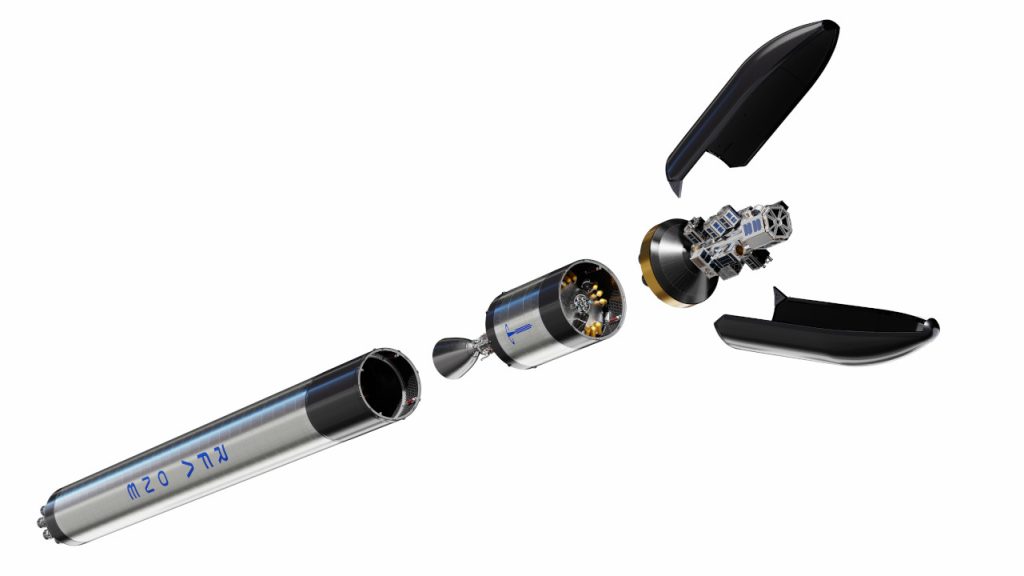
The Helix Engine: High Tech from Germany
What makes the Helix different? The Helix uses a staged combustion cycle (Closed Staged Combustion Cycle). This means that no exhaust gases escape from the engine prematurely. All material arrives in the combustion chamber. This is significantly more efficient.
Click to expand
Those familiar with history may recognize the intriguing irony of the partnership between Augsburg and the United Kingdom. Once, the V-rockets of the Third Reich terrorized England. They were powered by nothing other than the precursors to all modern engines for launch vehicles. In the future, one of the hopes of German space travel is set to launch from the land of the former enemy into orbit – the greatest progress often lies in lived cooperation.
There are not many such engines. The Soviets were long leaders in this field. Nowadays, mainly the USA, apart from SpaceX, relies on this technology. The Space Shuttle used the RS-25 for the first time, and the NASA still relies on the product, regarded as excellent, for the Space Launch Systems (SLS). Jeff Bezos sells and uses the newly developed BE-4 engine from his company Blue Origin. The Helix joins this class of excellence.
Those wanting to read more in-depth can find a longer article exclusively about rocket engines from our colleagues at GameStar-Tech.
Next is a video of a hot-fire test of the first stage of the RFA One. It is exactly what it sounds like: it’s going to be fiery. All four installed Helix engines will be fired for an extended period and tested across various power levels.
In the final configuration, nine of these engines will launch the rocket into orbit before the second stage takes over and lifts the payload with a single vacuum-optimized Helix further into the target orbit. Finally, a third stage with a mini-engine can make further adjustments to the orbit, for example, to deploy multiple payloads sequentially.


Are there other German rockets? Yes, there are. Apart from RFA, Isar Aerospace and HyImpulse are currently developing and building orbital rockets as well. The latter even took off for the first time in Australia recently, albeit with a far smaller and weaker test rocket compared to the RFA One.
However, both competitors are still exciting. HyImpulse utilizes candle wax and Isar Aerospace uses manufacturing processes like 3D printing, even if their Spectrum rocket is less powerful than the RFA One.
If you are interested, we would be happy to introduce you to both companies and their rockets, or would you like to read more about SpaceX’s Starship? Let us know in the comments! If you are intrigued or have long been drifting mentally into the vastness of space, you should check out our recommendations for movies that resemble Interstellar.

Your opinion is important to us!
Do you like the article? Then let us know!