

[vc_row][vc_column][vc_column_text]
On the night from Thursday to Friday, the official release of the fantasy MMORPG The Elder Scrolls Online is upon us.
We have given you an intensive preview of TESO, providing you with first impressions and insights from the head start that was open to pre-order customers, and we ask the question: For whom is The Elder Scrolls Online actually the right MMO?
Long-awaited by fans
Last Sunday it was finally time for the eager ones. About an hour before the scheduled time, Zenimax opened the gates to the online spin-off of the popular Elder-Scrolls series, which has captivated fans across age and country boundaries.
Especially since Skyrim, the Elder Scrolls of the “Generation Now”, the fantasy world of Tamriel is as well-known in fandom as Middle-earth, Azeroth, or Westeros.
The head start can be imagined like the doors of a department store opening for a winter sale as the masses pour in. After all, many gamers had been waiting for years for an MMO set in their favorite world. At launch, everything went surprisingly smooth. There were hardly any complaints about lags or long queues. Only a few buggy quests disrupted the flow. However, the creators behind the game, Zenimax, are already at work and have released the first patch.
What is special about The Elder Scrolls Online?
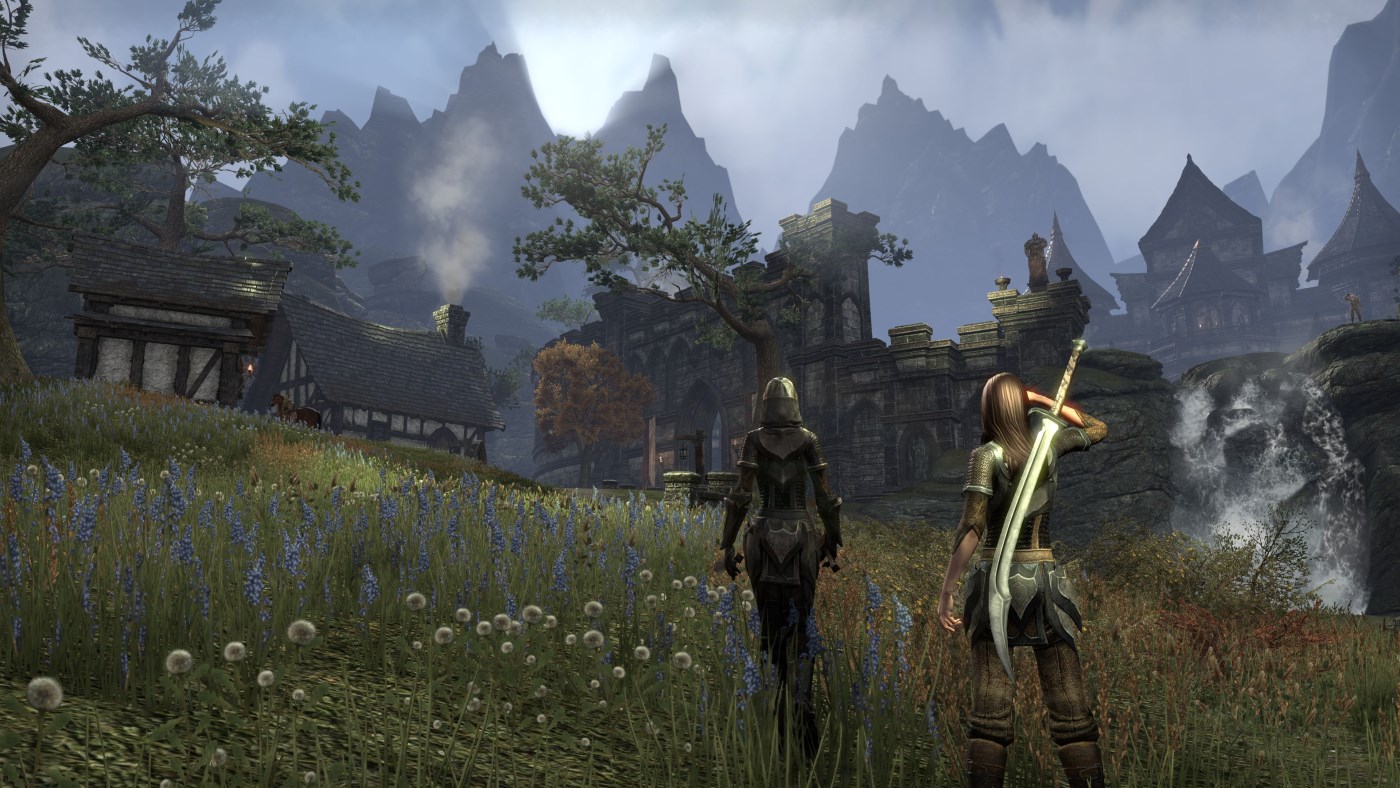
First and foremost, the graphics. Those accustomed to the comic style of World of Warcraft will definitely be amazed. Particularly interesting is that the landscape includes hills and valleys, lakes and mountains. This has tactical consequences in PvP as well.
When you chase a few fleeing enemies with battle cries over a hill, convinced that you just have to be faster than your comrades to deal a few killing blows and gain some prestige, you might be in for an unpleasant surprise. The enemies may have gathered behind the hill again. And they won’t find a lone hero who has just exhausted all his stamina in a full sprint particularly dangerous, but rather tasty.
So: Beware when climbing a hill.
The storytelling as a compromise between MMORPG and single-player
The quests evoke a true Elder Scrolls feeling. As in Guild Wars 2, the developers have found an interesting compromise. The questing lies somewhere between a hero’s journey like in a single-player game and the typical race from quest hub to quest hub that defines the genre. Although the hero in The Elder Scrolls Online also moves from area to area, he is not artificially sent there, but arrives organically and first takes a look around. Then he addresses the local problems, often two or more quests that are closely interconnected. And lo and behold: The land around him changes, a story has been told, and he can move on.

This may not sound particularly exciting, but it plays well. While WildStar makes no secret that it is clearly rooted in the MMORPG genre, The Elder Scrolls Online successfully conceals its concessions to a somewhat tired MMORPG genre filled with kill quests and the dreaded grind.
The quests, the quests, the beloved quests
For an MMORPG, the quests are naturally crucial: How well are they written? How are they presented? How are they told? And are they any good? This is, as experience shows, a matter of taste.
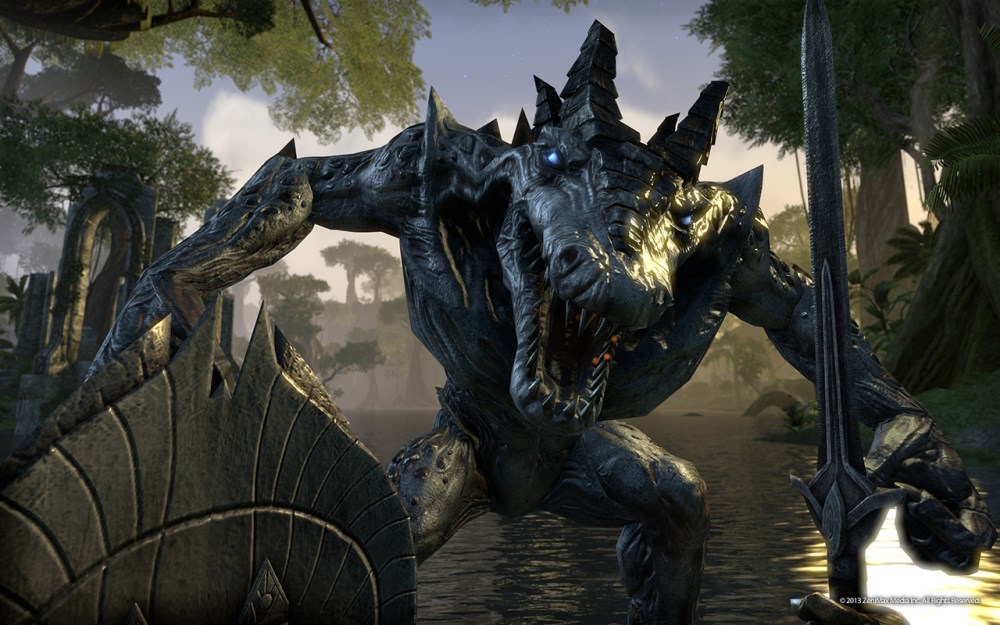 It is a form of high fantasy, but with a wink. There will always be certain quests that fully immerse the player and draw him into the fantasy world. However, he must be willing to engage with the events.
Gamers who are playing with the TV on in the background while friends in Teamspeak are yelling at them will likely feel overwhelmed by the complex stories. They will wonder when the ghosts stop discussing their family history and the fighting can finally continue. The quests are fully voiced and done by truly good speakers. Only the faces of the characters that speak often look stiff and strangely doll-like.
The Elder Scrolls Online is a game for those who want to hear a good story and are willing to give the game the necessary attention and time.
Admittedly, the stories are not all of an incredibly high standard. There are recurring standard plots involving a bit of betrayal and a dash of greed. But now and then, a true gem sneaks into the narrative mix and can truly captivate a player.
New paths are needed for the genre
The Elder Scrolls Online surprisingly excels in some aspects that MMORPGs have lost sight of in recent years, which have been flourishing in single-player RPGs, namely the versatility of the hero and the crafting system.
Crafting and the economy
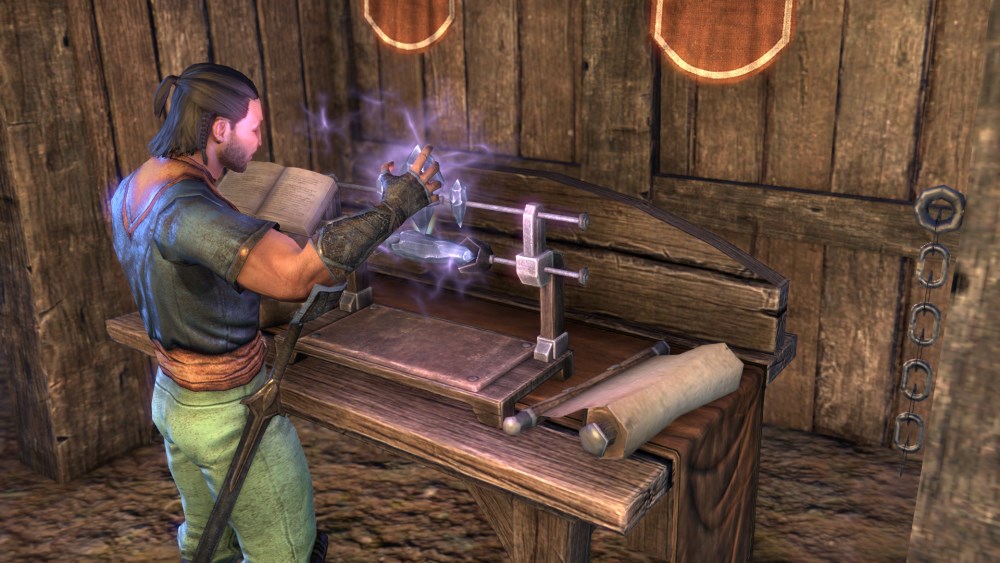
The Elder Scrolls series is known for its sophisticated crafting system, alongside The Witcher saga. TESO follows this example: There’s hammering, carving, and brewing going on. The same skill points that you invest in your weapon skill can be used to procure better wood for the next bow or to locate a vein of ore more easily. Magical potions must first be discovered using the trial-and-error principle and runic combinations explored. And in the wild, secret workshops await discovery and use. Only there can craftsmen enhance items with specific abilities.
Compared to the banal crafting exercises that World of Warcraft demands of players, this is a delightful surprise!
The economic system takes TESO seriously again, the idea of a mega server without an auction house will delight hobby capitalists, monopolists, and wannabe Gordon Gekkos.
The skill system and races
Even in the progression of the character, or how a hero becomes stronger, TESO takes interesting new paths. Here, the currency is not called “level”, but “skill points”. You can earn them through various means. A rank in PvP, earned by defeating other players, grants a skill point, just like leveling up, completing a main quest, or finding three skyshards. These are scattered throughout the area and reward a sense of discovery.
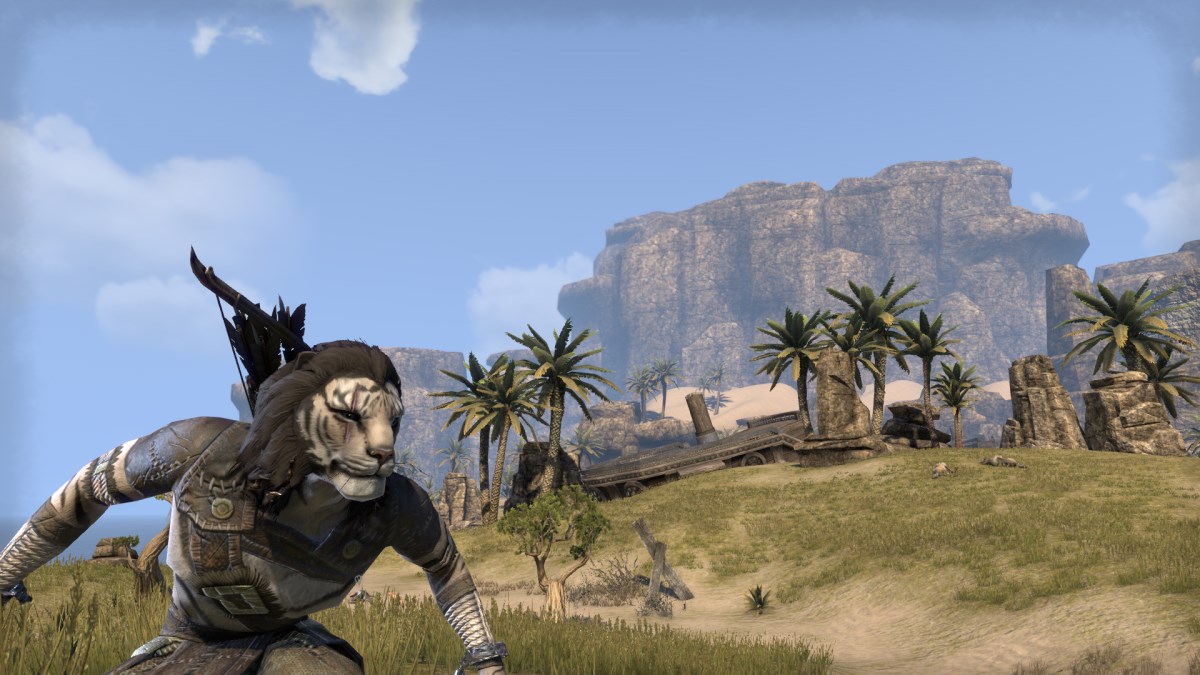
These skill points can be invested in different and unusual aspects for an MMORPG. The possibilities for customizing your hero are limitless. Because every character can wear any weapon and armor. Depending on the class, there are three different skill lines, and certain achievements unlock opportunities to invest points. Points can flow into typical PvP skills, and crafting skills still need to be nurtured. It’s truly an amazing story.
While other games have something like “a ranger”, the same idea of this class can be achieved in The Elder Scrolls Online in countless ways. A hefty dragon warrior in heavy armor, drawing a bow? No problem. The nightblade as an assassin with a bow drawn? Good idea! Or a mage who first showers the enemy with arrows before he launches his magical show and even sends a pet against the foe? Why not!
Here, TESO may not be the first MMORPG to blaze new trails, but it is one of the first “big” titles.
My-MMO says
Whether The Elder Scrolls Online will ultimately establish itself in the market with good ideas and approaches is uncertain. However, we believe that the “diluted Elder Scrolls elements” that many fans ridicule do surprisingly well in the MMORPG genre.
The diversity known from single-player games regarding skills, the focus on crafting and storytelling, and the different graphical style are all plus points that benefit the genre, which at times seems exhausted and tired from an endless series of World of Warcraft clones.
[/vc_column_text][vc_tabs interval=”0″][vc_tab title=”Schuhmann” tab_id=”1396546064-1-73″][vc_column_text]
First impressions from the head start
I just started with the three-day head start and created a Khajiit nightblade for the Aldmeri Dominion. Yes, Schuhmann loves cats. By now, she is level 16 and on a good path from house cat to feared wild cat.
What has bothered me in the 3 days is the pre-order bonus for the Imperial Edition. Beforehand, some were outraged and were a bit paternalistically laughed at: That’s not so bad. You can buy it later easily with money.
The Thousand Gold Horse Problem
 Yeah, sure. In four weeks, when money doesn’t matter anymore. At the start, I found it extremely annoying that almost everyone rode past me with a one-gold horse, while the cheapest horse would cost me nearly 18,000 gold. An amount that is still far away even at level 16. The missing horse wouldn’t be a problem; long distances can be covered by teleporting, but especially in PvP, I missed the mount.
Aside from that: For principle, I am simply against the fact that virtual advantages are distributed among the populace in a full-price title in this way.
Of course, if you want to do something good for Zenimax, you say: Buyers of the Imperial Edition receive a horse for free, can start 5 days earlier, and also receive a hefty EXP bonus.
But if we look at it from the other side: Buyers of the normal game can only start five days later, pay 18,000 gold for a horse that is worth just one gold piece, and level slower than the “normal players”. The only thing that determines the perspective here is the fact that the industry talks about a “head start” while it could just as well be called a “delayed start” for everyone else. One will have to live with the fact that the gaming industry is moving in this direction. However, one does not have to endorse it, nor support it.
Clear strengths in PvP
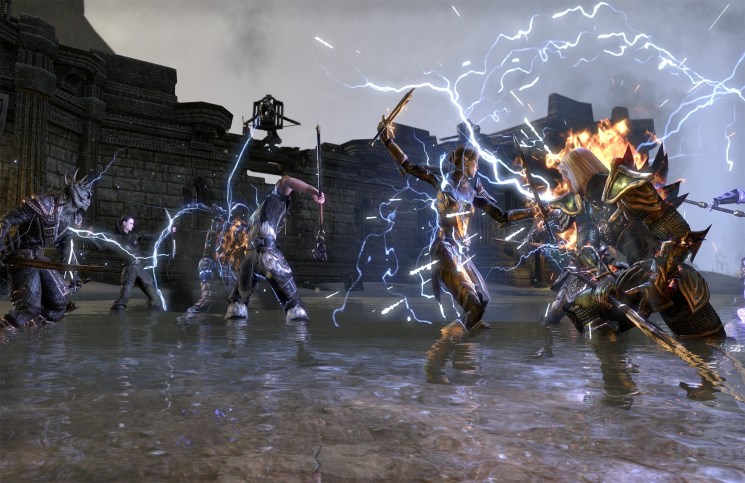
I enjoyed the PvP the most. I spent several hours there, mostly questing around Cyrodil – with the added thrill of being attacked by an opponent or coldly sending a foe to the afterlife while they are in the midst of intense map study, revealing themselves as the “Hmm, let me look it up where the next quest goes” type!
It just looks incredibly impressive when a wall of trebuchets is being shot down. The back-and-forth between attack and retreat, between triumph and disaster, makes me assume a lot of positive things for this aspect of the game.
I enjoyed questing with my Khajiit; I hadn’t checked out the area before, but I played a bit of the Ebonheart Pact in the beta – well, some of the Aldmeri had quests that were buggy and problematic, but it was good hours in which I could always dive into the story again.
The last cat on earth or a pack animal?
Only, the phasing is sometimes strangely regulated. One moment you feel like the only cat in the world fighting for justice, order, and fair beer prices, and the next, fourteen guys run past you (half of whom are of course also archers because they were cool in Skyrim), make the opponents crumble to the ground, and all stand in front of the quest object and press on it – and they are gone again.
Conclusion: After the first three days, I would cautiously recommend it for purchase. However, one must be willing to engage with the game. No television, no too many prejudices, just you, your hero, and the game. Then The Elder Scrolls Online is certainly worth the money. There is definitely enough content for many hours of gaming fun.
For me, the initial days of an MMORPG have always been the most eventful. It was the time I associate with the most memories. I didn’t want to deprive myself of that this time with TESO.
[/vc_column_text][/vc_tab][vc_tab title=”Dawid” tab_id=”1396546064-2-3″][vc_column_text]
All beginnings are difficult…
Admittedly, The Elder Scrolls Online didn’t grab me from the first second; it took a few tries: It can best be described as love at second sight.
During the first beta weekend, disappointment set in, but during the next phases, I began to find enjoyment – and now during the head start – the spark has gradually caught on.
Whether this love lasts forever is certainly written in the stars. But I don’t care at the moment, as it tingles and the areas and adventures around Tamriel ensure that plenty of happiness hormones are being released in my brain.
Actually, Schuhmann has already said everything, and in many areas, I am on his wavelength. I still want to share my first experiences. Cats always do what they want. Let’s go, my Khajiit lion, you sneaky nightblade.
MMORPG players needed to adapt
My biggest issue was that I was unsuccessfully searching for the flow of the game that I have followed for years in classic MMORPGs.
It’s just unusual because the game from Zenimax goes at a completely different pace. If you want to rush through the world, you quickly realize that the game does not cater to that. Fun with a quick number here only works to a certain extent. It starts with PvE and seamlessly transitions into PvP, where things can sometimes be pretty quiet for 30 minutes (my first steps in Cyrodiil). Sometimes I miss being able to simply jump into a battlefield and rush into the action immediately. However, Cyrodil has other strengths. Fantastic castle sieges, unpredictable skirmishes, and a huge amount of drama, baby. Schuhmann would say here: Everything makes sense and is coherent.
By now I can say: You can get used to almost everything and it even feels refreshingly new. If not, then it’s just not your thing.
Strengths lie in the atmosphere
The world and everything that comes with it looks great – you can really see a lot of love for detail, which also applies to the characters. The immersion, in this case, the intense immersion in a virtual world, is a strong point of The Elder Scrolls Online. I have rarely seen such beautiful settings – and here comes the catch – in a non-Asian setting. Congratulations, Zenimax, you have revived the lost scout in me.

I still have some issues with the storytelling, while some stories can be quite thrilling, and the decisions I make even have consequences. However, it is not always easy for me to follow all the stories with full attention. I occasionally catch myself wanting to click through all the text quickly to progress faster *hitting my own fingers*.
From a narrative style perspective, I honestly see Star Wars: The Old Republic ahead, although of course, it is also a personal preference. In TESO, the dialogue sequences feel a bit too stiff, and the conversations are one-sided (only the NPC speaks). Star Wars, on the other hand, feels more like a film in these moments, as there is simply more movement due to various camera angles and a two-sided voiceover, which makes the scenes feel more varied. Nevertheless, TESO undoubtedly belongs to the big ones in the genre when it comes to storytelling. Especially how the environment adapts to quest progression is excellently done and gives a sense of being right in the middle of everything rather than just being there. The quests here are unusually varied, and in terms of presentation, you have to search a long time in the MMORPG genre to find something comparable.
Outlook
We will need several weeks before we can comprehensively share our experiences with you in a test. For example, I have not yet tested instanced group content in PvE, but I have already heard from friends that the dungeons are incredibly fun. In particular, compared to GW2, the MMORPG benefits from implementing the holy trinity, or so they say. The bosses also have interesting mechanics and challenge the player in combat. So far in the open world, I have not had a group atmosphere, which is certainly “due” to the single-player aspects. But as the saying goes: What is not, can still become. So far, it has been a lot of fun.
Also positively, Zenimax has worked hard on the combat system and introduced collision detection. It’s already a huge difference from the first beta, the so-called air battles. This was a major drawback then, which is why my first experience with ESO was rather disappointing.
Anyway, see you in Tamriel!
[/vc_column_text][/vc_tab][vc_tab title=”Not enough yet?” tab_id=”1396557552646-2-1″][vc_column_text]
- The somewhat different preview
- 1-2 million players expected
- A snowflake between Skyrim and World of Warcraft
- What to expect in endgame and Class special
- The forum review and PvE and PvP press review
- Racial bonuses, atmosphere and all without an auction house
[/vc_column_text][/vc_tab][/vc_tabs][/vc_column][/vc_row]

Your opinion is important to us!
Do you like the article? Then let us know!