A YouTuber tested how long an OLED monitor lasts in daily use. After 21 months, he concludes that the damage is not as bad as feared.
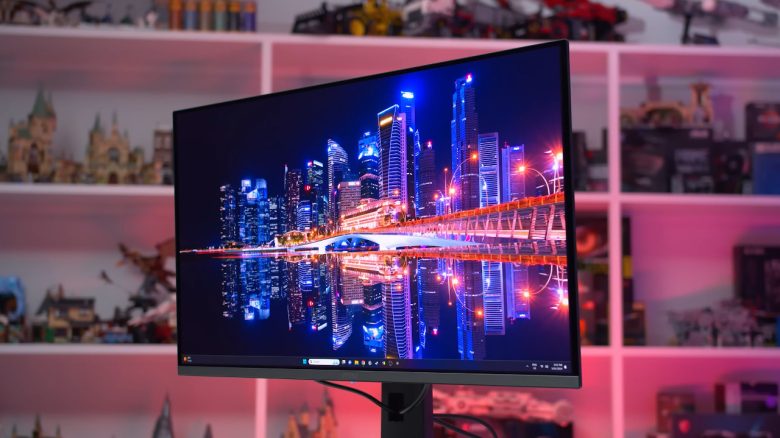
The YouTube channel Monitors Unboxed wanted to find out how long an OLED monitor lasts in daily use. Two years ago, he started the test with an MSI monitor, using the model mainly for work and static desktop applications.
After more than 5,000 hours, he is surprised that the model is still surprisingly usable. The problems have only increased to a limited extent.
After 5,000 hours, brightness decreases, the monitor remains fully usable.
What exactly did the YouTuber do? Tim from the YouTube channel Monitors Unboxed explained that he has been using the monitor for almost 2 years (21 months) for about 60 hours per week at a brightness of 200 Nits. That’s a little over 5,000 hours.
He consciously chose to perform a burn-in test by keeping the taskbar activated and also set the monitor to enter sleep mode only after 2 hours of inactivity. This way, he aimed to put additional stress on the display.
What did he find out after 21 months? The YouTuber noticed a slight, measurable decrease in brightness of about 2%, which is practically not visible in daily use. Furthermore, the burn-in defects have only slightly increased. A vertical line is visible in the middle, a visible burn-in zone at the level of the taskbar, and a slight change in color uniformity. Overall, the difference is relatively small. The most significant changes occurred in the first 3 months.
What does the test indicate? For the average user, the YouTuber’s test is initially good news. Because even if someone uses an OLED monitor daily for several hours, damages such as burn-in are only partially recognizable. Most users are therefore unlikely to notice any deterioration in their OLED display in daily use.
Regular protective functions like automatic “pixel refresh cycles” from manufacturers help at least to reduce burn-in and other issues, but do not completely prevent them. The Switch OLED also offers a feature aimed at preventing burn-in.
And Tim from Monitors Unboxed, who deliberately operated his display for 5,000 hours under incorrect settings, additionally claims that the monitor still provides an acceptable level of daily performance, so that burn-in is only noticeable in certain situations.
For comparison: The lifespan of OLED displays is usually stated to be between 30,000 to 100,000 operating hours. This corresponds to about 7 to 10 years of use on a daily basis.



Experts have subjected OLED televisions to long-term testing. All devices exhibited the same problems after 2 years, namely burn-in. The severity of the damage varies, but all are affected: Experts tested 100 OLED televisions for two years, and all devices have the same problem