

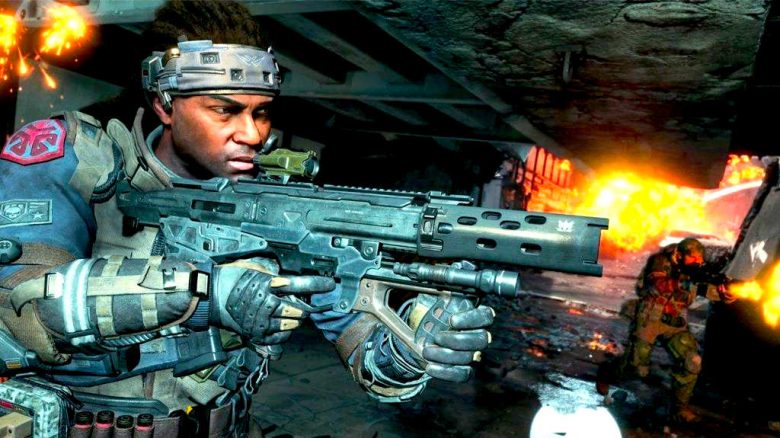
American wrestler Robert Booker Tio Huffman (known as “Booker T”) sued the “Call of Duty” publisher Activision more than two years ago over an operator in Black Ops 4. The lawsuit has now been lost and the reasons for it seem somewhat curious.

What happened so far:
- Booker T sued Call of Duty over the operator “Prophet” for copyright infringement
- The lawsuit was about the similarity of Prophet to a depiction of the wrestling role “G.I. Bro” in a comic book
- The court has now dismissed the lawsuit – the reasons are understandable, but somehow curious
What is it about? Black Ops 4 is the Call of Duty from 2018 and relies on a specialist mechanic for the characters. Each character has their own skills and traits – including David “Prophet” Wilkes. The operator carries many technical implants in his body and is almost more machine than man.
Prophet was also featured in Black Ops 3; however, his face was often covered there. In Black Ops 4, Prophet showed more of his visage, and what WWE legend Booker T saw there did not please him.
Booker T saw a blatant copy of his wrestling gimmick “G.I. Bro” – but not of his ring character. The character was also used in a comic, illustrated by the artist “Erwin Arroza”. It was specifically about a particular poster that indeed bears a certain resemblance to the CoD operator Prophet:
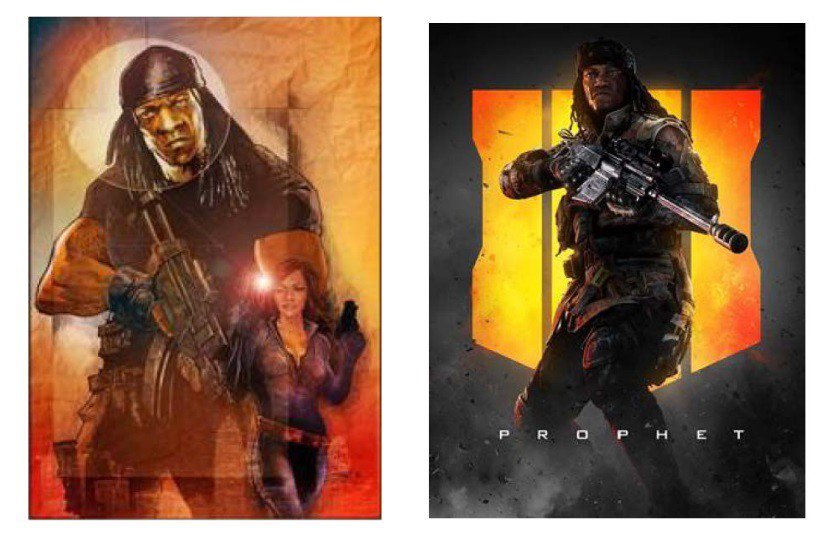
Booker T then sued Activision for copyright infringement. In his opinion, the character was clearly created based on the comic version of G.I. Bro. Booker T argued that he was entitled to damages because the idea for the character came from him and Activision used his intellectual property.
Why was the lawsuit dismissed? The court found, with the help of witness statements, that the artist did not only use Booker T’s body as a reference when creating the artwork for the poster. From the neck down, wrestler Dwayne “The Rock” Johnson was rather the inspiration.
If one removes everything from the neck down, only the facial expression and posture remain as the subject of the lawsuit – which was confirmed by plaintiff Booker T. The court’s application states:
You cannot obtain a copyright for a posture. […] (“Copyright law protects tangible, original expressions of ideas, not ideas themselves.”) The plaintiff does not own the idea of an angry man with a dark gaze. The plaintiff’s claim to a copyright on “facial expression” or “posture” is not […] permissible and must be rejected. […] The similarities that exist here – two black men with dreadlocks – are general, public domain elements that cannot support the claim of striking similarity.
From the defendants’ application (PDF via thomsonreuters.com)
The court also rejected the plaintiff’s assumption of when and where Activision came into contact with the “G.I. Bro” poster. The plaintiffs argued that Activision stole the idea for Prophet from Booker T during a Comic Con. However, the exhibitions of Activision and G.I. Bro only overlapped at a single Comic Con – San Diego in 2015. At that time, the Arroza poster, which the lawsuit relied on, did not yet exist.
The plaintiffs around Booker T essentially fought with their own weapons. Initially, the poster that the lawsuit mainly relied on was not entirely valid, and the evidence for the possibility of “copying” was also not accepted.
Who is Booker T? The US wrestler originally hails from Texas and made his debut in a regional wrestling show as early as 1989. In the “Western Wrestling Alliance” he appeared as G.I. Bro. Later, in the “Global Wrestling Federation,” Booker T was part of the tag team “Ebony Express” alongside his brother Stevie Ray and caught the attention of the major “World Championship Wrestling” (WCW) officials. As the tag team “Harlem Heat,” Booker and Ray managed to win the WCW Tag Team Championship a total of 10 times.
Booker T then got more appearances as a solo wrestler and won the “WCW World Heavyweight Championship” four times. When WCW was acquired by market leader “World Wrestling Federation” (WWF) in 2001, Booker T was the reigning Heavyweight Champion and secured a contract with the new parent organization.
He regularly fought for the WWF until 2007, which later became WWE (World Wrestling Entertainment). There, he won the United States Championship three times, and once won the World Heavyweight Championship as well. His victory at the “King of the Ring” event in 2006 is also regarded as significant. Booker T made this victory a part of his wrestling gimmick and from then on liked to be called “King Booker.”
After that, he made appearances for small promotions. Nowadays, Booker mainly works as a commentator for WWE and rarely steps into the ring. In 2013, he was inducted into the WWE Hall of Fame.
Currently, Call of Duty is openly relying on actors for some operators who can identify with the military image. Also, licensed skins are now in the game, as well as characters reminiscent of film characters.
What do you think about the development of the characters? Do you like the idea of possibly controlling an operator based on someone you are a fan of? Or do you completely dislike the direction this is taking? Feel free to discuss with us in the comments on MeinMMO.

Your opinion is important to us!
Do you like the article? Then let us know!