

The new talent trees are one of the great features of World of Warcraft: Dragonflight. We show you how to experiment with this feature.

With Dragonflight , Blizzard aims to revisit the old strengths of World of Warcraft and strengthen the foundation of the game a bit. Therefore, there’s a major overhaul, especially regarding the talent system. Large talent trees are making a comeback. We have taken a look at this feature and show you where you can also start experimenting with the already known talents.
The talent trees have already been in the game since the pre-patch 10.0. So you can already experiment with them in World of Warcraft and test the new skill trees.
This is how talents work in Dragonflight: In the latest expansion, the talent trees are returning. However, each class and specialization will always have 2 talent trees at the same time, for which different points are available:
- A talent tree for the class (Priest, Paladin, Rogue, etc.)
- A talent tree for the specializations (Holy, Shadow, Discipline, etc.)
This means that you will receive one talent point per level while leveling. Sometimes that’s a point for your class tree and sometimes one for your specialization tree.
How do the trees differ? Basically, Blizzard pursues different approaches with the two talent trees. The core idea is:
- Your specialization talent tree improves what you do. As a DPS character, your damage increases, and you get new attacks. As a healer, your healing becomes more efficient, you save mana, or gain new spells.
- Your class talent tree only occasionally boosts the effects of your specialization. Most talents here ensure that you have more variety or “utility” available. For example, you can reduce the mana costs of dispels, unlock special movement effects, or – in the case of healers – decide how strongly you want to function as a hybrid. However, there are occasionally talents that simply make you better at what you already do.
What else Dragonflight has to offer is shown in this video:
How are the talent trees structured? Those who have played other games with talent trees will quickly find their way here. You start at the top of the talent tree and then work your way down point by point. Most talents are connected by lines. If you find a specific talent you want far down, you need to carve out a “path” to it and ideally select other talents that fit.
Each talent tree is divided into three indirect “areas.” The top area represents the base. There you will find many spells and abilities that currently belong to the standard toolkit of a specialization. As a Shadow Priest, for example, you will find “Mind Flay,” “Vampiric Touch,” or “Devouring Plague” there.
In areas 2 and 3 – that is, as you work your way down – the talents become more complex and have more interactions with your abilities. Often these are passive effects that refine your abilities and add extra complexity. Really significant new features are mainly found in the last rows, at the end talents. These sometimes have completely new effects.
Sometimes there’s also a talent that presents a choice, allowing you to choose between 2 options. For example, Priests can choose whether they prefer “Scorching Nightmare” or “Misery” when spending a talent point.
To access the next area of the talent tree, two conditions must be met:
- You must choose a talent that has a connection to the next area of the talent tree.
- You must have spent at least 8 points in the 1st area to access the 2nd area (to access the 3rd area, you must have spent 20 points).
Ultimately, you have 31 talent points available for your class and 30 for your specialization. However, since there are significantly more than 30 talents available, you will have to make choices. Currently, it is possible – depending on the class – to unlock about 1-2 of the “end talents.”
This is how you can already test the talent trees: The talent trees are already in the game! When you log into World of Warcraft, you can start experimenting and trying out builds. Don’t worry: you can reset infinitely and free of charge. If you prefer to experiment externally, you can use the “Talent Calculator” on the wowhead site.
Meanwhile, the talent trees are largely final, meaning: little will change before the launch of Dragonflight at the end of November.
Talent Tree Example: The Shadow Priest in Dragonflight
To give you a better picture of the talent trees, we are taking the example of a Shadow Priest here. It is expressly not optimized for maximum performance, but rather aims to show a possible path and illustrate how the new talent trees are structured.
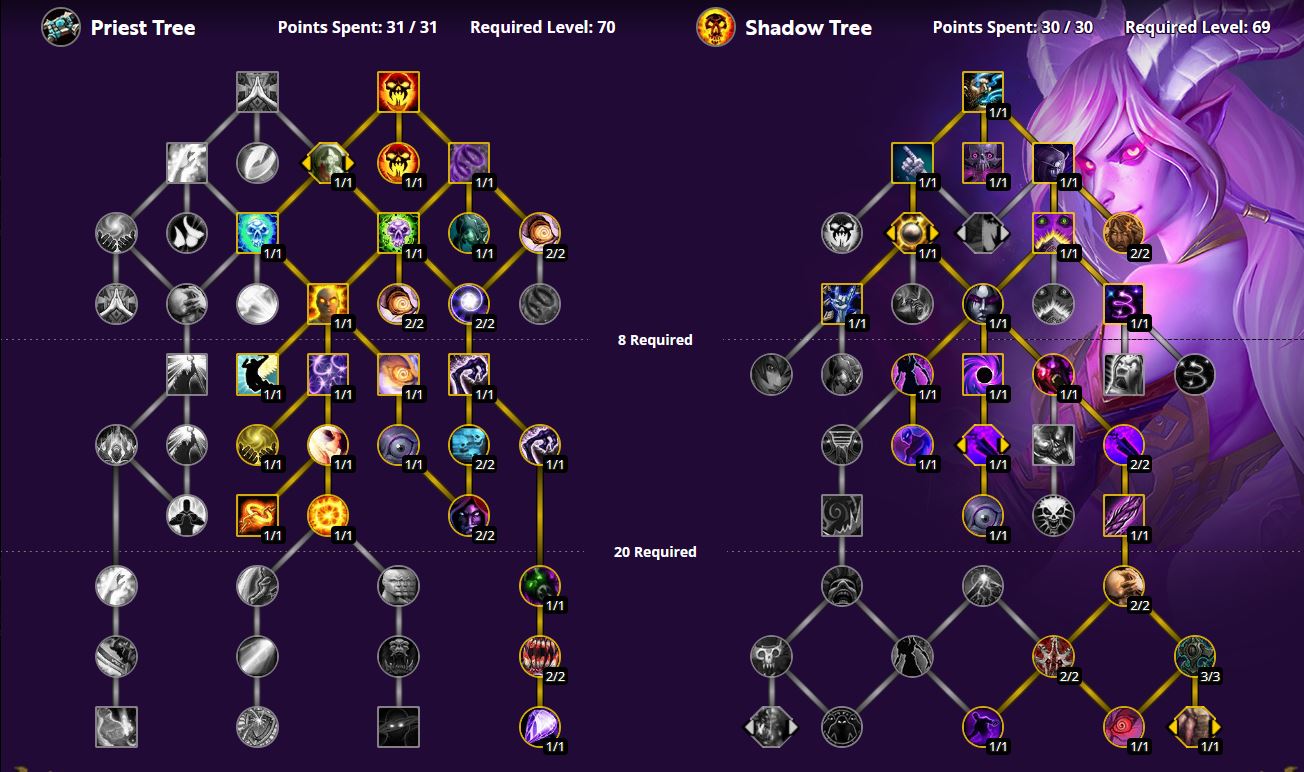
The image shows a fully filled talent tree – at level 70. This gives you a rough idea of how many of the available talents are actually up for selection and can be chosen. The tree in its current selection focuses on generating many shadowy apparitions, which then grant bonus effects such as creating a shadow servant that also casts spells.
Whether the talent trees can withstand modern times remains to be seen. Many players fear that there will simply be “the one correct way” again, and that in principle only successful talents from community sites will be adopted, without a real selection. However, Blizzard seems to be striving to create as great a variety as possible, so that there can be different playstyles within the same class and specialization.
How do you find the talent trees in Dragonflight so far?
If you want to refresh your knowledge of the WoW story, we have summed up the entire lore of World of Warcraft here.

Your opinion is important to us!
Do you like the article? Then let us know!