

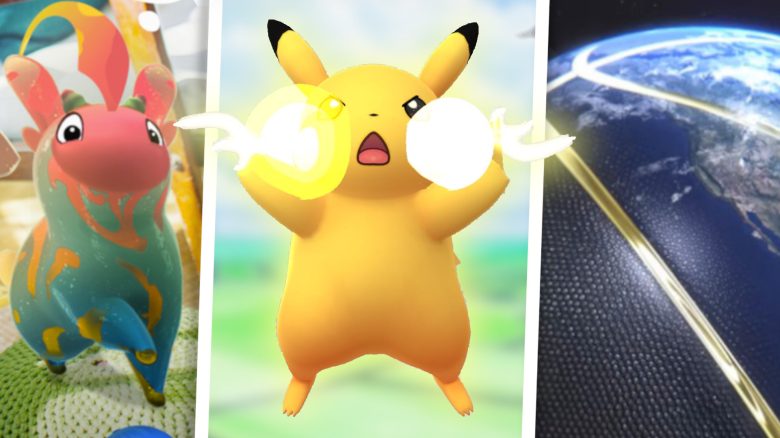
When Pokémon GO launched in the summer of 2016, it became a global phenomenon upon release. People roamed everywhere to collect the virtual pocket monsters in their neighborhoods. A success that developer Niantic has not been able to replicate to this day. Now, Peridot is set to try again.
How time flies: This summer, Pokémon GO turns seven years old, it’s practically entering the second grade. The big hype that surrounded the game’s birth is long gone. Scenes like back then, when players rushed in masses to catch a wild Pokémon are now quite rare.
But even today, there is a large, active community. They are still regularly out and about with Pokémon GO on their phones to catch monsters, participate in raids, or hatch eggs.
The game continues to generate impressive revenue. Statista reported the following revenue figures for the past years (via Statista):
- 2016: $550.45 million in revenue
- 2017: $444.75 million in revenue
- 2018: $607.68 million in revenue
- 2019: $653.59 million in revenue
- 2020: $909.11 million in revenue
- 2021: $874.4 million in revenue
- 2022: $645.59 million in revenue
The game has experienced its ups and downs. Just the last few weeks brought a lot of criticism after remote raid bonuses were removed, creating frustration within the community that even led to open letters, calls for boycotts, and petitions directed at Niantic. Who knows – if there were a really good alternative to Pokémon GO, players might even switch.
But to this day, no augmented reality game has been able to fill the niche that Pokémon GO has opened up on its own in the same way the current market leader does. In this regard, Pokémon GO remains a phenomenon. One that Niantic itself has tried to replicate multiple times – but has not succeeded to this day. Let’s take a look back.
The search for the AR alternative to Pokémon GO has so far been unsuccessful
In recent years, there have been several games aiming to lure players outside like Pokémon GO and connect gaming with the real world. The latest attempt is called “Peridot” – a game that can best be described as an “AR Tamagotchi”.
The concept is quite suitable for an AR game. A virtual pet is projected into the real world via the camera, which, by the way, works better at first glance than the AR function in Pokémon GO. The little creature is to be cared for, taken on adventures, and further Dots
bred.
The game itself is easy to play, but the release day on May 9 has so far come without much fanfare. There is, at least for now, a lack of attention. An indicator: The subreddit for Peridot currently has only 886 members, while Pokémon GO has 4.3 million members. Of course, this could grow further, and the development of the game remains to be seen – but at present, nothing suggests that Peridot will also become a global phenomenon.
However, “Peridot”, as a previously unknown brand from Niantic, logically has a harder start than Pokémon GO, which could draw on the immense appeal of the brand.
But just having the large brand is not enough. Other attempts in the realm of AR games have shown that.
- Harry Potter, for example, is an incredibly large brand that attracted some people to the game “Wizards Unite” at launch – Pokémon GO with wizards and Hogwarts. But after just 2.5 years, it fizzled out, the game was discontinued in January 2022. In the Google Play Store, it ended up with 10 million+ downloads, which was not enough to keep it going.
- Pikmin Bloom has invited people to walk since 2021 and enjoys positive reviews in the app stores, but has not become nearly as big as Pokémon GO. Pikmin Bloom currently stands at 1 million+ downloads in the Google Play Store.
- With NBA All-World, Niantic also released a basketball game where players could sign basketball stars at stops in the real world and play matches. Yet here, too, no great hype developed. It stands at 500,000+ downloads in the Play Store.
- Catan: World Explorers was also discontinued after about a year. It managed only 100,000+ downloads in the Play Store.
Peridot currently also stands at 100,000+ downloads in the Play Store but has just had its release day. Pokémon GO is currently at 100 million+ downloads in the Play Store. As a benchmark, this provides a good comparison base – even if official exact figures, or the figures from the iOS Store are not known.
Another indicator: Here you can see the current interest in Google Trends for Pokémon GO (blue line) over the past 12 months, compared to Peridot, Niantic’s first title Ingress, Pikmin Bloom, and NBA All-World. It can be seen that the search interest in the other games during this period does not match that of Pokémon GO, despite its age:
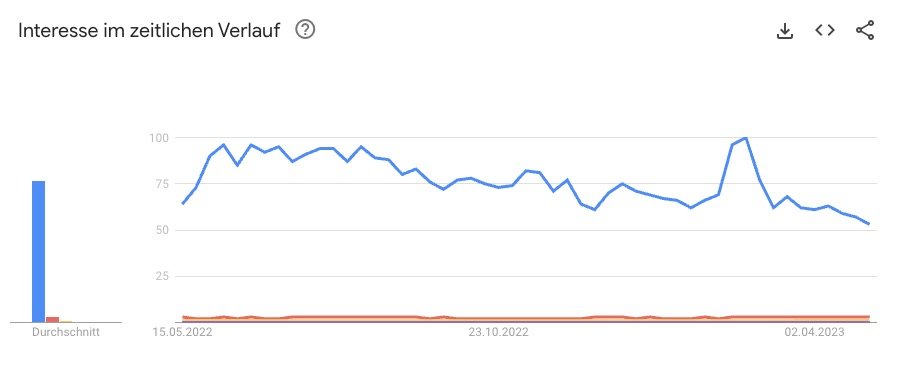
It seems: None of the experiments really wants to generate the same interest as Pokémon GO.
Another game about monsters is meanwhile already in the starting blocks: Monster Hunter Now is supposed to be another attempt to transform a popular game series into an AR experience. Whether that will succeed remains to be seen.
Niantic is not facing this issue alone: The Witcher: Monster Slayer, developed by Spokko and CD Projekt Red, also aimed to become an adult competitor to Pokémon GO. It did not succeed: In 2023, the game will be shut down.
Why is nothing comparable to Pokémon GO?
What makes Pokémon GO so successful? One could easily argue “it’s Pokémon”, after all, Pokémon is currently one of the largest brands in the world (via titlemax.com). And that is certainly a crucial factor, as one often sees the argument in the Pokémon community I play this game just because it’s Pokémon
and not because of the AR component.
There is also criticism regarding the design and gameplay decisions surrounding Pokémon GO. It is often mentioned that the game itself could actually be much better.
But looking at it a bit more closely, a few hypotheses arise as to why Pokémon fits so well with this type of game. On the one hand, it is a game that works for various age groups. Children can do a lot with Pokémon, but the target audience with a certain nostalgia for the franchise also gets engaged. Parents can play with their children, friends can go out together – it is a game for everyone.
In addition, the mechanics that define Pokémon are not incredibly complicated and can be ideally transferred to a game like “GO”. After all, in the main games, one primarily walks around and collects suddenly appearing Pokémon. Exactly this is also the main content of GO: Discovering and collecting while exploring the world. In the case of Harry Potter, for example, this connection did not arise directly.
Team Rocket has also made it into Pokémon GO:
Also, the gyms from the main games have found their place in the game in a modified form. Simple, fitting elements were adopted. Notably, for example, that the breeding
aspect that is a bit more complicated has not found a place in GO – and now appears in Peridot.
Overall, Pokémon GO
is just very close to the pure gaming experience expected from the main brand. This is less the case with other candidates that wanted to fill the same niche.
Last but not least, longevity itself is an important argument for the game’s continued success. Many players who have been involved for years would be reluctant to have invested time and money only to then just drop out. This is perhaps comparable to WoW in the world of MMOs, where people always speak of the “WoW killer”, which simply does not come.
What reasons do you see for the success of Pokémon GO? And why is there no other game that can do it? Have you tried alternatives? Tell us in the comments.

Your opinion is important to us!
Do you like the article? Then let us know!