

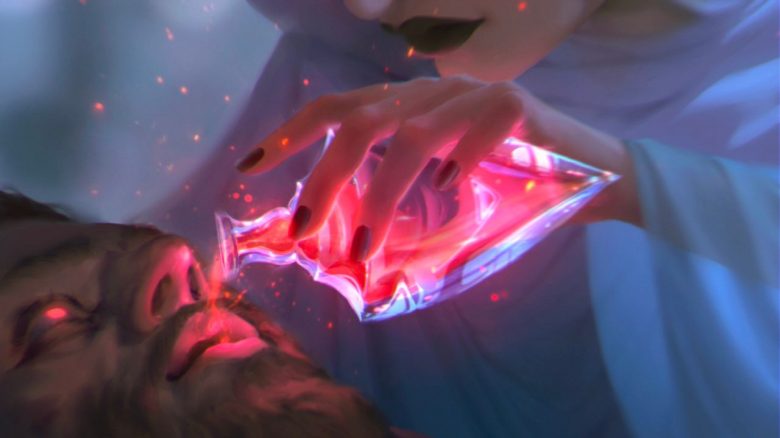
In video games, there are certain rules that transcend various titles and are universally understood by the general public of players. Rules that are taken for granted, which can be applied to almost any game and function without explanation – Or do you not know what a red potion does?
Those who play various video games will likely have noticed that healing potions or potions related to vitality are almost always depicted in red, while mana potions or potions related to magic are shown in blue.
Examples of this can be found in games like Elden Ring (see below), World of Warcraft, Baldur’s Gate 3, or even Dungeons & Dragons. A general understanding that is transferable to many different games.
To clarify the question of why red represents healing and blue represents magic, some knowledge of color theory in relation to game design is needed. What sounds like dry theory is actually more understandable and logical than one might think.

Thus, a kind of subconscious color language developed over the course of video game development as a medium that almost everyone who plays regularly understands. But how did this understanding come about? And how is each color used in video games?
Colors are used in the visual language of video games to convey information. They serve as signals that are meant to show players at a glance what to expect from something. The game has to explain less through text or dialogue, which the principle “Show, don’t tell” facilitates for better immersion.
What do certain colors mean in video games?
The meaning of individual colors has never been officially “determined” or randomly assigned. Instead, it lies in nature and culture and therefore elicits the same effect in many people.
Green and Red
The colors green and red are often associated with life. Green represents grass, plants, and nature. Red represents blood, decay, but also passion and courage. Life bars are often depicted in green and/or red, and many games use a red vignette at the screen edges to indicate damage taken. For this reason, a red potion is associated with healing and vitality.
Blue
Blue often appears in video games in relation to magic. It is the color of the sky and sea and also represents tranquility and focus. Mana is a resource that users of magic need when they have only a limited amount of spell power available.
The concept of mana in video games mainly comes from Southeast Asian cultures, where mana is considered a sacred power of supernatural origin. This influence of oceanic culture in relation to controlling a supernatural power of nature is the origin and reason why a blue potion is associated with magic and/or mana.
Yellow and White
The colors yellow and white are used in games for information and navigation. They are often employed in UIs to highlight or mark items, but also in the environment to indicate direction. They are bright and eye-catching and thus draw attention quickly, just like white stars in the dark night sky or a light from a lamp that shows the way.
Purple
Purple is often used in games for unknown and unnatural influences. In some cases, it is a secondary color of magic from a “corrupted” source. It is a color that rarely occurs in nature and was very expensive in earlier times. For this reason, the color is seen as a sign of royalty, corruption, and power. Additionally, it is often used for poison.



Of course, there are additional factors that can influence how colors are perceived. The saturation of a color (how bright or muted it is), the color palette (the harmony of the colors used), and the context of a color within a story can significantly influence its effect.
However, this brief excursion into the color theory of video games should clarify the question of why healing potions are red and mana potions are blue. Perhaps now you can even better understand other potions in their color design. By the way, there is also a fixed color code for loot: Why is loot always white, green, blue, purple, and gold?

Your opinion is important to us!
Do you like the article? Then let us know!