

The strategy game Crusader Kings 3 has been newly released on Steam since September 1. Since there is currently a lull in new MMOs, we take a closer look at the game. Our author Schuhmann explains how he plays Crusader Kings 3 and why it feels a bit strange nowadays.
Crusader Kings is, at first glance, a series that mixes strategy and RPG elements in the medieval period.
To the uninitiated, it involves things like: “Christians reclaiming the Iberian Peninsula from the Arabs”, “Bloody Crusades over Jerusalem”, and “Viking invasion of England”. It looks like a “game of thrones”, and Crusader Kings is often compared to the fantasy epic “Game of Thrones”.
For many hardcore players, however, Crusader Kings has been about building a genetically superior dynasty for 16 years by intentionally choosing who to marry to ensure that the next generation of characters is better than the previous one. It is a “game of genes”.
In Crusader Kings 3, characters have various “genetic traits”: The most desired trait is “Genius”, which gives +5 to all skills. In Crusader Kings 3, Genius also supports character development in the new “Lifestyle” system with a substantial bonus.
However, it is also beneficial if rulers are physically strong, particularly attractive, and fertile.
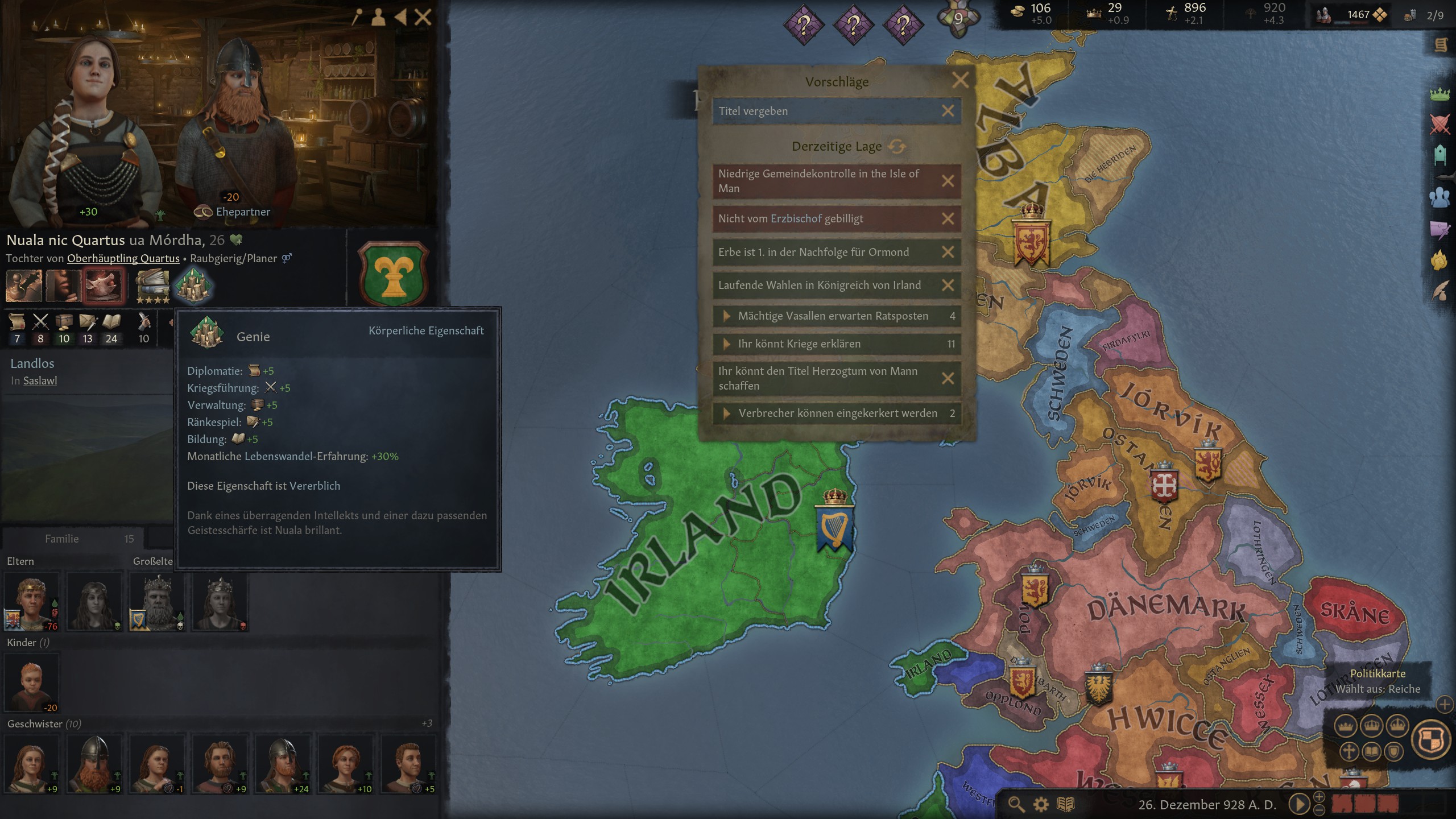
Everything in Crusader Kings 3 depends on 5 open values and some hidden ones that are influenced by these genetic bonuses. Those who are particularly beautiful receive a diplomacy bonus and are revered by their vassals, who pay higher taxes and recruit more troops for them.
This is important: Because when the Vikings come to raid, and they will, you want to meet them with a proper military force and not just with a few half-naked peasant lads.
A Genius Changes the World of Crusader Kings 3
Particularly important is the “Learning” value, as a wise ruler creates faster cultural progress and can thus drive inventions forward:
- It’s up to the player whether a land like Ireland remains undeveloped and wild in 930 A.D. – with little military strength and a weak economy that is plundered and occupied by nasty Vikings
- or if early marketplaces are established, people pay taxes, and obediently rally for the king.
If you have a series of fools in power, it can take centuries for inventions to enable the leap from the clan age to the feudal Middle Ages. A genius in power can influence the fate of the world in Crusader Kings 3.
That’s why it’s so important that the ruler has “good genes”.
Those new to Crusader Kings might think that genes are a matter of chance: sometimes you get a good ruler, sometimes you don’t.
But those who have been playing Crusader Kings for a while know that genetics is also something that lies in the player’s hands. While it’s about probabilities, these can be influenced.
Breeding your own dynasty, “breeding”, is a theme that is openly and frequently discussed in the game forums. However, journalistic articles apparently consistently ignore this: probably too sensitive a topic.

Players Have Been Searching for the Kwisatz Haderach for 16 Years
Ultimately, you breed the king in Crusader Kings in one generation, with whom you will play in the next generation: If you marry two smart people together, offspring will come out who are also sure to be “smart” and even have the chance to become even smarter and thus receive a higher bonus.
Many have been playing this game of genes since the first Crusader Kings. In forums, there has always been discussion about how to breed the “Kwisatz Haderach”: This is the desired result of a breeding program across generations from the sci-fi epic “Dune”.
It is the “Overman”, who embodies all positive genetic traits and carries none of the negative ones.
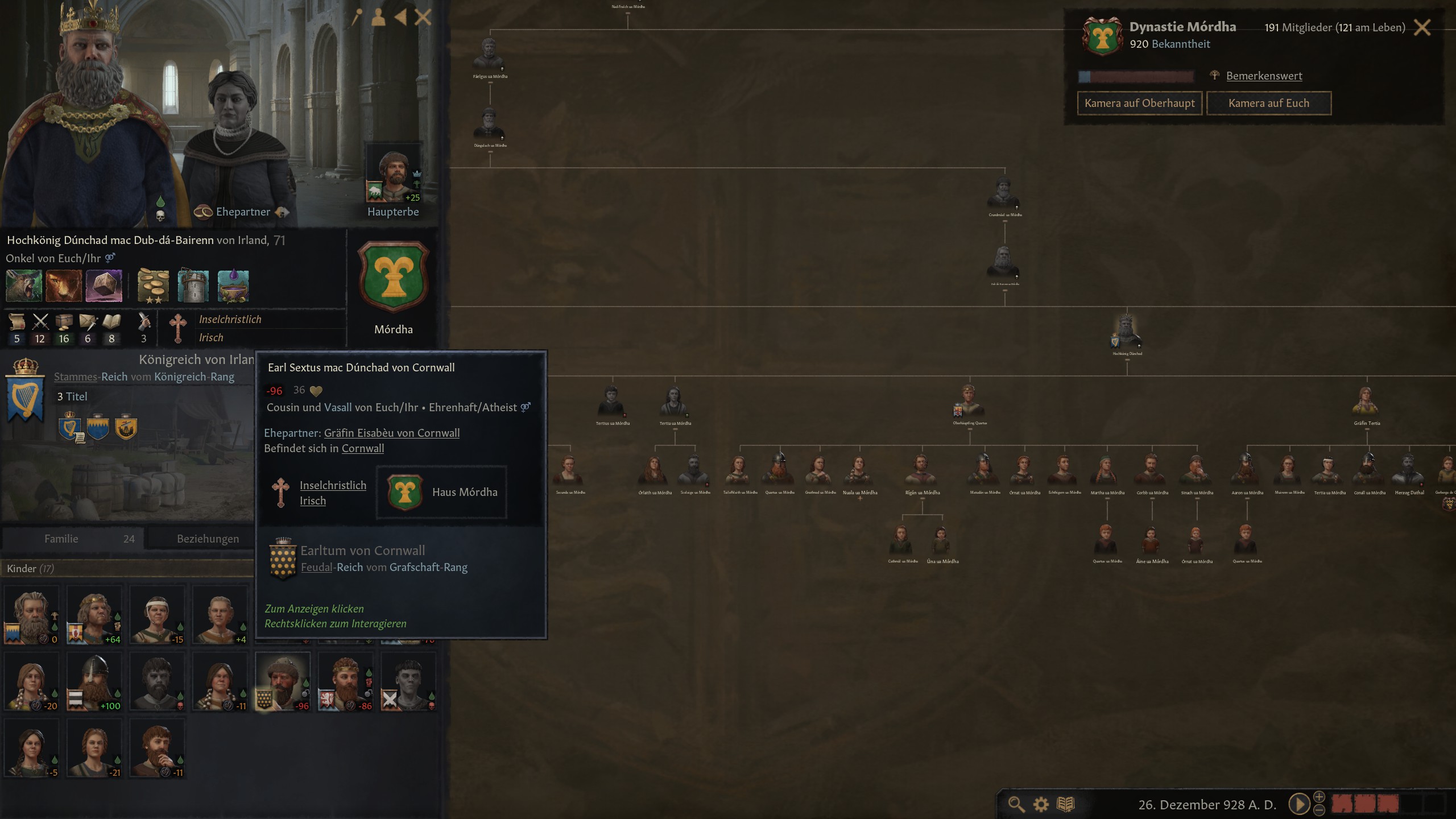
I have been playing Crusader Kings for sure for 15 years primarily in the same way:
- I start at the lowest level and at the earliest possible time in Ireland – with a preferably young ruler. In earlier titles, I could create my own. In CK3, there is a 24-year-old chieftain in Ormond who is suitable.
- My character snatches up the woman with the best genes he can find and populates the world properly.
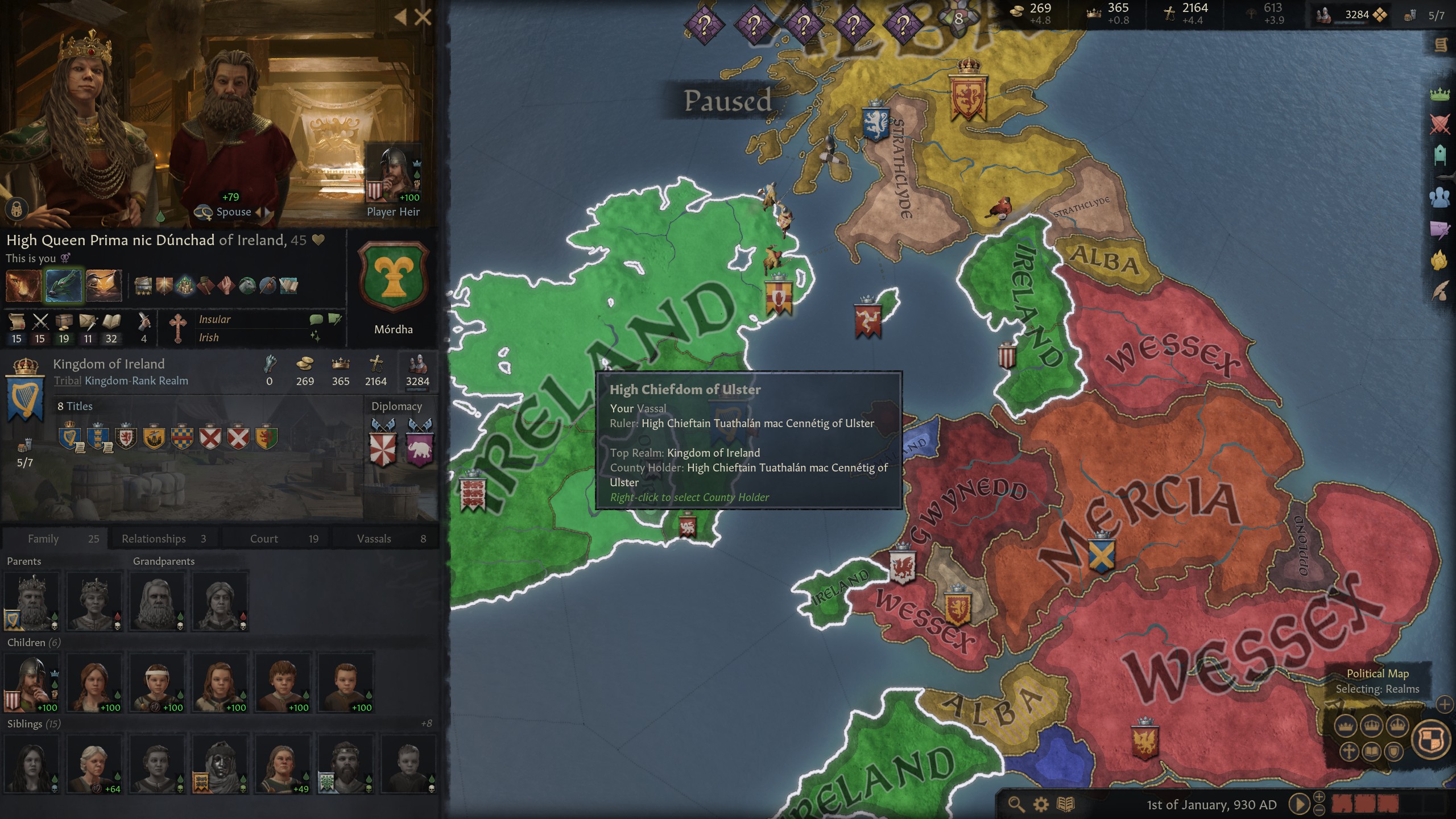
- From my small county, I first conquer the neighbors and become a duke. Then I slowly take Ireland and crown myself king. Now it’s Scotland and Wales turn.
- I distribute the conquered provinces among my offspring and ensure that they too are married to genetically strong women: In Crusader Kings, “Nobles” with their own realms breed best. Because the game mechanics ensure that landowners have more offspring, while landless dynasties remain small and die out.
- I rely on an elective monarchy: This ensures that the best one of a generation becomes my ruler (and my character) for the next 20 to 50 years – if all goes well.
Gene Experiments with a Guilty Conscience
This playstyle has been possible since Crusader Kings 1, and when you realize what you are doing, you get a pretty uneasy feeling.
Ultimately, it’s the same as explained in the movie “The Crimson Rivers”: You are running a breeding program over generations, which has a slightly Nazi-like vibe. But it’s just so much fun to play with the characters and see what comes out. It fulfills a desire for power and is an exciting dynasty simulator.
There is a fascination in this playstyle. You look at the world you have created like an ant farm, and you know: “Practically every character there was created by my decisions.” Then you look around after 200 years and see that the great-great-niece has somehow become the Empress in Byzantium, because last Monday you urgently needed an alliance and married a daughter there. Or there is an obscure French branch of your own dynasty that you can’t quite explain how that happened.
I have always played Crusader Kings like this, but a bit sheepishly and with a guilty conscience. I thought I should see it more as an RPG and less as a medieval breeding program.
Crusader Kings 3 Massively Promotes Gene Playstyle
What surprised me after nearly 30 hours in the new game: In Crusader Kings 3, this playstyle is massively supported. What I previously did with a slight guilty conscience, many apparently did so much that it has now become a playstyle that Crusader Kings 3 fully embraces and supports:
- When I want to marry someone, I can specifically search for “heritable traits”: In Crusader Kings 2, I had to painstakingly type in the individual traits.

- There are now “Dynasty” perks that promote such breeding programs: A game mechanic ensures that positive traits are particularly well passed on in my dynasty.
- There is even a special bonus “Strong Blood” if I manage to breed a ruler who has good traits from all 3 genetic areas.
- In Crusader Kings 2 there were “4 positive genetic effects” – in Crusader Kings 3, I have already seen around 12 or so.
- Additionally, at the early start in Ireland, a ruler can have up to 4 wives. This quickly leads to a family tree in which you can completely lose yourself. In the past, it took several generations until you had enough offspring to occupy each free county. Now it can happen immediately.

The Community Loves Incest, and So Does Crusader Kings 3
A catch with such “breeding programs” is incest. The likelihood of inbreeding was measured in Crusader Kings 2 by how many different relatives a character had in the last 5 generations. It was simulated this seriously:
- If everything goes normally and no incest is practiced, that’s 62.
- If you had fewer than 32 different ancestors, the likelihood increased for the negative trait “Inbreeding”.
- If it was less than 17, you certainly had this negative “Inbreeding” trait, which makes a character practically useless.
With the gameplay involving genes, it quickly becomes the case that you flood Ireland with your own descendants. They are then in the key positions of power, and only there do characters have many descendants: Because the count or duke of a province may mechanically have more children than a simple NPC without a “great house” behind them.
After just a few hours of gameplay, your own dynasty has spread across the realm and continues to multiply from there. The AI likes to marry dynasty members to each other, as it makes sense for vassals to marry the neighbors’ children, securing militarily valuable alliances and enabling inheritances.
Inbreeding can lead to unintended side effects in Crusader Kings. Children are born with particularly negative traits, may be fertile, or suffer from genetic defects. They also tend towards madness. This has also been frequently discussed in the community of Crusader Kings 3.
Some made it a fun challenge to keep the bloodline as “pure” as possible – reminiscent of “Game of Thrones”; where the Targaryens married children among each other. The dynasty was also considered prone to rampant madness.
In Crusader Kings 3, the developers have also considered this gameplay mechanic. There are the traits “Pure Blooded”.
If you practice incest over generations, the developers say, there is a chance that the dynasty will notice the negative consequences of inbreeding less, because it has managed to breed out “negative traits” from the gene pool over time.
In test reports on Crusader Kings 3 (like those from our friends at GameStar), I often read: the game has consistently developed Crusader Kings 2 further. This is certainly true.
What the developers have essentially done: They have looked at how people actually played Crusader Kings 2 and made it easier for them to play as they wanted to.
And apparently, many want to play Crusader Kings as a genetic building kit, dynasty, and incest simulator – just like I do.

I play Crusader Kings exclusively in single-player mode, but it is also a game that you can play in multiplayer. If you want to play strategy games as an online game against other humans and not just against the AI, which you can easily outsmart at some point, we recommend a series of titles: