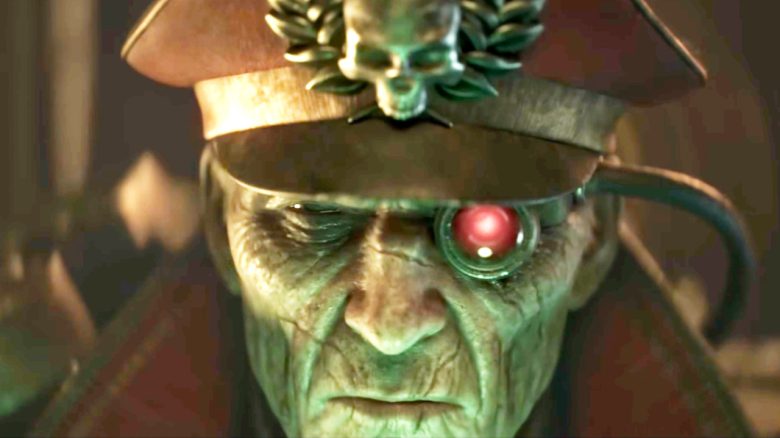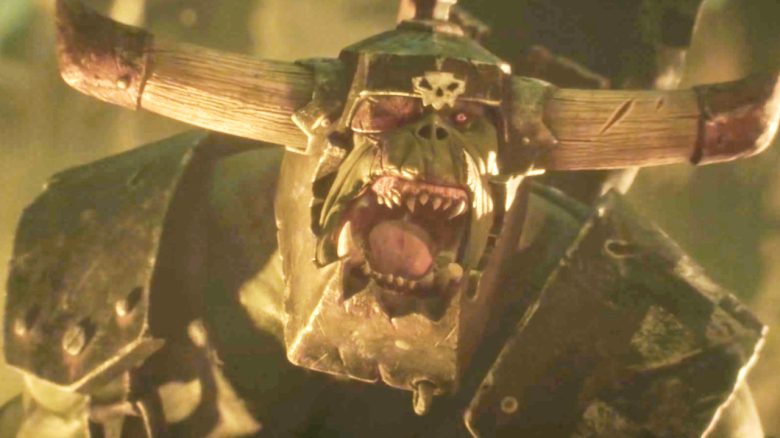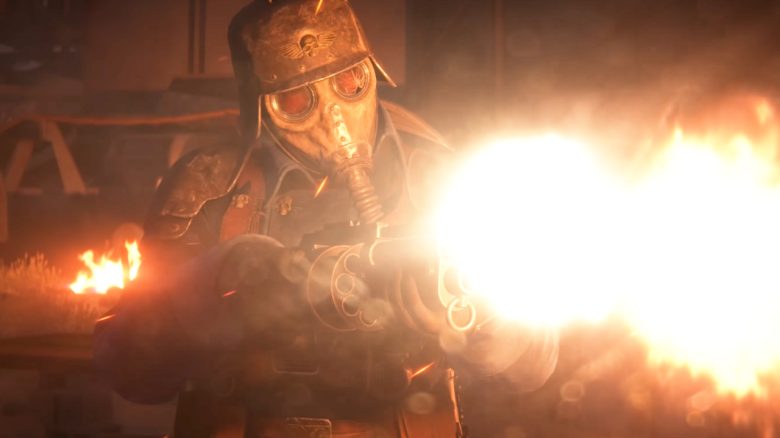

The world of Warhammer is divided into three universes, each of which stands on its own but is still somehow connected. MeinMMO explains the relationship between Warhammer Fantasy, Warhammer 40,000, and Age of Sigmar, and what makes these worlds unique.
If you want to get into Warhammer today, you will be confronted with a huge world. Each part of Warhammer has its own lore, its own heroes, and characteristics. In short:
- Warhammer Fantasy, or now “The Old World”, is the original fantasy world with elves, humans, dwarfs, and orcs.
- Warhammer 40,000, the science fiction world full of heavily armored super-soldiers, fanatical warrior-priestesses, and… space elves and space dwarfs does many things similarly, just on a much larger scale.
- And Age of Sigmar, the latest iteration of Warhammer, is particularly interesting for players who like fantasy with a certain, quirky steampunk element in Frankenstein style.
Even though each of these worlds stands on its own and brings its own lore, they do have some commonalities, which go far beyond the name. All Warhammer universes are interconnected in certain ways. We will attempt to provide a comprehensible explanation.
Warhammer Fantasy – The world where it all began
The original Warhammer, where it all began in the 1980s, is the fantasy version of the game. Here knights in armor meet dwarves in fortresses, wood elves with bows, or nasty rat and beastmen.
You can expect a classic high-fantasy world, and by the way the world where Warcraft originates – just much dirtier. Warhammer Fantasy borrows many things from our history and aligns factions with real nations, such as:
- Bretonnia, which roughly corresponds to the similarly named Brittany and combines French culture with the British Arthurian legend
- the Empire, which bears strong similarities to the Holy Roman Empire of the German Nation
- the Great Empire of Cathay, which resembles ancient China and is the newest army available in the game
- pirates, which exist in the form of… vampire pirates, of course
- or very unmistakably the nations Nippon (Japanese for Japan) or the kingdoms of Ind
Warhammer Fantasy eventually ceased to exist, and there is a lore reason for that: the world was destroyed during the “End Times.” Archaon, the Everchosen and 13th Champion of all Chaos Gods, destroyed the “known world” in his crusade and left only the “World-that-was” behind.
Today, Games Workshop is working on reviving the fantasy world in the form of “The Old World.” However, the actual sequel is much wilder.
Age of Sigmar is what remains after the end of the world
In principle, Age of Sigmar picks up where Warhammer Fantasy leaves off. As the world is destroyed, Sigmar – the Imperator and God-King
of humans – and some powerful characters manage to escape into another world.
These new “Realms of Mortals” are interconnected worlds where Sigmar and others act as gods. What fundamentally distinguishes Age of Sigmar from Warhammer Fantasy are:
- quirky, more sci-fi reminiscent concepts like the Stormcast Eternals, which roughly resemble Space Marines or even the cybots bound to their duty even in death
- the historical context that Warhammer Fantasy had has been reduced in favor of more freedoms in a high-fantasy world
- with “Order” and “Chaos,” there is a clearer line between factions, but morality is still rather in the gray area
Chaotic dangers include the Skaven from Warhammer Fantasy, which have also made it into the world of Age of Sigmar and represent one of the greatest threats there. In fact, Age of Sigmar has a significant peculiarity here.
Actually, the four Chaos Gods Nurgle, Slaanesh, Khorne, and Tzeentch are the same for every Warhammer world. They are the only continuous connection between all three universes and are supposedly always the same entities.
In Age of Sigmar, however, there is a fifth Chaos God, the Horned Rat. This God is neither in Warhammer Fantasy’s pantheon, nor in Warhammer 40,000, where the Skaven no longer exist. However, Warhammer 40,000 has its own developments.


Warhammer 40,000 – More than just “Warhammer in Space”
Newcomers often think that Warhammer 40,000 is simply equivalent to Warhammer Fantasy and takes place 40,000 years later. However, this is not the case; the worlds are fundamentally different.
The most important feature: Warhammer 40,000 is actually “our” world, just far in the future. Important wars and events from our world have also happened in Warhammer 40,000, and the Emperor was born on our Earth a few thousand years ago.
To roughly imagine the world, the comparison of “Warhammer in Space” is quite fitting, as many elements are the same or similar:
- The Imperium of Man is still there, just much larger (and politically questionable)
- Elves and Dark Elves appear as Aeldari and Drukhari
- Space Dwarfs are also there, the conglomerates of Votann have a slightly different story
- Greenskins are now simply Orks, who have been in the story for quite a while
- In that context, the Necrons – formerly Necrontyr – are probably the oldest race that still exists in Warhammer 40,000 and correspond to the Tomb Kings from Warhammer Fantasy
In general, the world of Warhammer 40,000 is vastly larger. Where Warhammer Fantasy only takes place on one planet, Warhammer 40,000 consists of billions of worlds connected by the Warp. Battles with a few million participants are a daily occurrence here.
The Horus Heresy is part of Warhammer 40,000, but is not Warhammer 40,000
As it would be too easy to have just these three connected yet separate worlds, Games Workshop has been releasing the latest set under the name “The Horus Heresy” for some time.
This set takes place during the time of the Great Brother War in the 31st millennium – so it is actually Warhammer 30,000 (which is also a common term among fans, but not an official setting).
There are numerous fundamental differences to Warhammer 40,000. For example, there are still some armors and weapons that have been lost today and the legions of Space Marines are entirely differently structured. The great reformation only took place after the heresy, as this was the very reason for it.
Simplified, one could say:
- If you are into gritty fantasy for adults, The Old World or Warhammer Fantasy is your setting.
- Sci-fi fans who find Star Wars and Star Trek too clean have a home in Warhammer 40,000.
- If you can’t decide and want a bit of both, play Age of Sigmar.
- If you find the scale of Warhammer 40,000 not absurd enough, read up on the latest set surrounding the Horus Heresy.
If you are interested in the lore behind it, you can dive into any of these worlds with loads of books and fan wikis. The Lexicanum (and of course MeinMMO) is a good starting point for free information. If you prefer books, you can find a few tips here: There are over 350 books on Warhammer 40,000 – these are the 15 best for getting into the world