
MMORPGs like World of Warcraft statistically show one of the highest addiction risks among various gaming genres. We wondered why this is the case and sought answers from psychologist Karl Brühwiler. He specializes in gaming addiction as a psychotherapist and provided us with deeper insights.
This is the background: Here at MeinMMO, we deal with video games daily and are passionate gamers ourselves. The same probably goes for you, dear readers, as otherwise, you would likely not be visiting us right now. It is a hobby that we share and brings us joy.
Uncontrolled gaming can become a problem. The World Health Organization (WHO) decided in 2018 that the addiction to video games and its accompanying symptoms are officially considered an illness. In this case, it is referred to as “Gaming Disorder.” Especially players of MMORPGs are particularly at risk.
We were interested in what lies behind this strong attraction of MMORPGs and why they can make us addicted. We asked psychologist Karl Brühwiler, who was able to name four reasons that stand out in this genre.

Who is speaking? Psychologist Karl Brühwiler is the chief psychotherapist at the foundation Albisbrunn, which supports adolescents in developmental crises. Mr. Brühwiler is a child of the 80s and grew up with video games. In his work, he often encounters gaming addiction and has specialized in it. Mr. Brühwiler manages the blog gamesucht.com, where he publishes informative articles on the topic.
Mr. Brühwiler explained to us in writing why MMORPGs are particularly addictive. He wrote the following lines for this article and made them available to us:
How do you know that MMORPGs are more addictive than other genres? Players of MMORPGs show, on average, many symptoms of addiction compared to players of other genres. This is evidenced by a study by A. Eichenbaum and colleagues from 2015, which investigated an American sample of 4744 students.
An earlier study by Smyth and colleagues (2007) also showed that MMORPGs, compared to other genres, had a greater impact on the number of hours played, the mental and physical health of players, and on their social life.
The following section lists 4 reasons from Karl Brühwiler why MMORPGs can be addictive:
The social appeal of MMORPGs
Already 15-20 years ago, it became apparent that many young gamers were literally “sunk” into the then emerging first generation of MMORPGs like Ultima Online, Everquest, World of Warcraft, or Asheron’s Call. Offline role-playing games like Baldur’s Gate, Fallout 1, or Planescape Torment suddenly became much less appealing. Gaming was done to the fullest of what the 48.8k modem could provide.
In this personal column from GameStar Plus, the author highlights the dangers of online gaming addiction. And how he gained a closer bond with his father through WoW. (To read the texts from GameStar Plus, a paid online subscription is required.)
Even today, MMORPGs still have a strong appeal. Players join guilds and gain social status online. They embark on shared adventures and feel a sense of brotherhood. Unlike MOBAs like League of Legends or real-time strategy (RTS)
online role-playing games are less micro-based and less competitive. Primarily, it is about immersing oneself in fantastically designed worlds and developing one’s own character. Often it is also about the social union with others.
Gaming is simply a great hobby for these MMORPG fans because it offers many players a sense of what they miss in real life. They can take on responsibility in the group, feel like a hero, engage with exciting stories, and escape the gray, demanding everyday life.
MMORPGs and Human Primary Needs
MMORPGs correspond to the primal human need to play a vital role in the social structure, to develop, and to experience adventures. During puberty, young men release more testosterone, which is responsible for the development of goal-directed, positive aggression. 10,000 years ago, this was the time when young men were given a spear and tasked with helping in the hunt and contributing to protecting the tribe from enemies.

Today, these testosterone-laden youths sit in classrooms and have a lot of personal responsibility but very little external responsibility. These primal needs, which are not always easy to satisfy in a performance-oriented society (and by the way, also during the gameplay of offline games), are met in MMORPGs.
Players collect items for the clan. They help each other with challenges. They learn from one another and experience the same adventures. This is one of the main reasons why MMORPGs continue to be so popular and why they often have a long-standing, loyal player base.
Neurophysiological Mechanisms in Video Games
MMORPGs generate – like other genres – neurophysiological incentives through loot drops, gaining XP, and defeating opponents. Every time the player collects loot, defeats an opponent, or earns XP, a small amount of happiness is created in the brain, which corresponds with the release of reward hormones like serotonin and dopamine, also released when consuming drugs.
In extreme cases, and with corresponding predispositions and excessive consumption, a habituation of the brain to this release of happiness hormones can develop over time, leading to the formation of an addiction.

MMORPGs Are Fun and Have Addiction Potential
The neurophysiological incentives and the satisfaction of these human primary needs are the reasons why MMORPGs are both a lot of fun and have a high potential for addiction. However, this does not mean that someone who plays a lot is automatically addicted.
As with any medication, what matters is whether the user can manage it responsibly. MMORPGs can be a great, fascinating hobby that gives the player the strength to bridge what can sometimes be a dreary everyday life and then tackle it again with full energy after playing.
However, they can also lead to the player’s priorities shifting and the tasks and obligations of everyday life being neglected.
In summary, we learned from Mr. Brühwiler’s lines that MMORPGs:
- have a strong social factor through functions like clans that convey a sense of comforting togetherness
- satisfy human primary needs that are sometimes lost to us in modern everyday life
- trigger a release of happiness hormones in the brain that, especially in habitual use, can lead to dangerous consumption
- are similar to a medication, where it depends on whether the user can handle it
How do I know if I am at risk of addiction?
These are criteria for the diagnosis of gaming addiction: According to the APA (American Psychological Association), at least 5 of the 9 criteria from the graphic below must apply to diagnose gaming addiction. The APA is a large North American professional association for psychology. The symptoms are based on those for pathological gambling addiction.
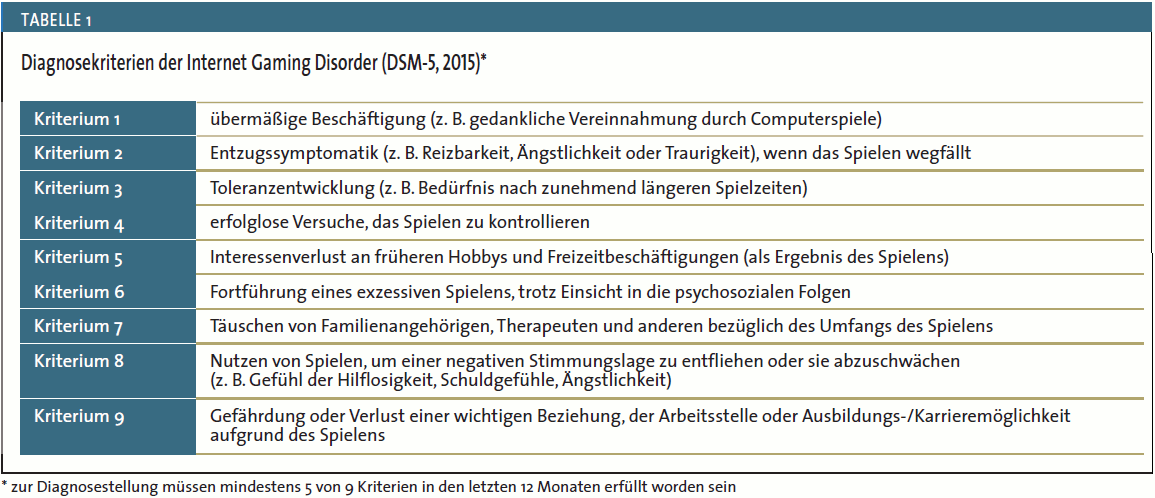
These 9 criteria can be found in the manual for mental disorders (DSM-5) of the “American Psychological Association.” This catalog is used in the USA for the definition of mental illnesses.
The World Health Organization (WHO) also has such a guide (ICD-11 catalog) and establishes a total of 3 criteria for the diagnosis of Gaming Disorder:
- the priority of gaming over other activities
- the frequency and duration of gaming
- continuing to play despite negative consequences
Warning: At this point, we would like to point out that self-diagnosis is not sufficient to ascertain an addiction. If you feel that you are affected by (Internet) gaming disorder, you should seek professional help.
Here you can find help:
- The Media Dependency Association has an overview of clinics and self-help groups in the area of “Gaming Disorder”
- OASIS, the Online Ambulance Service for Internet Addicts, is an alternative
What do you think about this topic? Do you find the reasons understandable?