
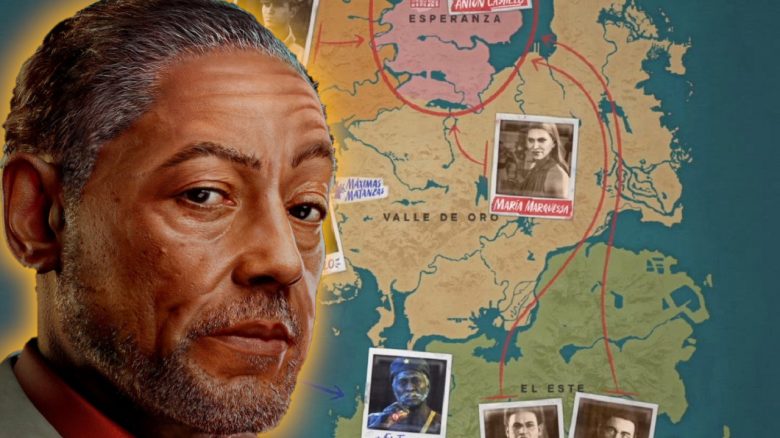
Ubisoft has recently introduced a new cloud-based technology called “Scalar.” This is said to allow for the creation of “even larger worlds.” In the presentation, this was portrayed as something good. MeinMMO author Tarek Zehrer, however, believes: Games don’t need this.
What kind of technology is this? Here’s the summary:
- Scalar is based on cloud technology but is not meant to be a streaming platform like GeForce Now or Google Stadia.
- Rather, the cloud takes over tasks that would otherwise have to be calculated by graphics cards and chips thanks to Scalar. Thus, for example, the computation of AIs, in-game physics, and other things could be outsourced.
- This is expected to make it possible to create technically more demanding games without needing to upgrade the hardware again.
Here you can watch the trailer:
The announcement states that Scalar is supposed to enable “even larger” games. At first glance, that sounds good. But then I remembered how Ubisoft’s games have been structured over the years and how the infamous Ubisoft formula has established itself.
For me, this is not good news. It’s akin to a threat.
The Ubisoft formula shows that “larger” does not equal “better game world”.
Ubisoft has built in a number of systems and features in numerous franchises like Assassin’s Creed or Far Cry 6 that are nearly identical in every new installment. This is known among gamers as the Ubisoft formula.
The best example here is Far Cry 6, which was released 10 years after the 3rd part of the series. But regardless of whether it’s 2012 or 2022, the pattern has remained exactly the same:
- One takes a “twisted” setting with an “iconic villain”
- Add a huge game world as an adventure playground.
- Some generic enemy strongholds are interspersed, mixed with repetitive mission types.
- On top of that, one adds imposed RPG mechanics, predictable skill trees, and resource grinding.
- The whole thing is framed by a meaningless story that can at best pretend to be provocative.
- Also “iconic” are the lookout towers that reveal parts of the map. This mechanic has been copied numerous times in other games since then.
The series evolved from action- and story-heavy games with compact open worlds to games with absurdly large worlds.
The maps are getting larger and larger, while the content becomes more monotonous, stretched, and generic. This video shows you how ridiculous the dimensions have become:
And now Ubisoft wants to bring even larger games with new technology? For whom, who even wants this? One can only hope that with “larger” something other than the dimension of the next mega-map is meant.
Open-world games need many things, but not more boring time-eating tasks
I am a fan of games with large, open worlds and have loved many of them. And yes, I used to have fun with games like Far Cry 3 or Assassin’s Creed Black Flag.
But back then, these formulas were still relatively new and served their purpose, especially since they were created due to the limited resources of the developers. However, if, almost 10 years later, there are barely any advancements in terms of variety and quality, I start to wonder.
Ubisoft should focus much more on filling larger worlds with meaningful content rather than creating larger worlds. Because nothing is more boring these days than a packed, generic game world where nothing feels special.
There are plenty of examples that do it better.
- Those include games like Elden Ring, Zelda: Breath of the Wild, or Red Dead Redemption 2. They are by no means perfect, also have massive dimensions and their own issues.
- But they fill these game worlds in a meaningful way, or offer outstanding gameplay, as in the case of Breath of the Wild’s sandbox mechanics. Thanks to the incredibly good game physics and the possibilities to exploit them, the world has a pull and is literally a playground.
- Or they are extremely immersive like RDR2, which presents a believable world at the beginning of the 20th century in the dying Wild West, including a grand story and characters. The game world serves here as an unbelievably beautiful backdrop that carries the main story while still offering freedoms for players who want to spend more time in it.
- Elden Ring, on the other hand, excels in using exploration as a central gameplay mechanic and does not throw everything at you with quest markers. No matter which corner you are currently exploring, there’s something cool to discover. It hides its valuable loot so well sometimes, that it makes you really paranoid. That’s why, in my eyes, it also has the best open world to date.
Such elements are clearly missing in games like Assassin’s Creed and Far Cry. The maps are littered with icons, the backdrops are beautiful, but offer hardly any interaction options. There is now no feature, aside from their size and nice graphics, that really stands out.
In this regard, I hope that Ubisoft doesn’t mean simply enlarging the maps with “larger.” Rather, the technology should be used to move away from the efficient but excessively worn-out Ubisoft formula and bring some depth to the worlds.
Whether this happens, I doubt it. The successes of Far Cry 6 and Assassin’s Creed Valhalla show that the Ubisoft formula is at least financially very profitable.
So why dismantle a functioning system? But hope dies last, and perhaps Scalar will indeed turn out to be a “game changer.”
But what do you think about the topic? Do you have similar concerns or are you more optimistic than I am?