
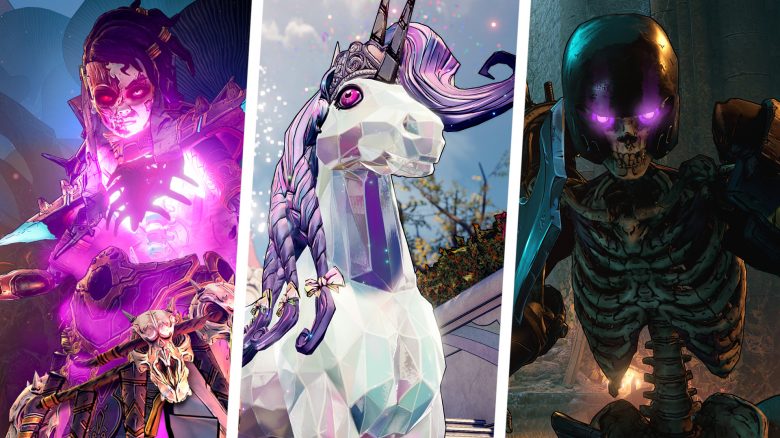
After Borderlands 3, things get magical: The spin-off “Tiny Tina’s Wonderlands” throws the familiar Borderlands mechanics into a fantasy world that is meant to feel like a living tabletop game. In an interview, the developers explained to us how this works.
Who is speaking here? On March 25, 2022, Tiny Tina’s Wonderlands will officially be released – a fantasy looter-shooter that combines the absolutely crazy firearms of the Borderlands series with everything you would normally find in fantasy worlds.
We spoke with Matt Cox (Creative Director), Adam May (Art Director), and Gabriel Robitaille (Senior Level Designer) to get a glimpse into the world of Wonderlands.
The idea for the game didn’t come out of nowhere: Fans of the series were already given a glimpse into Tiny Tina’s imagination – namely with the Borderlands 2 DLC “Tiny Tina’s Assault on Dragon Keep,” which became a fan favorite.
“The inspiration from the DLC was there,” Cox explains: “But we quickly realized that a fantasy looter-shooter had to be a standalone game. Instead of making a bigger “Assault on Dragon Keep” game, we wanted to create some features that are 100% ours, 100% Wonderlands, and nothing else.”
One of these elements was meant to be a completely new kind of open world – the “Overworld,” inspired by tabletop games. Because the entire setting in the game corresponds – like “Assault on Dragon Keep” – to a tabletop style reminiscent of Dungeons and Dragons.
This should become a fundamental part of Wonderlands.
A bit of tabletop, a bit of Pokémon – The “Overworld” in Wonderlands
This is how the Overworld came to be: Of course, a large part of Wonderlands is played from the familiar first-person perspective, as you know it from Borderlands. However, the first-person areas are connected by the “Overworld.” Here, you move a bobblehead miniature of your character from point A to point B – in keeping with the game’s tabletop setting.
This is what it looks like:

“There were so many iterations of what the Overworld could look like. We even had figures with bases that weren’t animated, but could only wobble back and forth,” Cox reports.
The basic design of the miniature world went through various phases and also suffered from a few failures:
“At first, I tried it with tilt-shift photography: This can make large 3D spaces look flat – as if it’s a miniature model set. It looked really cool. But, what I didn’t know: When you move the camera around the player, this strange morphing effect occurred – and it made me sick for an entire afternoon. Kate, our lead world designer, also tried it on a small map, and she felt sick too. We both felt sick for an entire afternoon and had to take time off. So: That didn’t work.
Matt Cox (Creative Director)
Another variant was a world based on hexagonal tiles: “But it didn’t feel interactive and playful enough to fit the kind of world we envisioned for Tiny Tina, where players would move around,” explains Adam May: “In the end, the solution was somewhere halfway between a traditional board game and the players’ fantasy of moving within it.”
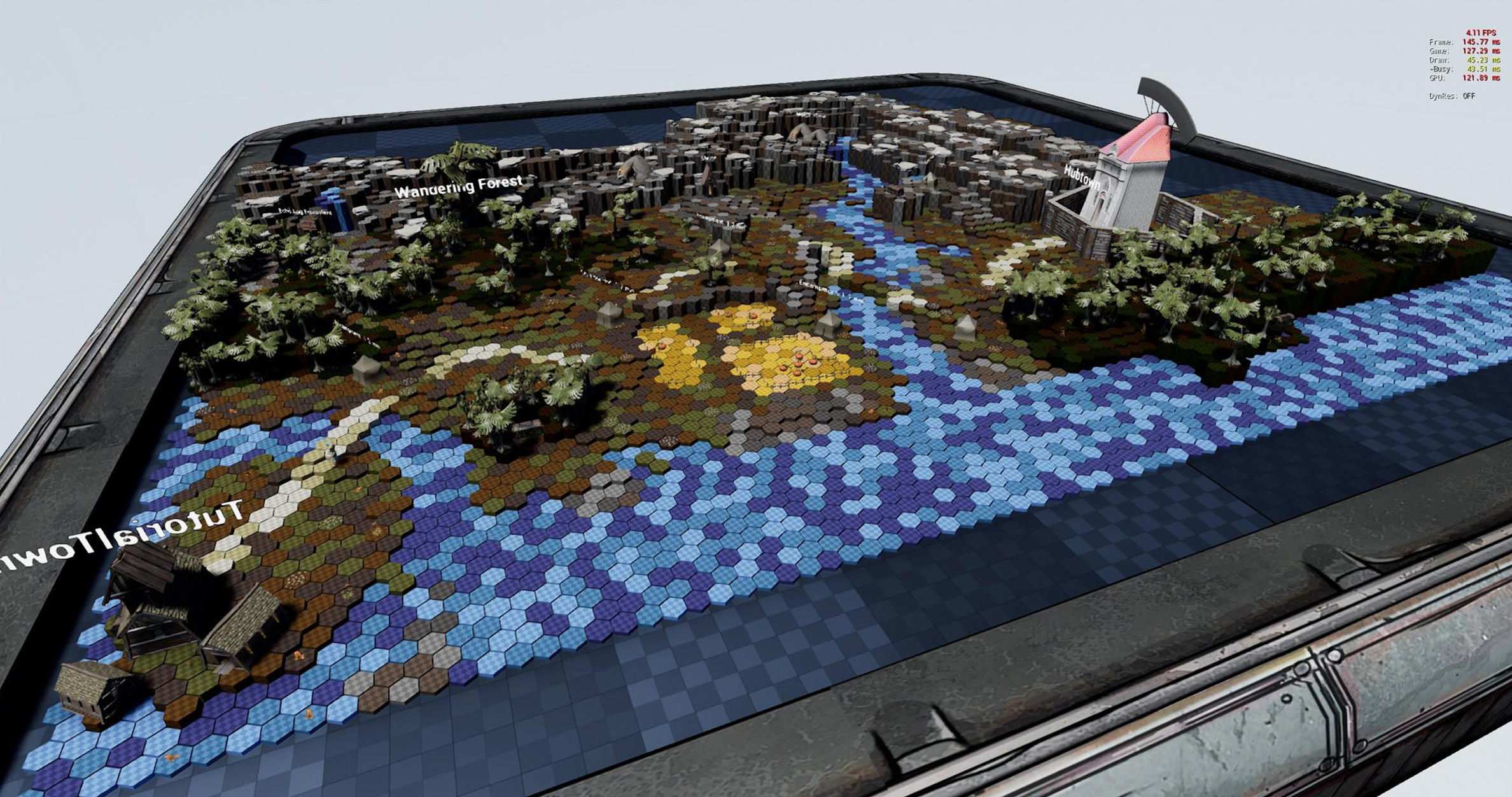
This is what makes the Overworld special: The final version is characterized, among other things, by a colorful appearance and a certain adaptability. Because, in effect, it is a game board subject to external influences. “We could do all sorts of fun things. For example, we have a drink can on the table that overflows. It turns into a winding river that the players have to cross,” May says: “The team has come up with so many fun ideas. For example, Cheetos that turn into a block that players need to overcome.”
Apart from the snacks through which the world can change, the Overworld also offers loot opportunities and enemies: “One of the challenges at the beginning was that we didn’t want to deal with low times,” May says: The Overworld brings “random encounters” – suddenly spawning enemies that can touch you to trigger a fight. In these moments, you seamlessly switch to the first-person view and fight in close quarters – a bit like in Pokémon.
“That’s a great reference point. Just like in Pokémon, there is tall grass – it’s the same: If you walk through the grass at the sides, they spawn,” May says. So you have to be careful even in the Overworld, and Gabriel Robitaille adds: “It looks like a playful and carefree place, but we want you to always be on your guard. We don’t want the Overworld to consist of Candyroad and Rainbow Avenue and everything to be fine. We wanted it to feel dangerous. That’s why we developed this random encounter system that can attack you.”
What’s exciting: These encounters, while challenging, can bring particularly strong gear if you survive the fight. Also interesting: If you want, you can simply fend off the random spawns on the Overworld with a melee attack and not engage in the fight, but continue exploring.
In general, exploration is an important theme: “The Overworld is the link between all these experiences. You have these small encounters, but you also have large maps. We even had them in the trailer: For example, the large goblin head that is not even on the plot line. That’s a huge map that you can discover when exploring the Overworld.”
There are supposed to be a total of 4 large areas – or “side modules” – that can be explored outside of the main story: “For those who like to explore, there will be a lot of content,” says Cox. How long exactly players will work on the story and the side quests, the developers did not want to reveal yet.
Meanwhile, there was also a glimpse into the combat system.
Borderlands Shooting with a Touch of Magic and Swords
How do you fight in Wonderlands? When you are not on the Overworld, you will move around in Wonderlands in the familiar first-person perspective. The gunplay and basic movements correspond to what you already know from Borderlands 3.
“We built Wonderlands on the BL3 engine. So all the elements you’re used to, like shooting weapons and how you move, will feel 100% right,” Cox explains, “but we’ve added a few things.”
These mainly involve magic and melee weapons.
“The weapons are still the backbone of our combat loot. But spells will be a big factor in your fights. There is no ammunition for spells; they all have a cooldown. They are like mini-skills that are ready faster than normal skills.”
Matt Cox
And because a fantasy game without swords and axes somehow isn’t a fantasy game, they are also included – along with a host of other melee weapons: “We pursue a combat style that is offensive and action-oriented.”
Instead of the simple melee attack from Borderlands, you can access a variety of weapons in Wonderlands: “Some weapons swing faster, some with more force, some slower.” They also can come with bonuses: “Melee weapons can return ammunition, some can return skill cooldown or spell cooldown.” This way, the weapons can have a direct impact on your overall build.
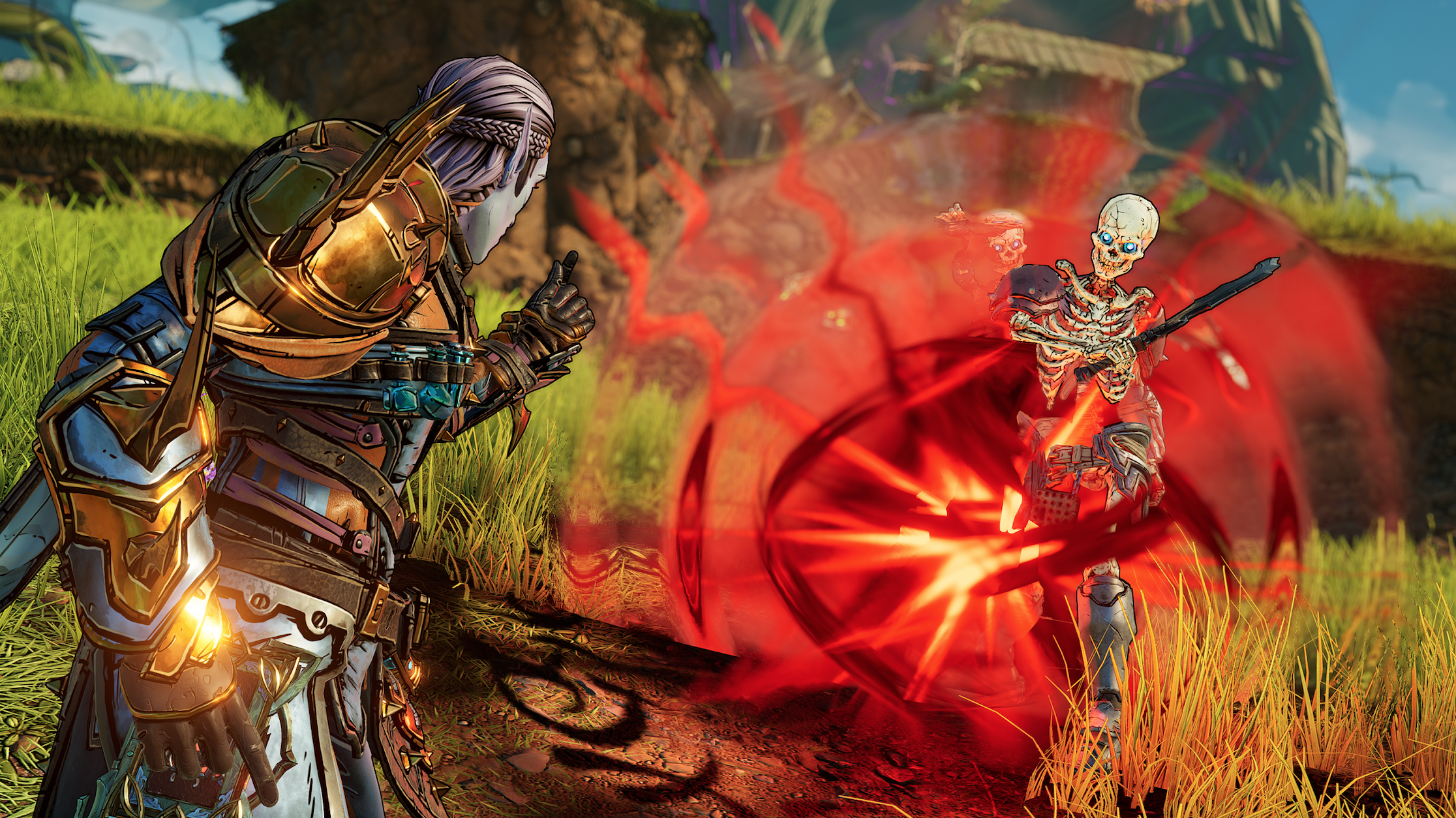
Nevertheless, besides firearms and magic, melee combat will take a complementary role. At its core, Wonderlands is still a shooter, and you wouldn’t necessarily rely solely on melee combat in Call of Duty either. Depending on your build, it can still be a powerful tool: “There are certain weapons and skills that can make you a melee powerhouse,” says May: “Then melee feels like bazookas from close range, with which you can recharge your skills.”
In general, May summarizes it this way:
Borderlands was fast and hectic, but mostly a pure shooting gallery. This is just as hectic, crazy, wild, and fun, but it’s like a constant back and forth between firearms, magic, and melee. Weapons are the only things that have ammunition.
More Freedom in Customizing Characters
Overall, players should be able to shape Wonderlands as they wish. This applies not only in combat: “Traditionally, you create your own character in tabletop RPGs, you have a character sheet. You can express yourself, depending on how you want to play the game,” explains Cox. That’s why in Wonderlands you also have the opportunity to create and extensively customize your own characters: “It was a very straightforward decision to develop a character creator, something we had never done in our games at Gearbox. That was a big deal for us.”
Visually, you get many options, says May. “You get tattoos, makeup, hair, helmets, not just skin colors, but also skin types – like diamond or gold.” These cosmetics are part of the loot and are meant to allow for crazy combinations: “You can be a fish person or a dragon creature. You can have one big eye and one small eye. It doesn’t have to be symmetrical. You can mix anything you want,” says May: “There will probably be a lot of monsters created.”
Everyone as they wish seems to be the motto – even with the classes. Overall, there will be 6 classes, each with different skill trees and abilities. As you know from Borderlands, you can freely distribute your skill points – and later in the game, you will also gain access to extra abilities.
Sounds like there’s a lot to do in Wonderlands. The final question remains about the endgame – which was only answered very briefly: “There will be an endgame. That’s all we can say for now, but we will reveal more about our endgame plans over time.”
For now, it seems like we just have to wait. Are you looking forward to Wonderlands, or is the fantasy looter-shooter mix not for you? Let us know in the comments!
For Cortyn from MeinMMO, Wonderlands could be a real hit. Here you can find his assessment.

Your opinion is important to us!
Do you like the article? Then let us know!