
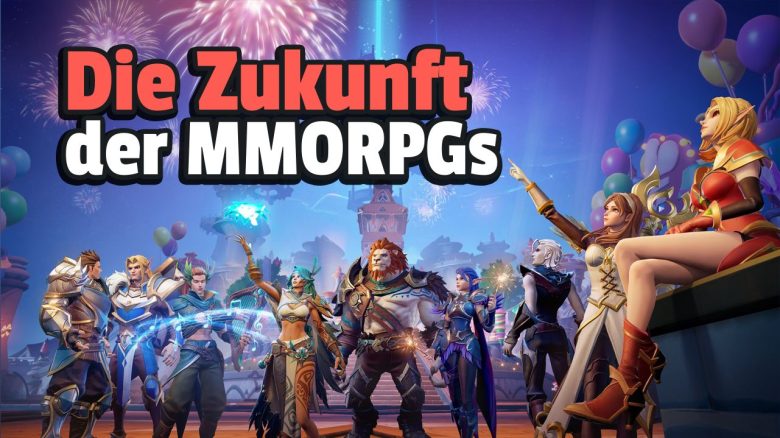
The genre of MMORPGs has fascinated and thrilled millions of players for decades. In a multi-part report, MeinMMO editor Karsten Scholz highlights the roots, development, and future of online role-playing games. Part 6 focuses on the current state and future of online role-playing games.
In the fifth part of the MMORPG report, it was about a rather difficult phase for all fans of online role-playing games, where the new releases mainly consisted of ports of Asian online RPGs, smaller crowdfunding projects, and mobile MMORPGs.
In the sixth and final part of the series, we dive into 2021 to analyze the past years as well as the current state of the genre and take a look at the future of MMORPGs. For those who missed an episode of the report during our MMORPG theme week, you will find it here:
Part 1: The pioneers of online role-playing games
Part 2: The first 3D MMORPGs
Part 3: The exceptional success of WoW and its reasons
Part 4: The peak phase of MMORPGs and the failure of the WoW killers
Part 5: The great drought and the flight into other genres
Part 6: The current state of the MMORPG genre and the future
A new world, a new hope
After the launch of Wildstar in June 2014, it took more than seven years for a new, ambitious online role-playing game from a Western publisher and developer to appear. New World attracted players with an exciting setting, buy-to-play model, and great trailers.
At the same time, outsiders knew that development was difficult. The focus shifted due to tester feedback from survival and PvP to a theme park framework with quests, PvE challenges, and more story content. Skepticism was also warranted since Amazon Games had not published a single successful game up to that point.
As a result, New World was quite mixed at launch. While the audiovisual design of the game world excited and crafting and combat were enjoyable, the quests, which were designed in a very short time, were terribly generic. There were also numerous problems at launch, such as queues and gold duping exploits.
In October 2023, the first expansion for New World was released – here is the trailer:
The immense hype at launch (supported by Amazon’s streaming platform Twitch) clearly showed how great the demand was for a new, ambitious MMORPG. 913,634 players were simultaneously online in New World on Steam at times – which is still enough for 8th place on the all-time charts (via SteamDB).
Hype MMORPG from Asia
Even more hype was generated a year later by Lost Ark, which is also being managed by Amazon Games in the West but developed by the Korean developer Smilegate. The level of anticipation was quite unusual, as Asian MMORPGs often come with peculiarities that deter many Western players.
One might think of the quirky design of characters, clothing, and races, but also restrictions like classes that are gender-bound (gender lock), often a high grind factor, or the abundance of currencies that are supposed to obscure monetization.
Lost Ark contains all of this. Additionally, the hero is controlled from an isometric perspective, resembling hack-and-slash titles like Diablo or Path of Exile. The fact that an incredibly large number of genre fans wanted to try the MMORPG from Smilegate was mainly due to the following reasons:
- In 2014, there was a first, 19-minute long gameplay trailer for Lost Ark that overshadowed everything seen so far in isometric perspective games (via YouTube). Over the following years, there were always new gameplay presentations that only increased the anticipation.
- Since 2019, Lost Ark has been playable in Korea and Russia. The reviews were positive, and the player numbers high. Various Western streamers had already played these versions with great enthusiasm, and it rubbed off on their communities.
- Similar to New World, Amazon Games also used synergy with Twitch for Lost Ark to ignite the hype further.
- Because New World could not meet high expectations, many genre fans were ready for the journey to Arkesia in February 2022.
As Lost Ark also launched in the West only on Steam, the hack-and-slash MMORPG can be easily compared to New World. The player peak at launch was significantly higher (1,325,305 simultaneous active players, 4th place on the all-time charts). In the weeks and months that followed, Lost Ark’s numbers also fell, but not as sharply and quickly as those of New World.
Instead of suffering from launch problems, lack of polish, and insufficient content supply, Lost Ark still struggles with a grindy endgame, where chance plays too large a role in character upgrades, as well as a flood of bots that cannot be controlled due to free-to-play access without severely inconveniencing normal players.


New MMORPGs, old insights
The enormously successful launch phases of New World and Lost Ark show that even now – about ten years after the peak of the genre – there is a large market for ambitious MMORPGs. At the same time, both titles demonstrate how difficult it remains to assert oneself alongside established genre giants and to attract players to the servers in the long term.
The genre remains a beast that is difficult to tame. Currently, various MMORPGs slated for release in 2024 or later are also struggling with issues:
- The development of the MMORPG for League of Legends had to be restarted after three years.
- Blue Protocol from Bandai Namco was supposed to be released in the West in 2023. However, there has only been a launch in Japan so far. The Korea release is on hold for the time being.
- The development of Throne and Liberty by NCSoft took at least 13 years. The launch in South Korea last year fell short of expectations. There is still no release date for the launch in the West.
- Odin: Valhalla Rising was released in Asia in 2021 and should have been out in the West long ago. Recently, publisher Kakao Games stated that the EU and US launch is planned for the second half of 2024.
- The sandbox MMORPG Pax Dei showed a lot of potential in the latest alpha test, but plays more like a survival game without survival struggle in the first hours. Therefore, many MMORPG fans are already disappointed.
- For Corepunk, there should have been an open beta phase years ago. Then the start of the early access phase was planned for 2023. The developers of Artificial Core are already miles behind their own plans.
- Tarisland comes from Tencent, is set to be released for PC and mobile, and at first glance looks like a WoW clone – not optimal conditions for a successful launch in the West. There was also a pay-to-win shitstorm during the beta.
The light at the end of the tunnel
Even though the past two gaming years had few highlights for MMORPG fans and many of the upcoming projects are struggling with difficulties, you can look optimistically towards the future of the genre. It has been a long time since so many exciting titles have been in development.
The most notable project is certainly the new MMORPG for The Lord of the Rings, which is currently being developed by Amazon Games. The best impression is currently left by Ashes of Creation, which receives exciting updates from development every month. This year the big “Alpha 2” test is set to begin.
Ashes of Creation is developing brilliantly, and the progress is noticeable:
With the “Ghost” project, the community of Greg “Ghostcrawler” Street and his team has been involved in the development from the start. Those hoping for sequels of well-known franchises should keep an eye on ArcheAge 2 (the big presentation is supposed to take place at Gamescom), Aion 2, the Warhammer MMORPG by Jack Emmert, and Guild Wars 3.
There have also been multiple rumors about an MMORPG in the Horizon Zero Dawn universe, the studio of Elder Scrolls Online has reportedly been working on a new online role-playing game since 2019, and then there are also exciting projects like Chrono Odyssey, The Quinfall, Pantheon: Rise of the Fallen, Camelot Unchained, and many more.
Old, but alive
This large number of potential new releases collides with a whole range of MMORPGs that have been dividing the market for many years and continue to receive regular updates and paid content packages. The shadow of World of Warcraft is no longer as large and all-encompassing as it was 15 years ago.
Nevertheless, the Blizzard MMORPG remains a topic. Never before have there been so many different versions of WoW. Never have so many developers worked on World of Warcraft. In the coming years, we can expect the three-part World Soul saga and various Classic versions (Classic Era, Hardcore, new phases for the Season of Discovery, the patches from Cataclysm Classic).
The World Soul saga of WoW starts with the expansion The War Within this year:
Things are also going really well for the other two MMORPGs that have managed to position themselves on par with WoW. Elder Scrolls Online is said to have generated more than 2 billion US dollars in its first ten years. One day after our theme week, on June 3rd, the new chapter Gold Road starts on PC.
You only have to wait a little longer for the new expansion for Final Fantasy XIV, Dawntrail, which will be released on July 2, 2024. As there are already queues at prime time on some servers, you should prepare for a turbulent launch.
Success stories can also be found among other MMORPGs. The Lord of the Rings Online saw a real surge in players after its transition to free-to-play in April 2022, and Albion Online recorded a player record seven years after launch.

A special genre
Even though elements from online role-playing games and vast worlds can now be found in almost all service games and genres, MMORPGs still offer the foundation for a unique social gaming experience that cannot be found anywhere else in this form.
It is therefore nice to see that more and more publishers and developers from the West are willing to take the risk of developing an ambitious MMORPG again. And perhaps there is once again a game that will become THE topic of conversation on schoolyards, at work, and among friends.
A game that draws fans of the genre into a fascinating game world for months and years, where communities can build, and each guild and player can eventually make a name for themselves. A world where friendships and rivalries are formed. A community with which successes are celebrated together and defeats processed.
With daily farming rounds and nightly phone chains. With boozy in-game weddings and even boozier guild meetups in real life. A virtual sandbox that can create the most fascinating, demanding, emotionally moving, and memorable moments that the hobby of gaming has to offer. Even if part of the fascination has been lost over the years.

Your opinion is important to us!
Do you like the article? Then let us know!