

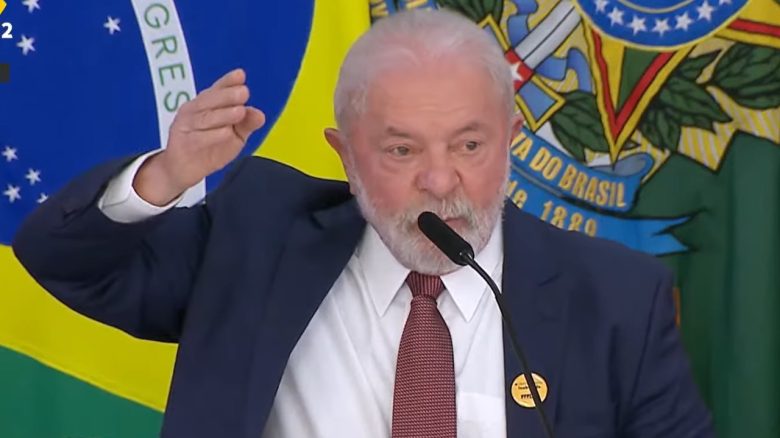
The Brazilian President Luiz Inácio “Lula” da Silva spoke at a conference about safety in schools. In his speech, he made a connection between violent video games and crime.
What is this debate about? Games with violent content, often derogatorily referred to as “killer games”, still have the reputation of causing violence in real life. However, there is no scientific proof of such a connection.
Nevertheless, there are reports that depict the colorful battle royale Fortnite as wild carnage. The prejudice against such games can also affect individuals.
For example, in the case of the “Angry German Kid,” whose seemingly funny video suddenly made him the face of video game-addicted teenagers in Germany for years.

Too Much Violence and Too Little Love in Video Games
What did the president say? After other speakers discussed the issue of safety in schools for nearly two and a half hours, Lula da Silva took the floor. In his opinion, increased security measures in schools alone would not solve the problem.
Much more needs to be done to address the causes of violence among young people, which the president sees at home: in the behavior of parents and in video games with violent content.
Lula da Silva criticizes that very young children are introduced to video games and that they convey the wrong values:
If a four-year-old child cries, what do you do? You immediately give them a tablet to play with. You teach them very early to play video games. There are no games that talk about love. There are no games that talk about education. Games teach children to kill.
President Lula da Silva via 3D Juegos
Also, the time children spend playing video games concerns the president: exceptions may exist, but hardly any child between 8 and 12 years old would not spend their time with this “trash.” The result is ultimately violence among children.
In Brazil, some demand a 30-Day Ban on Violent Games
What is behind these statements? Da Silva’s speech came against the backdrop of a series of violent attacks on educational institutions in Brazil.
Deputy Marcos “Zé Trovão” Pereira Gomes had already called for a 30-day ban on games that “incite violence” after a violent act at a kindergarten in early April. The perpetrator allegedly exchanged messages in the chat of such a game.


This argument seems to cyclically resurface. After the rampage of an 18-year-old at a school in Emsdetten, Lower Saxony, in 2010, there was a nearly identical statement from CSU politician Edmund Stoiber: “[Killer games] encourage young people to kill others.” (via sz.de)
The question of whether video games incite violence has been a topic in Germany since the early 2000s. After the events of New Year’s Eve 2022, when riots occurred in several German cities, the debate was also reignited here:

Your opinion is important to us!
Do you like the article? Then let us know!