
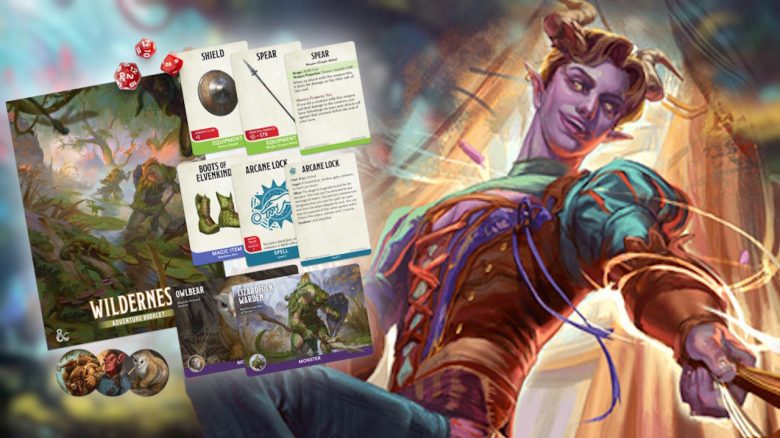
Have you always wanted to persuade your friends to Dungeons & Dragons? Or are you a newbie yourself? Then the new Starter Set “Heroes of the Borderlands” could be your gateway into tabletop role-playing. MeinMMO editor Alex has thoroughly tested the new box for you.
Beginner boxes for various tabletop role-playing games are very popular. They promise easy access to the vast world of their rules and mechanics and are designed to make it as easy as possible for newcomers.
The new Starter Set “Heroes of the Borderlands” from Dungeons & Dragons follows the same direction. Released on October 16, 2025, and designed for 2-4 players plus 1 Game Master, the new box takes a different approach than previous beginner boxes. The included rules and modules are based on the ruleset of the 5th Edition from 2024 and are compatible with it.
The adventure is a reimagining of the classic “Keep on the Borderlands” and offers an open sandbox approach with 3 independent short adventure modules, in contrast to its very linear predecessors. With various visual aids and enormous scope, the box is designed to be a kind of “construction kit” that allows newcomers to quickly and easily get creative and learn the rules and game mechanics.
We took a close look at “Heroes of the Borderlands” and tested it in various configurations with bloody newcomers and seasoned veterans to see how it performs in practice. We also focused on who the box is suitable for and who it is not.
Box open and here we go?
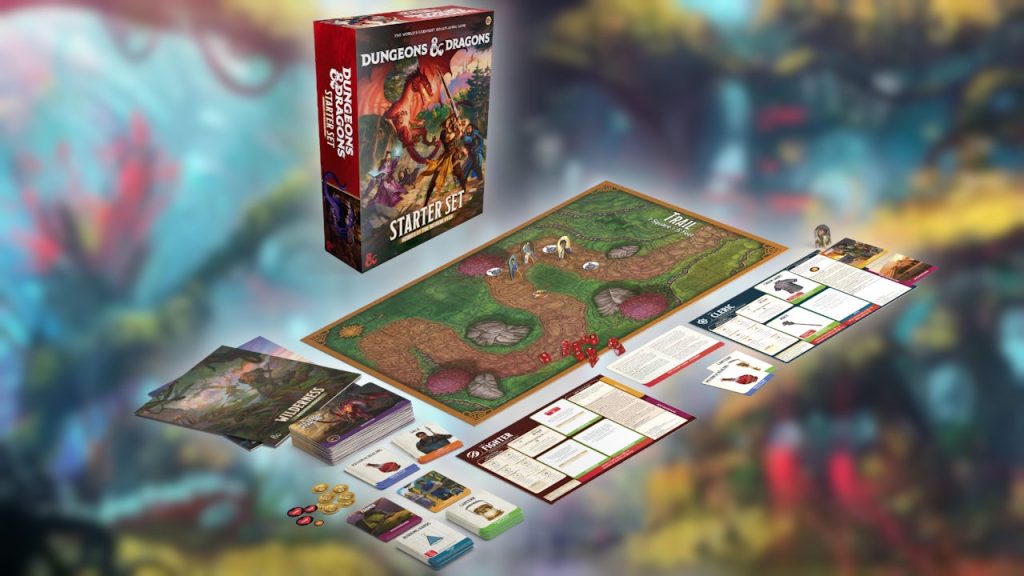
When you open the box, you immediately notice how extensive the material is. It contains:
- Quick-Start Guide
- Game Instructions
- 3 Adventure Booklets
- 9 Maps
- 5 Supplementary Materials
- 1 Combat Tracker Pad
- 8 Character Sheets
- 210 different cards for enemies, NPCs, spells, and items
- 273 tokens for enemies, environment, and resources
- 1 Set of Dice
The contents are all very high-quality and offer an incredibly great, immersive material that almost conveys the feeling of a board game. You have cardboard figures for your characters and maps for the places you move to. This makes it easier for newcomers to orient themselves and makes the possibilities for actions more tangible.
The Quick-Start Guide helps unpack the box and get started right away, without needing to read extensively beforehand. Using a step-by-step guide, both the Game Master and players are led to the beginning of their first session. The Game Instructions should only be skimmed through by players and Game Masters, noting where to find which information in case of doubt and not read intensely. Then one of the 3 adventures should be selected.
This leads to a truly quick start (in our tests, we were ready in about 15 minutes, both with the beginner and the expert group), but it also brings the problem that things that are listed as really important hints in the adventure books are often read too late in the flow of the game. Therefore, it is advisable for completely new Game Masters to read the selected adventure booklet while the players build their characters, so that important side information does not get lost, which can later spoil the fun.
As a player, the process is a little easier, as there are a few building blocks for each character that you can quickly and easily piece together along the Quick-Start Guide. Choose a class and grab the corresponding character sheet. Background and race are selected modularly based on cards and placed on the character sheet. Then follow the instructions on your sheet and lay out the necessary equipment, hit points, and your gold, and you are ready for your first round.
A construction kit full of useful and sensible tools
The character sheets are significantly slimmer than in the complete
experience of Dungeons & Dragons and only show the most important information about the class for the current level, so new players are not overwhelmed here. However, their openness encourages creativity and experimentation.
You have the choice of 4 classes: Fighter, Cleric, Rogue, and Wizard, each with a fixed, easy-to-play subclass. As races, you can choose a male and a female representative of Humans, Elves, Dwarves, and Halflings, each of which also has a game figure. Additionally, you can choose from 8 different backstories that make it easier to start with your character.
As you level up, you simply turn the sheet over or take the next one. So, you don’t really have to deal with leveling up itself. On one hand, this has the advantage that you can just play, but on the other hand, you don’t really get to know an important part of your character’s growth in later gameplay.
Materials like tokens, maps, and item cards massively help newcomers keep track and visually access the game. This is especially helpful for players who are not yet familiar with the Theater of the Mind
where Dungeons & Dragons primarily takes place. In particular, item and NPC cards are a helpful tool, especially for new Game Masters, to easily understand what things do and which aspects are important.
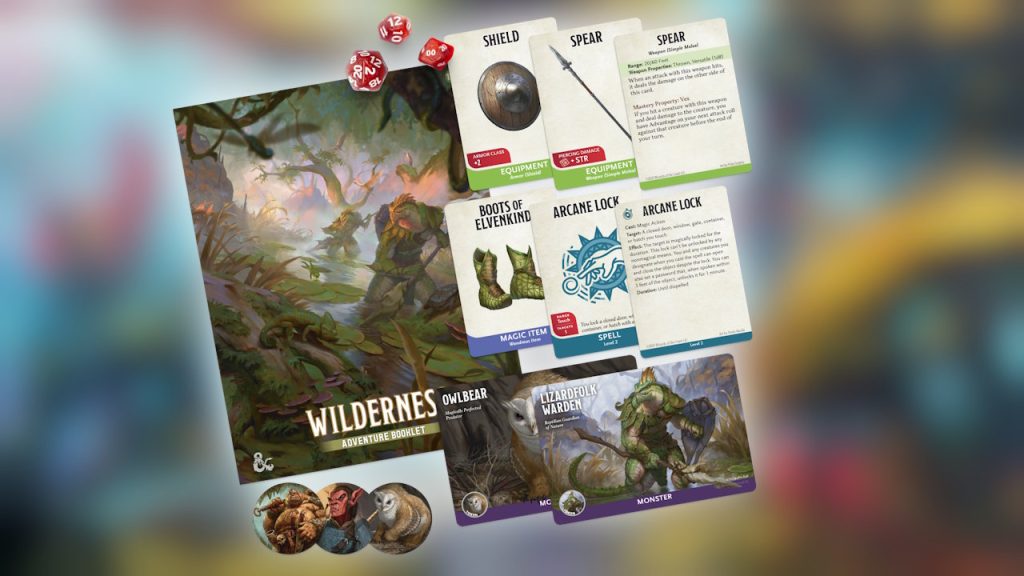
The construction kit principle also continues in the 3 adventure booklets. There is no cohesive overarching story, allowing you to play them individually as short adventures or combine them in any order. This not only increases the replay value through the many different combinations with characters and classes, but also allows you to switch roles in between with little effort.
This way, you can easily try out different classes and character concepts, or switch from player to Game Master or vice versa. The adventures themselves are simple without much frills, allowing all types of players to express themselves easily and focus. The stories also provide a pleasant entry into elemental game mechanics without being boring or feeling too much like a tutorial.
This, however, also means that players and Game Masters who need a clear storyline will feel quite lost if they do not have enough creativity and quick thinking to manage it and make it more exciting themselves. Another small downside is that there is only one set of dice, which according to the rules should be shared – which can be a bit annoying in practice. True aspiring role-players probably already have their own set, right?
The thing with balance
During gameplay, there were frequent issues both in the configurations with complete newcomers and in the mixed group of beginners and veterans. The sessions played out mostly like a board game with a bit of role-playing involved. However, complete newbies seemed overwhelmed more quickly by the openness of the story. Here, a clearer framework would have been particularly helpful for aspiring Game Masters.
It was particularly frustrating that both the rulebook and the adventure books were partially confusingly and poorly designed – especially compared to the real
rule and campaign books. It happened frequently that the aspiring Game Master read important information about a combat, for example, only during or after the battle because it was listed much too late in the booklet.

For example, it happened that a very early fight was much too hard for the group, and in the first round, 3 characters lost all their hit points. This was only based on the guidelines of the booklet. The hint that you can and should also adjust the difficulty of a fight came too late in the text and did not explain in which cases you should do so.
Also, in the adventure Wilderness
, the first combat encounter was almost designed for the characters of the players to die
. The booklet stated (very late in the text) that the characters, when they fall to 0, do not die but are only
unconscious and robbed. Combined with the difficulty and an inexperienced Game Master, this can lead to frustration quickly. At such points, the concept seems poorly thought out and requires a high degree of flexibility and openness from both players and Game Masters.
Veterans also have their fun
In one session, we also tested this with veterans who were familiar with the ruleset and had several years of role-playing experience. The group had continuous fun and mainly used the box for a quick round and to experiment without breaking anything
.
Unlike regular short adventures or campaigns, which often require a lot of preparation, they were able to get started within a very short time and let loose in the sandbox
with the various tools of the box. The combination possibilities of the modules also show a high replay value, especially suitable for veterans in the context of quick after-work rounds for which you do not want to invest much thought – but can if you want.
Thus, veterans can also find enjoyment in the box if they want a well-designed toolbox that can be supplemented with their own ideas as desired.
Conclusion:
The new Starter Set Heroes of the Borderlands
is of very high quality and the best tabletop entry I have ever experienced. The modularity and sandbox approach are well thought out and suitable for every knowledge level, even if completely new newcomers without any gaming or role-playing experience will have a hard time getting through quickly. Nonetheless, the box does a lot to make it accessible, allows you to visualize everything well, and encourages experimentation.
However, newcomers expecting a sensible entry into the world of Dungeons & Dragons from the box must be flexible and make some compromises. Important mechanics like leveling up are hardly explained and need to be learned additionally when switching. The adventures and rule booklets
are also not well structured didactically and require relatively high flexibility for a beginner box that can be detrimental for completely inexperienced Game Masters.
But those who are not discouraged by this will find a great box here that provides a lot of fun and a first impression of the world of tabletop role-playing games and Dungeons & Dragons.
Who is the box suitable for?
You can confidently rely on the box if you …
- have some experience with role-playing games (including video games) or board games
- find D&D too abstract without visual aid
- do not shy away from initiative and experimentation
- do not want to be completely guided
- as veterans want a toolkit for quick evening rounds
- enjoy diving in and creating your own story with your own characters
Better keep your hands off if you …
- expect a linear and didactically sound guide
- are demotivated by very challenging, too easy, or almost impossible combat encounters
- as a new Game Master cannot multitask or need a lot of support
- expect an overarching storyline with a clear thread and driving story
- want to have the “real” D&D feeling right away
- need a lot of creative input



Especially when you want to take the step from the starter set into the vast, expansive world of Dungeons & Dragons, the sheer mass of diverse possibilities can overwhelm you. This begins for many players with the choice of class. Therefore, we have selected 5 classes for you that are clear and beginner-friendly, but still fun and can become really powerful: Here are 5 classes from Dungeons & Dragons that are particularly suitable for beginners
