

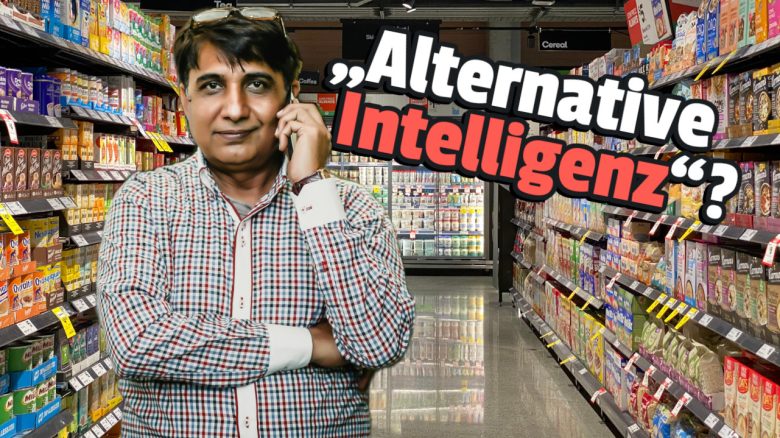
Amazon boasted about automated supermarkets equipped with state-of-the-art sensors and artificial intelligence. In reality, it was more than 1,000 human workers who kept the store running.
What was this project about? Under the name “Amazon Fresh,” the tech giant operates supermarkets where shopping can be done on-site. A technology called “Just Walk Out” was used to handle the shopping fully automatically:
- The company advertised “cashier-less shopping”: cameras and sensors were supposed to closely track shoppers and automatically scan the goods.
- Customers had to scan a QR code upon entering the store and could simply walk out after shopping, without any annoying cash registers.
- As The Information (Paywall) reported on April 2, however, they are now distancing themselves from the concept.
It turned out that the system only worked because of more than 1,000 Indian workers who watched and tagged the videos. So there were still cashiers somehow – just not on-site anymore.
In 2022, 70% of purchases made through Just Walk Out reportedly required a manual review – significantly more than the 5% targeted by Amazon.
However, Amazon denies the number of manual reviews. A spokesperson for the company told Gizmodo that employees merely annotated the videos to improve automatic recognition. They only had to validate a “small minority” of purchases when the AI could not determine a purchase.
However, many internet users seem to be left with one thing: Amazon’s AI is actually 1,000 Indians.
With news like this, the “Deep Dive” feels very far away again, doesn’t it?
Users mock: AI = All Indians
How is this being discussed? Numerous videos are already circulating online that humorously address the topic to varying degrees. A sketch depicting a theft in the supposedly fully automated fresh supermarkets received more than 60,000 likes on TikTok within a day.
In many places, there are also comments making fun of reinterpreting the English abbreviation “AI” for “Artificial Intelligence”:
- chocolateboomslang writes on Reddit: “It was AI… All Indians.”
- Nor 2020 says on TikTok: “They use AI = Alternative Intelligence.”
- Other users on TikTok speak about “Accurate Indians” or “Actually Indians”.
Yet others point out that the Indian workers were merely involved in quality control. This is how machine learning works: Humans still need to tell the AI whether it has arrived at the correct conclusion.
While this is true, it cannot completely remove the bad aftertaste. After all, Amazon bragged on its website about the technology: They speak of a combination of computer vision, object recognition, advanced sensors, deep machine learning, and generative AI – but not of workers in a low-wage country like India.
In fact, this is not the first time something like this has come to light: AI-driven drive-thrus for fast food are reportedly actually staffed by Filipino workers (via The Verge).
The startup x.ai advertised AI assistants, but here too, humans did the work. In 2021, the company shut down, apparently unable to bring the algorithms to a point where they could work independently.
Another prominent example is Facebook, which shut down its AI assistant “M” in 2018 after about two and a half years. Here, too, human employees were involved when the AI did not know how to proceed – and that apparently happened more often than planned.



Ironically, Amazon itself even has a department dedicated to helping other companies train and operate AI systems. “Amazon Turk” is named after the “Turk in the Box,” a supposed chess robot from the 18th century. In reality, however, the mechanical chess player was operated by a human.
“We have invested a lot of time over the past year into redesigning some of our ‘Amazon Fresh’ stores to provide a better shopping experience with more value, convenience, and selection – and so far, we have seen positive results, with higher customer satisfaction scores and more purchases. We have also heard from customers that while they enjoyed the benefit of skipping the checkout line with Just Walk Out, they also wanted the ability to find products and deals nearby, to see their receipt while shopping, and to know how much money they saved while shopping in-store. To offer even more convenience to our customers, we are introducing Amazon Dash Cart, our smart shopping cart that offers all these benefits, including skipping the checkout line.”
Reports like these highlight that in the wondrous world of AI, not everything is as it seems, and that we may still be quite far from a “real” AI. According to Elon Musk, things won’t improve in the foreseeable future, as the development of AI could significantly slow down next year:

Your opinion is important to us!
Do you like the article? Then let us know!