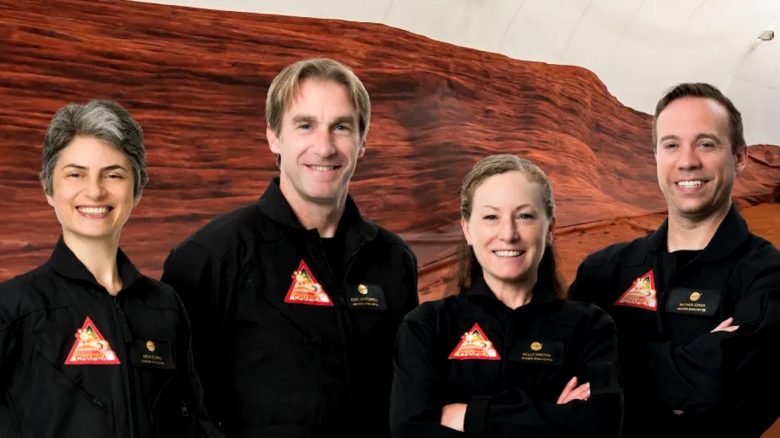
The crew of the CHAPEA mission was isolated for over a year. Now they share what they have been doing all the time.
What mission is it about? A few years ago, NASA initiated the CHAPEA missions (Crew Health and Performance Exploration Analog) to explore how a mission on Mars might unfold. For this, they created a 3D-printed habitat modeled after Mars (see Nasa.gov).
With four selected volunteers, an experiment began in June 2023, where they lived in isolation for 378 days – with the goal of growing their own food and managing simulated everyday situations on the Red Planet (see Nasa.gov).
During the mission, the crew conducted simulated spacewalks and collected data on a number of factors, including physical and mental health as well as performance.
After the end of the project, the participants reported on their experiences and what they did the whole time.
Between Growing Their Own Food and Playing PS4 Games
What did the participants do? Since no one worked around the clock during the CHAPEA mission, a central focus of the project was to examine how the crew coped with the long isolation: how they managed stress, entertained themselves, and what social dynamics developed within the team.
The main activities of the crew during the simulation consisted of simulated spacewalks with virtual reality, communication, growing plants, preparing and eating meals, exercising, hygiene routines, maintenance work, leisure, scientific work, and sleep.
Practical challenges included growing their own food, managing with limited supplies, daily outdoor excursions in spacesuits, and communicating with “Earth,” facing a delay of 22 minutes between sending and receiving messages with the transmission control team.
Aside from that, they spent their leisure time mainly watching television, reading previously downloaded books, engaging in creative activities like painting, and playing on a PS4. In particular, strategy and simulation games were said to have been played, as well as games like F1.
The launch of a second analog mission is planned for the year 2025.


In addition to a simulated Mars environment, NASA is also researching many other questions and fields of space. Recently, a research team confirmed a hypothesis that could influence how we perceive our home planet: NASA has confirmed a 60-year-old hypothesis that could completely change our perception of Earth