

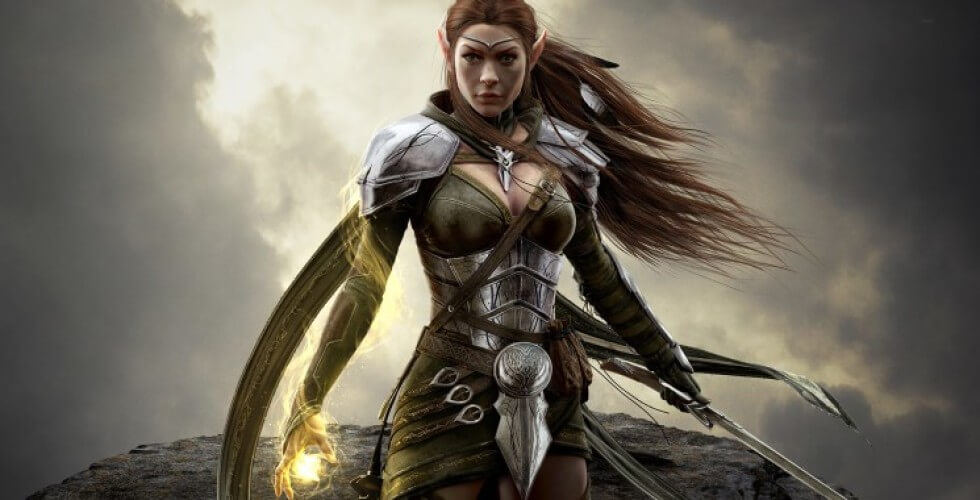
The fantasy MMORPG The Elder Scrolls Online has had a tumultuous year, and 2016 brings new opportunities and challenges. We take a closer look at TESO (PC, PS4, Xbox One) in a State-of-Play Special.
Where did TESO stand at the beginning of last year?
The Elder Scrolls Online was at a crossroads a year ago. At that time, we asked “A reboot on consoles or will TESO ultimately flop?”
Now we know: It was a reboot on the consoles. The flop that it could have become in 2014 is now nowhere to be seen. Matt Firor, the head of TESO, beamed like a Cheshire cat as he spoke at Quakecon about the sales figures of The Elder Scrolls Online on Playstation 4 and Xbox One.
The one-year delay of the console port had no negative impact. Players on Xbox One and Playstation 4 were thrilled to “finally get a real MMORPG” and one that played great on consoles with a strong interface.
This paid off since TESO was developed with the console port in mind from the beginning. Most of the “rough” problems of the game with bugs and phasing that plagued TESO at its PC launch were fixed. The release phase on consoles was a great success. Most structural problems of the MMORPG were noted by players only after many hours of play.
Success came at a high price in 2015
However: Success came at a high price. For TESO, there was hardly any development in 2015. After the PC launch, the developers announced a transformation at Quakecon 2014 and later invited to a “Guild Summit”. Huge change plans were presented on how TESO should once be: a fantastic MMORPG in the world of Tamriel with new game systems and ideas.
In 2014, work began on implementing these ideas. Every 6 weeks, a new patch came out, the game noticeably grew, and progress was made. Of course, new problems constantly arose – after each update, which came with huge patch notes, hotfixes and changes were needed to extinguish the hotspots.
By 2015, nothing of that rapid development pace was noticeable. Early in the year, it became clear: We can’t change so many systems anymore, it’s going to slow down significantly. We are making the Buy2Play transition, coming to consoles, and afterwards, people want DLCs. That’s what we need to focus on now.
The goal: As long as we have a solid, functioning game when we come to consoles. Instead of fully developing systems, “small solutions”, stopgap measures, and interim ideas were favored. They worked “somehow”, but created massive long-term problems for developers and frustrated players.
The systems do not scale properly, twinking becomes a nightmare, or something is simply missing.
On the next page, we will take a closer look at the issues TESO currently has.

Your opinion is important to us!
Do you like the article? Then let us know!