

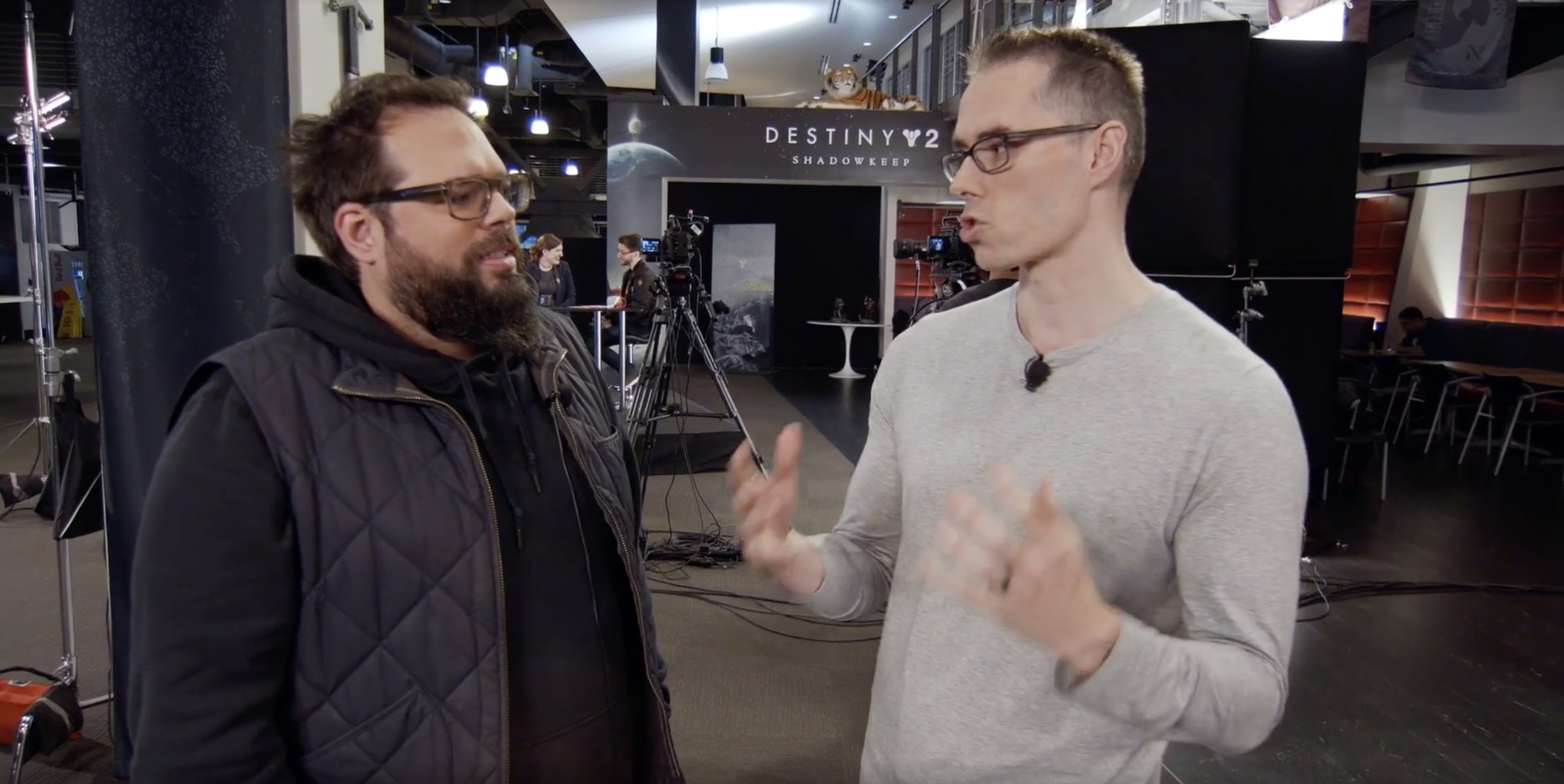
Luke Smith talked about the launch of Destiny 2 and what went wrong during the development of the game in the years prior. In his view, the time after the launch was a terrible year. He and the team vowed: “Never again.”

Who is speaking? It is Luke Smith, who was responsible for the launch of Destiny 2 and is now the Franchise Director at Destiny.
As we now know, Luke Smith took over the Destiny 2 project only in April or May 2016, after a previous Game Director had left. Destiny 2 was supposed to be released in September 2016 – but that didn’t happen.
Destiny 2 was rebooted. At its release in September 2017, Destiny 2 was well received for about 6 weeks, but then harsh criticism of the game arose, which grew stronger and only calmed down with the release of Forsaken a year later.

Smith gave a long interview to “Kinda Funny” and revealed many details from his time at Destiny. He considers the period leading up to Destiny 2’s release as the lowest point of his career.
“Couldn’t carry over features from Year 2 for Destiny 2”
Why did Destiny 2 go wrong? Smith says that at the time, they had a different organizational structure at Bungie. The problem was “multiple overlapping releases and teams.”
There were small bubbles of people working on their different projects. He, Noseworthy, and others were one team. Other people were in other teams.
When he and Noseworthy were assigned the Destiny 2 project, the game had already been “in development for a longer time.”
At that time, Bungie was unable to say due to the organizational structure: Hey, what are the cool features from Year 2 and 3 of Destiny 1? How can we use them for Destiny 2?
It was not possible for technical reasons: The features could not be carried over to Destiny 2.
“It’s scary,” Smith says when he describes how the technicians spoke about various “executables”.
Noseworthy and others from the production team identified this organizational structure as a problem and worked on it. Smith hopes that the fruits of this work will soon be seen.
Destiny 2 felt unfinished
This is how Destiny 2 felt for Smith: Smith is later asked in the interview what the lowest point of his career was. He says, Destiny 2 after the 6-week honeymoon phase.
Smith looked at Destiny 2 at the time, what was happening with the game, and it felt as though the work was simply not finished. He and Noseworthy were working on “other things.”

The game director says that with Forsaken and since last year, Bungie has gathered and now wants to finish what they started.
Smith, Noseworthy, and others from the team got metaphorical “Never again” tattoos and vowed never to let Destiny slide like that again.
“Terrible time”
This is how Smith felt at the time: Smith says that for him personally, the crisis phase after the release of Destiny 2 lasted about a year, during which he felt unwell. He calls it a terrible time. His wife later told him that during this period he came home from the office dejected, retreated to his study, and went to bed.
Smith says:
It was a terrible time. But I don’t want to complain; many people go through a terrible time for many reasons. I’m nothing special. And for me, the reason was that I got to make a video game. Which in itself is something pretty fantastic.
What lies behind it: It probably isn’t a very satisfying answer for fans, but it’s what has continuously shone through the 5 years of Destiny:
- The organizational structure at Bungie in the first years required teams to work separately on releases. Smaller teams on the DLCs, larger ones on expansions and main games. This was probably Bungie’s way to fulfill Activision’s big master plan and provide constant new content.
- This resulted in insufficient communication. A variety of problems arose: Things were delayed, didn’t feel cohesive, and followed no common vision.
Changing and restructuring this internal structure has probably been the major thing Bungie has been working on internally for many years. However, it will take years to see the effects of that.
It is now said that they want the seasons following “Shadowkeep” to be thematically linked.
Smith does not clearly state what went wrong, but he hints at it. But from his words, you can hear:
- that there was pressure to meet the release date.
- that the reboot surely caused problems because his team joined Destiny 2 too late.
Smith and his team had too little time due to organizational problems to make Destiny 2 the game they wanted.
This is shown in the clip: We fast-forward the video to 2:43:45. Here Smith talks about the low point of his career so far, the launch of Destiny 2 and how he felt about it.
Smith’s interview grants us many interesting insights behind the otherwise tightly shut doors of Bungie. He has explained, among other things, what the first raid in Destiny was supposed to be.
But there are also statements about the future of Destiny 2:


Your opinion is important to us!
Do you like the article? Then let us know!