


Tim Sweeney (52), the founder and CEO of Epic Games (Fortnite), has a billion-dollar fortune but still finds Twitter to be simply too elitist.
What system is this about? Like many social networks, Twitter had a verification system that allowed notable users to confirm their identity.
The verification badge, the so-called blue checkmark, was primarily intended for Twitter users whose identity could be used to spread lies or fake news: politicians, news agencies, and celebrities, including numerous content creators.
There’s trouble on Twitter about the blue checkmark
What is the problem with the system? Critics of the verification system on Twitter complain that the blue checkmark is reserved for certain people and see it as a form of favoritism.
With Elon Musk’s takeover of Twitter, there was new excitement surrounding the blue checkmarks: First, a payment system called Twitter Blue was introduced, allowing users to simply purchase the badge, leading to numerous convincingly looking fake accounts.
Then Elon Musk announced the removal of the old “Legacy Verifications,” which was implemented starting April 20 but has since been partially reverted. The back and forth caused much confusion and numerous discussions over the weekend.
Now the discussion about verification has also involved Tim Sweeney, the CEO of Epic Games. On April 22, he tweeted a series of messages in response to the hashtag #BlockTheBlue. The hashtag was a suggestion to block users who are willing to pay monthly for verification.
Tim Sweeney is co-responsible for the Unreal Engine, which forms the basis of successful games like Fortnite.
Epic CEO feels excluded from the “cool kids”
What does Tim Sweeney have to say? The Epic CEO was upset by the #BlockTheBlue campaign and stated that the users behind it are “losers and bullies” who excluded “us nerds” back in school.
He explained that he has criticized the “elitist” old system since 2018, sharing one of his own tweets from 2020. At that time, he wrote that he did not want to be verified as long as the process was reserved for certain people.
Sweeney, whose fortune is said to amount to nearly 10 billion USD according to Bloomberg, further elaborated that an online community should be a meritocracy that rewards solely performance. Instead, Twitter has used its verification system to preferentially favor supposedly noteworthy elites.
The 52-year-old also claimed that Twitter employees have exploited the old system for personal gain and exchanged verifications for favors. We have included the beginning of the thread for you here:
Sweeney doesn’t take the truth too seriously
How was it received? Not particularly well. In the comments, numerous Twitter users tried to explain to Sweeney why his assessment of the old verification system was not entirely accurate.
For one, the system was by no means reserved exclusively for elites; local reporters with lower income could also lend credibility to their reporting through it. Others wondered why a 52-year-old is still upset about school cliques.
Among some of Sweeney’s tweets, users provided additional context. The claim that the old system had nothing to do with verifying identity with official documents was disproven.
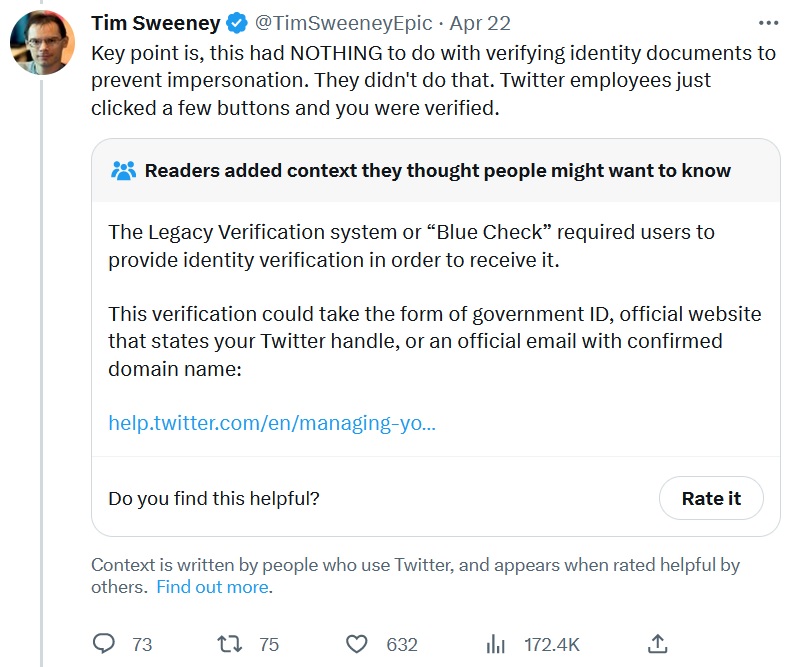
How did Sweeney react? He took the time to respond to some comments and slightly backed down. He ultimately explained that the best solution would likely be a mix of the old and new systems: identities should be verified, but the process should be open to everyone and ideally even free (via Twitter).



Tim Sweeney has not only criticized Twitter but also recently criticized the Epic competitor Steam in a phone call. He feels excluded by them as well, claiming they exploit their larger market share. You can read more about it here.

Your opinion is important to us!
Do you like the article? Then let us know!