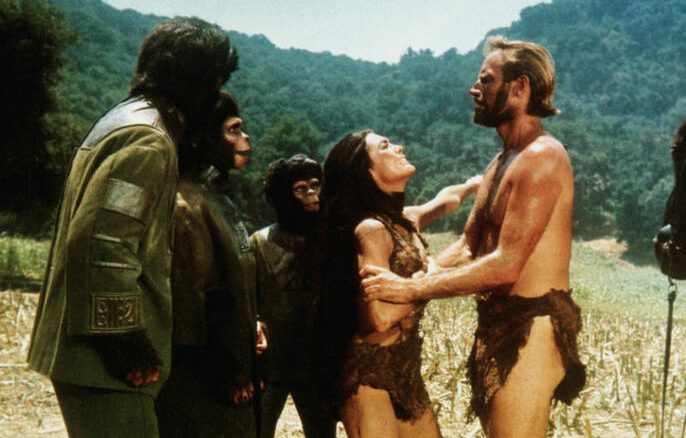
Planet of the Apes (1968) is one of the classics of the science fiction genre. Although the film’s plot is based on the novel of the same name from 1963, the director Franklin J. Schaffner found the ending too predictable and changed it.
In the novel “Planet of the Apes” by the French author Pierre Boulle, it is about a group of astronauts who land on a planet ruled by apes. The apes have built a highly developed civilization, while the humans on this planet are kept as primitive animals.
Here you can see the trailer of the 1968 science fiction classic:
The book ends with the protagonist managing to escape from the planet of the apes and return to Earth. He lands in Paris, about 700 years after his original departure. To his surprise, he finds that the Earth is also ruled by intelligent apes.
The frame story is taken up by the director Franklin J. Schaffner, but he changed the final scene. This created a shocking moment and even impressed the author of the original work, Pierre Boulle.
What did the director change? In the 1968 film, at the end, you see the Statue of Liberty – this offers the protagonist Taylor and the audience a shocking revelation: Taylor has been on Earth the whole time.
He realizes that the apocalyptic future he was in is actually his own destroyed home. He reacts with the exclamation: “You maniacs, you blew it up! Damn you all to hell!”
A scene that sticks in the memory and is likely one of the most iconic moments in the history of science fiction cinema.
“More inventive than the original”
Why did the director change the ending? Franklin J. Schaffner felt the ending in the novel was too “predictable” (via Planet of the Apes Wiki). While having lunch with Blake Edwards, who was at one point supposed to direct, he had an idea.
Schaffner said to Blake: “What if he [the protagonist in the film] has been on Earth the whole time and doesn’t know it, and the audience doesn’t know it either?” Blake thought it was a great idea and suggested contacting the book’s author.
Schaffner then sent the screenplay to the writer.
How Boulle reacted: He responded to Schaffner that he found the director’s version of the ending more inventive than his own. He wished he had thought of it while writing the novel.
Without the lunch, Schaffner probably wouldn’t have come up with the idea. After paying, he left the shop and noticed the large Statue of Liberty on the wall of the establishment, which ultimately gave him the idea.
Planet of the Apes (1968) is currently available for streaming on Disney+.
In 2011, NASA scientists compiled a list of the most unrealistic sci-fi movies. The top spot is held by a well-known disaster film from 2009.