
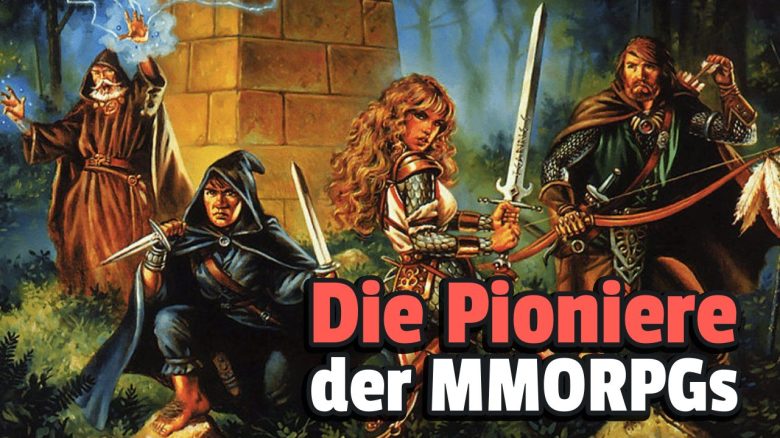
The genre of MMORPGs has fascinated and excited millions of players for decades. In a multi-part report, MeinMMO editor Karsten Scholz sheds light on the roots, development, and future of online role-playing games. Part 1 focuses on the pioneers of MMORPGs.
Let’s first clarify the basics, so that even game enthusiasts who have never played an online role-playing game can follow along. MMORPG stands for “Massively Multiplayer Online Role-Playing Game”, meaning a role-playing game that takes you into a persistent online world where a large number of other players roam.
The term “persistent” should be taken with caution, as it primarily means that the game world, with its content and challenges, continues to exist even when you are offline. However, persistence only goes so far in exceptional cases; for example, you can place an item in the world, and when you come back later, it is still there.
Part 1: The pioneers of online role-playing games
Part 2: The first 3D MMORPGs
Part 3: The exceptional success of WoW and its reasons
Part 4: The peak of MMORPGs and the failure of WoW killers
Part 5: The great drought and the flight to other genres
Part 6: The status quo of the MMORPG genre and the future
It all began with … Dungeons
When players today discuss the beginnings of the MMORPG genre, titles like Meridian 59 and The Realm Online from 1996 or Ultima Online from 1997 quickly come to mind. However, the roots of online role-playing games lie much deeper, in the so-called MUDs.
MUD stands for Multi-User Dungeon, referring to games that allow multiple adventurers to explore any form of dungeon or virtual world simultaneously. The first of its kind, MUD1, was created in the late 1970s. The focus here was still on social interaction, allowing up to 36 players to play at the same time.

In the 80s, the new genre gained significant popularity as affordable home computers became available. At the same time, the first commercial projects hit the market.
Among these was the text-based MUD Sceptre of Goth, which was based on the popular pen-and-paper role-playing game Dungeons & Dragons, allowed up to 16 players to enter the dungeons simultaneously, and even made PvP possible. The cost was nearly three US dollars per hour.
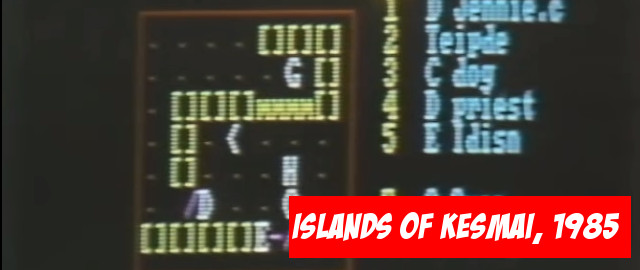
Another commercial multi-user dungeon was released in 1985, named Island of Kesmai. The game offered
- a character creation (with choice of class, origin, and gender)
- a chat room
- a virtual world where up to 100 players could wander
- five regions with 62,000 places
- around 2,500 creatures and NPCs
- rewards could be earned through quests
- the game used ASCII graphics to represent player characters, world boundaries, opponents, and loot
Interested players could experience Island of Kesmai through CompuServe’s online service for about twelve US dollars per hour. Yep, those were different times.
In 1989, this text-based online RPG by Yehuda Simmons was released, featuring remarkable systems for economy, agriculture, and jobs. Additionally, it included a player-controlled government, with ministers and elections, as well as conquest battles where entire legions, trenches, minefields, and fortifications were involved.
In short: The developer aimed to create a believable world where players could lead a virtual life (via Wikipedia). Avalon: The Legend Lives was thus an evolution of Habitat from 1986, which aimed for a similar direction.
Dungeons & Dragons in a different way
The next important milestone for the MMORPG genre came in 1991 from industry veteran Don Daglow, who has a portfolio that includes classics like Dungeon (1975), Utopia (1981), Amnesia (1986), and Stronghold (1993).
He got to develop a new game for the Dungeons & Dragons universe with his studio Stormfront, and the result was Neverwinter Nights, which is now considered the first graphical MMORPG (not to be confused with the 2002 Neverwinter Nights by Bioware).
A spiritual descendant of Neverwinter Nights – the MMORPG Neverwinter Online:
While “Neverwinter” refers to the city of Neverwinter from the D&D universe, the “Nights” was a nod to the fact that AOL’s online service (and thus the game) was initially only available at night and on weekends – due to the high costs of renting the available telecommunication lines at that time.
Neverwinter Nights used the venerable Gold Box engine from SSI (known for Eye of the Beholder, Stronghold), but featured a multiplayer mode, allowing players to form groups, complete quests together, and even band together into guilds. The battles occurred in a sort of real-time system, and there was a chat to coordinate.
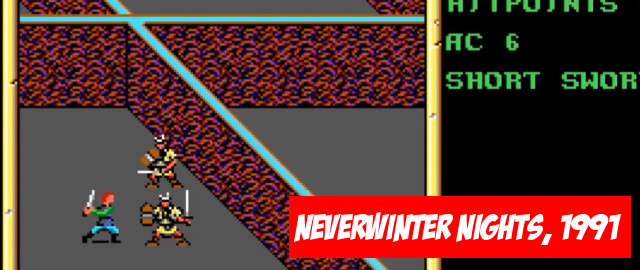
Initially, AOL supported a capacity of 100 simultaneously active players. However, due to high demand, this value had to be adjusted to 500 – making Neverwinter Nights the most populated online experience up to that point. There were still queues, which AOL monetized due to the per-minute connection charges.
The first crafting in an online world
As a kicker from the era of MMORPG pioneers, we have Legends of Future Past from 1992 for you. This commercial multi-user dungeon was no longer offered only via an online service like CompuServe, but also through this new thing called the Internet.

Legends of Future Past is noteworthy for two additional reasons. The game by NovaLink offered the first proper crafting system in an online game. Adventurers could gather resources like ores, furs, and herbs to craft weapons and armor or enchant items.
Additionally, it introduced paid game masters for the first time, who organized events, helped newcomers, and supported the community.
In the second part of our report, we will take a look at the 3D MMORPGs that paved the way for the modern big players. A first glimpse of what’s to come can be found here: 12 MMORPGs that paved the way for WoW and are still playable

Your opinion is important to us!
Do you like the article? Then let us know!