

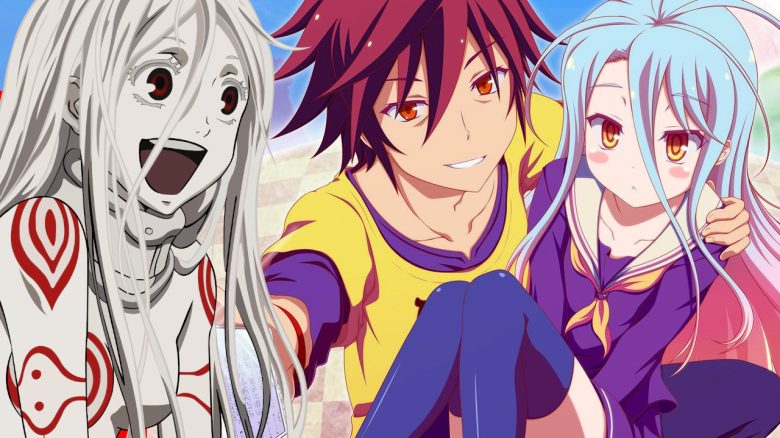
Really good anime series rarely get a second season. But why is that? The reason behind it is logical – but bad for anime fans.
Anime are one of the best forms of entertainment overall. It can be incredibly frustrating when a beloved series is suddenly canceled “in the middle of the story”. Many popular anime only get a single season, despite the series clearly having been successful.
Series like “No Game No Life”, “Deadman Wonderland”, or “Talentless Nana” have made waves only to disappear into oblivion after one season.
But why is that? We want to briefly explain it to you here.
What is the purpose of anime? Those who are not well-versed in anime and manga might think that anime is an end in itself. If an anime is good and successful, it makes money – but that’s not the case. The production of an anime is usually quite expensive and serves primarily one main purpose:
To boost the sales of the corresponding manga in Japan.
The idea is: through an anime adaptation, a story gets more attention. Those who have watched the 13 episodes of an anime should be so captivated that they go on to buy the manga to learn more about the story.
There are also “anime original” productions that typically exist independently of manga or light novels. For these series, it is of course not the case that they are primarily supposed to promote another product – but these anime series are still quite rare.
Exactly this creates a dilemma. Because the more successful an anime is, the more it has fulfilled its original purpose. If an anime is successful, it has boosted the sales of the manga and its purpose has been fulfilled. A second season is therefore not necessary for the time being.
If an anime was not successful, it did not boost manga sales and missed its purpose. Even in that case, a second season is unlikely.
For an anime to actually adapt the entire story of the manga – which is already completed – like in the case of the original Bleach series or Attack on Titan, is rather an exception. This is usually financed through additional products of the franchise. Thus, one can spend a lot of money on figures or merchandise, and it’s not surprising that many PC games enter into collaborations with Attack on Titan – like Dead by Daylight or Overwatch 2.
Ninotaku also has an interesting video with more information on this topic:
Is that changing? Slowly but surely, yes. Due to the increasing relevance of streaming services that license anime worldwide – such as Crunchyroll, HiDive, Netflix, etc. – the worldwide marketing of anime is also becoming increasingly lucrative. While the primary purpose is still to promote the corresponding source material, such as a manga or an associated video game, a change is slowly becoming apparent.



Through the global marketing and the fact that anime have increasingly entered the mainstream during the Corona crisis, the share of revenues from anime through streaming services is growing. This means that anime is slowly becoming worthwhile “in itself” – but it may still take a few years until that happens.
If you are wondering why your favorite anime is not getting a second season, the reason is often: it was simply too successful and doesn’t need a second season. Because it almost always revolves around the manga behind it, not the series itself.
In most cases, anime are one thing: pretty good advertising.

Your opinion is important to us!
Do you like the article? Then let us know!